



If one was searching for paradise in India, the closest in my experience would be Udaipur. A city of lakes surrounded by hills, the landscape opens up into panoramic vistas and trees of incredible colours. If I thought the miniature paintings of Rajasthan resorted to the painter’s imagination, I discovered there trees with crimson leaves. In march the countryside was aflame with these trees.
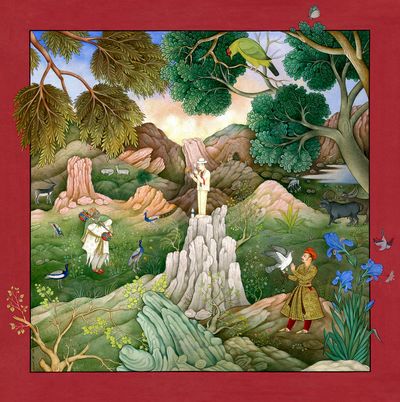 A Dream of Discovery
To find miniature paintings being done today was not surprising as this tradition continues in Udaipur. But to discover a Rajasthan painter who responds to the ideas of an American artist was a delight. Their collaboration over 9 years results in dream images to create a paradise of lakes, forests, birds, and the intrepid foreigner in a white suit and hat who is Waswo himself, in search of adventure. Their work results now in a book of superb illustrations and text by Annapurna Garimella, to be released by Gallery Espace in Delhi on March 26.
R. Vijay was not born into a family of artists but he held on and trained his skills—till he found success his family was against this career. Waswo remains practising as a ‘studio’ photographer (his studio is in a village) focusing on figures from rural Rajasthan and reinventing Krishna endeared by cows. He travelled through India and came to Udaipur by mistake (to the travel agent he had pointed at a picture of Pushkar lake) and since then he has lived there for nine years.
For both artists this collaboration has changed their lives and careers. Both changed their names and reinvented themselves! Perhaps if it had not been for Waswo, Rakesh Vijayavargya would still be painting miniatures of fine birds and flowers. Richard John, now Waswo X Waswo, may have remained a professional photographer who worries at times that his pictures of India are orchestrated with an ‘Orientalist’ outlook. Yet even the paintings he conceives with Vijay play upon the essential differences—in a painting titled Panni the foreigner in his white suit drinks from a bottle while the villager clad in dhoti drinks water from a lota. They inhabit their own spaces, on different sides of a tree. In the accusation they stand on two sides of an idyllic lake painted in Kangra style, confronting each other.
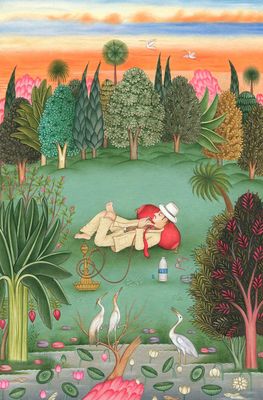 Dream of the Mirrors
Inevitably the narratives relate to Waswo’s own experiences as the protagonist, they play on cultural differences with insight and humour, and at times they read like a confessional. A remarkable series called The Secret Life of Waswo X Waswo begins with a dig at himself: “I photograph the palace of the lake where he appears with his Rolleiflex box camera, photographing not the palace but the crocodiles. In The Danger of Photography he confronts a dhoti clad villager, or an obliging monkey posing across a ravine (with an army of monkeys watching behind Waswo). But this series also offers confessions: Waswo is depicted with his white-skinned partner, exploring the forest and lakes with wonder. He is depicted weeping, never depicted in miniatures. Other personal notes such as I am watched While I Eat; and of course The Five Star Experience bring emphasis to being the Other. The most poignant triptych is of being Lost as lovers alienated from each other, which is the time for when You Break My Heart.
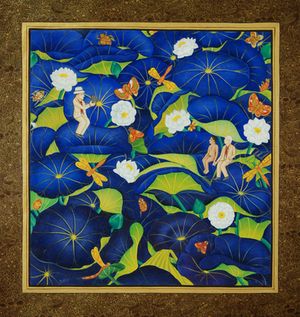 In the Land of Lotus Fantasy
At times the paintings possess the fabled story-telling quality of Sadi’s Bustan, in a series of 18 small works titled Chaos in the Palace, shown at the Delhi Art Fair 2016. Here wicked references to images by Jackson Pollock, Andy Warhol and Magritte as markers of modernism warn us against the dangers of both imitation and forgeries.
The danger of imitation or stereotypes is inherent because miniatures continue a tradition. Yet Vijay and Waswo are ingenious in avoiding the stereotypes! Firstly, through careful research in books they experiment and explore endlessly, introducing not just the high Mewar school but different styles: the undulating rhythm of Kangra lakes, roots winding around trees. I hear them speaking about their recent visit to Bundi and they introduce vibrant colour trees in an exquisite triptych titled Three Nights in Bundi. Waswo is continually in search of Dreams of Discovery; in different versions he intrigues us with his Dream of Death. Waswo crosses a river with parasols in the grand style of Maharana Fateh Singh.
The most innovative are the tributes paid to contemporary Indian artists, quoting celebrated motifs from Ramgopal Vijayavargya, full blown lotuses as tribute to A. Ramachandran In the Land of Lotus Fantasy. Tributes include one to Francesco Clemente and many others. Most wondrous (Vijay remarked this washis favourite) is the panoramic view of The Magic Circle. Such paintings take more than a month continuous discussions and ultimately yield pleasure. This is a long journey away from the conventions of miniature painting.