



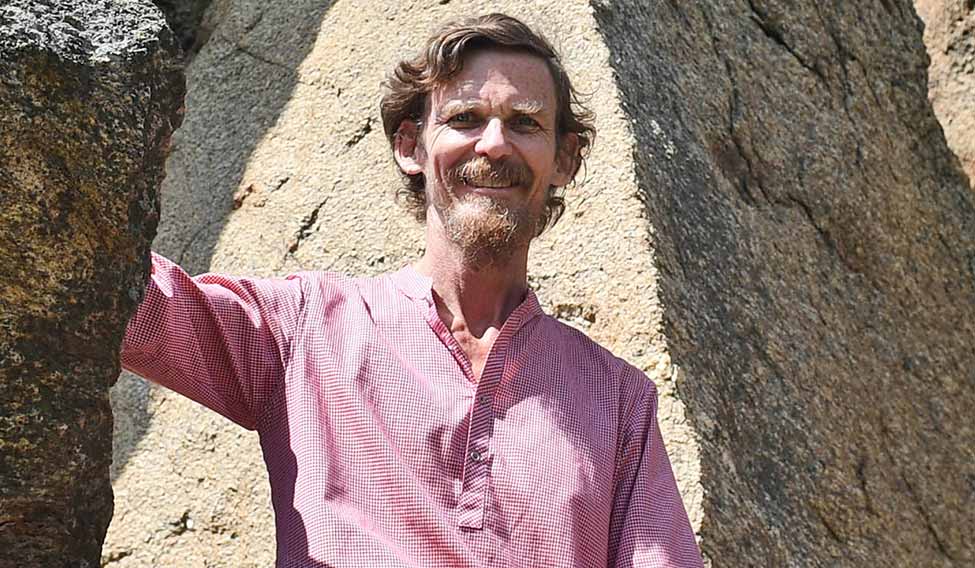
Belgium-born economist, academician and activist Jean Dréze, 57, came to India and stayed on, becoming an Indian national, ultimately making Ranchi home. Dréze is vocal about social and political issues, but he rarely talks about himself. Yet, when THE WEEK approached him, he opened up, revealing wit and personal facets he seldom shared. Excerpts from an interview:
What drew you to India?
I was not particularly interested in further studies after I completed my BA in Mathematical Economics at Essex University. I wanted to see the world, and find a way of making myself useful. I had a long-standing interest in issues of development and social justice, so the poorer parts of the world seemed like a natural destination. On the other hand, my supervisors strongly advised me to study a little more. So I decided to try and combine the two—further studies and first-hand experience of a poor country. In that case, I was told, India was the place to go, because it had some of the best institutions of higher education among developing countries. And so I ended up at the Indian Statistical Institute.
You have worked in India for several years before you decided to take Indian citizenship.What was behind this decision?
When I came to India for the first time, I thought I might proceed from there to spend some time in China and other countries. However, I soon felt at home in India. And the country seemed to offer endless possibilities. Also, all said and done, it was a relatively free country. Why go further? I decided to stay.
How did it feel to give up your birth citizenship?
It was one of the happiest days of my life.
If India had offered dual citizenships, would your decision have been any different?
I don’t know. All I can say is that if the facility were offered to me today, I would decline. One citizenship seems enough.
How different has your work or life been in India after taking the citizenship?
Well, it is nice to feel part of the family, even if the wrong members are in control, as Orwell said of England. Aside from that, the main difference is greater freedom to say and do what you like, when you are a citizen. When you are at the mercy of the home ministry for a visa, it is always a little risky to participate in activities that might be construed as political, agitational or anti-national. After I became an Indian citizen, I felt much freer to speak out and also to participate in a variety of social movements.
You’ve been an architect of the National Rural Employment Guarantee Act. Has it progressed along the lines you envisaged?
My role with NREGA has been greatly exaggerated. It was really a collective effort. If there was an architect at all, it was Nikhil Dey, though I did help him to put it in writing.
During the last five years, the programme has gone downhill because of problems with budget allocations, wage payments and flowof funds. These problems need some serious thinking and action if NREGA is to survive and thrive.
How have you been accepted as an Indian? In the sense, do people regard you as a foreigner still?
This is a difficult question. If you ask me whetherI have felt welcome in India, I would say yes, certainly. I can hardly remember any act of hostility in so many years. Often, the hospitality has been overwhelming. On the other hand, when it comes to being treated as an equal, attitudes vary a great deal by region, class and caste. Some find it difficult to treat a white man as an equal. Others are happy to treat you as an equal if you convey that this is what you would like. It is among them that I feel most comfortable.