



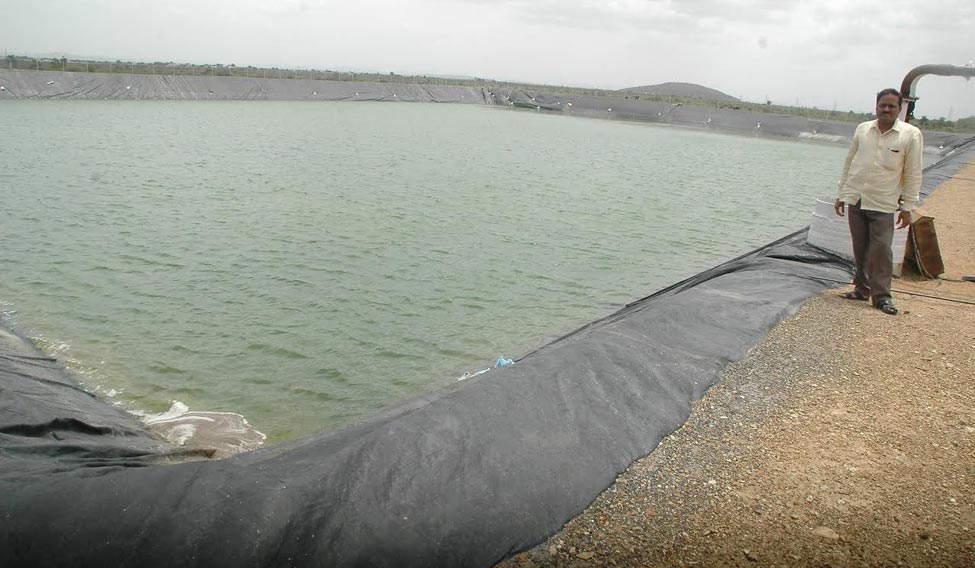
Modum Chowa Rajasekhar Reddy looks at the water tank and proudly says: "A little rain and it will be full again. In summer, we were able to water our fruit plants thanks to this water tank."
As you enter the village of Kothapur, abutting the municipality town of Tadipatri, you see a neat little structure looking like a mini dam. This is the water tank Rajasekhar is referring to. It is a 120 by 100 metres by five feet farm pond.
"Actually the state government gave us a subsidy of 20 lakhs for a 100 by 100 metres by 3 feet, but this would have stored three crore litres. We realised that if we put in seven lakhs more we could increase the size and store six lakh crore litres of water. Almost double and so we did it," he says. This was contributed by his family members and another farmer to be used for their 100 acres of land.
Anantapur district lies in the rain shadow region and even scanty rain is a big boon for this district. Most of the district agriculture is done by irrigation waters, whatever remains for this district, that is. Water conservation is a very important factor for every farmer in this district. And so when word spread that Rajasekhar had managed to dig a farm pond and used the water collected here during summer and got a hefty crop of sweet lime, pomegranate and other fruits, he became a star.
In Anantapur where drought-hit farmers have committed suicides, even a little water is precious. This pond was constructed under the Community Farm Pond scheme funded by the District Water Management Agency (DWAMA).
"I used to be known as the sweet lime man when I had 75 acres of land for this fruit but the 2014 drought has brought it down to 30 acres of land. But with this pond we are able to supply good fruit even in April, May and June," he says. He was awarded by National Research Centre for Citrus, Nagpur for the highest yield of sweet lime in 2012. He had a yield of 15 tonnes per acre.
Apparently grapes and pomegranate need less water and sweet lime a little bit more. "We have a check dam nearby and we lift the rain water from there," he says, adding, "earlier we had dug bore wells near the Penna river which is seven kms away and brought the water through a pipeline, but that was just a trickle."
Another smart technique used by this man who also teaches mathematics at a neraby school, was to check the evaporation of stored water in the farm pond. Initially he used to chuck lots of pet bottles into the water and they would deflect the sunlight. But then one fine day, a strong wind blew away the bottles. Then the maths teacher hit upon another idea—he made a raft with these bottles and let it float on the water. This reduced the rate of evaporation. He has removed the raft now since the weather is not so harsh.
The farm pond itself is reinforced with 14,000 metres of black HDPe sheet, brought from Ahmedabad and Kholapur. This is of standard size of six metres of width and any amount of length.
Even if there is one good rainfall, the rain water recharges the farm ponds and boosts the ground water table, he says. There are three other farm ponds with a storage capacity of 50 lakh litres each. "Actually there are 40 farm ponds in this region of Venkatareddypalli, the highest in this district and all of them are being used for horticulture," says Rajasekhar.
This horticulture farmer is also proud of another new technique he has used. Instead of connecting a pump directly into the farm pond, he has placed a submersible motor in a well near the pond. This keeps it from getting wet, while the water is lifted by a four to six inch pipeline and there are two motors.
He recently met Alamgir Swamy, a farmer in Tamil Nadu, who has won several awards for the varieties of drumstick that he grows. Apparently he uses air grafting for an improved variety of drumstick. Now Rajasekhar is growing drumstick using the same technique and is able to grow three tonnes in one acre of land. "After five years I will be able to grow 3,000 to 5,000 of these pods per tree," he says and adds that drumstick trees pollinate even in high heat.
A sight for sore eyes, it is nice to know that many farmers are also trying to learn the technique from Rajasekhar. This might green Anantapur, a district earlier famous for its deciduous forests.
Meanwhile the state government of Andhra Pradesh is leaving no stone unturned for water conservation. Under the Integrated Watershed Management Programme (IWMP), they take up specific mandals and work on huge tracts of land to build check dams and other systems so that rainwater is collected and later is used by farmers.
Mekala Eeshwaraiah,Project Officer at Anantapur, has currently finished working on 1,500 acres, covering four villages where 600 beneficiaries would use it. The works are in and around Pedapapur mandal of Anantapur district. "We do land development, water harvesting and production system enhancement. We started this project in 2009 and completed it in 2016. We have also built 60 farm ponds, which in turn help nurture the soil," says Eeshwaraiah. And since horticulture seems to be the solution for farmers in this region, the government helps them grow mangoes, jamun and ber (a local berry). The government bears the cost for the first three years, which includes cost maintenance and also helps them with livelihoods such as setting up of petty shops, livestock, etc. "We do not pay them cash, only give them the asset," says Eeshwaraiah.
At this mandal they have used the ridge to valley concept, because of the terrain and have built 15 check dams which covers five other mandals and 80 to 90 gram panchayats. They have taught farmers to build their own rock bund formations, to stop soil erosion. The point being that even with two or three rainfalls, 10 to 15 borewells can be dug near each check dam.
When rainfall fails completely, the government helps farmers with rain guns. Otherwise, besides these check dams farmers use drips or sprinkler systems.
They plan to build one lakh farm ponds and then the district will be on top in the state and country. About three lakh litres of water can be used from one farm pond and this can cover anywhere between 5 to 10 acres of land. And the farm pond can store water for three to four months. While some of it evaporates, there is also infiltration, which is good for the land, which spreads as moisture across the land and rejuvenates ground water table.