



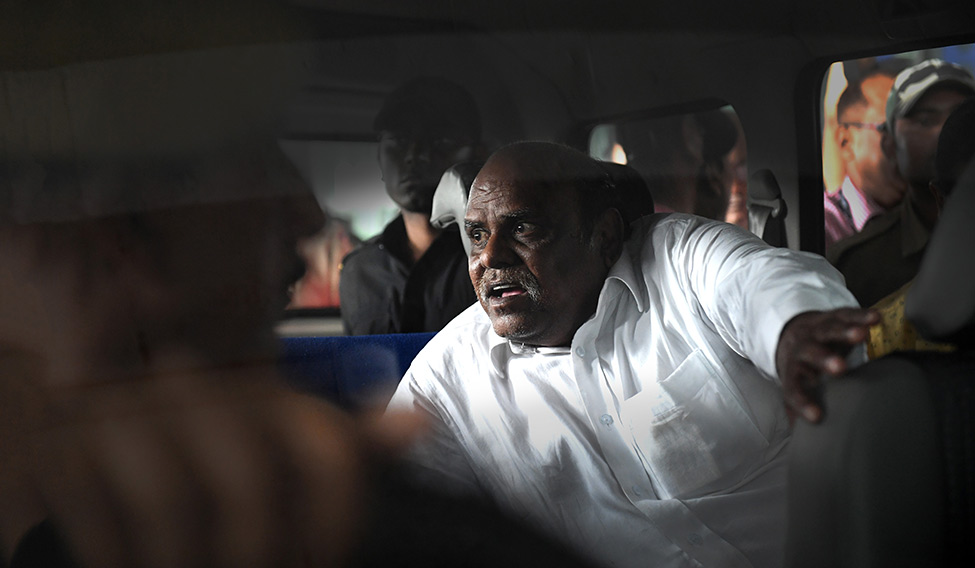
At the height of his feud with the Indian judicial system, Justice C.S. Karnan dared the Supreme Court to arrest him, but when it sentenced him to six months in jail, he just vanished, giving Kolkata Police the slip. For 43 days, he remained a fugitive, moving to different hideouts across south India, until his arrest on June 20 from a guest house in Coimbatore. Ironically, the arrest came on the day his supporters met Union Law Minister Ravi Shankar Prasad seeking his assistance in securing Justice Karnan’s retirement benefits.
When the West Bengal Police finally tracked him down, Justice Karnan asked them, “Could you not wait for some more days? My mercy petition is pending before the president.” But they were adamant. A member of the police team, in fact, started looking for air tickets to take him back to Kolkata. For a while, Justice Karnan sat still, his head bowed. A senior officer then told him, “Sir, you have to get ready. Whatever you want to say, you can tell the court.”
When Justice Karnan went to his room, he was asked to keep the door ajar. He changed his dress and came out. He did not call anybody, not even his son or wife. While in hiding, he only spoke to his son Sugen, an engineer who lives in Chennai, but from the mobile phone of his aide Monick Malaviya, who is an advocate.
“The police tracked Malaviya’s phone signals,” an upset Sugen told THE WEEK. Malaviya was in Chennai when Justice Karnan was arrested. “It was fishy. I had warned him about Malaviya’s mobile phone,” said Mathews J. Nedumpara, Justice Karnan’s counsel.
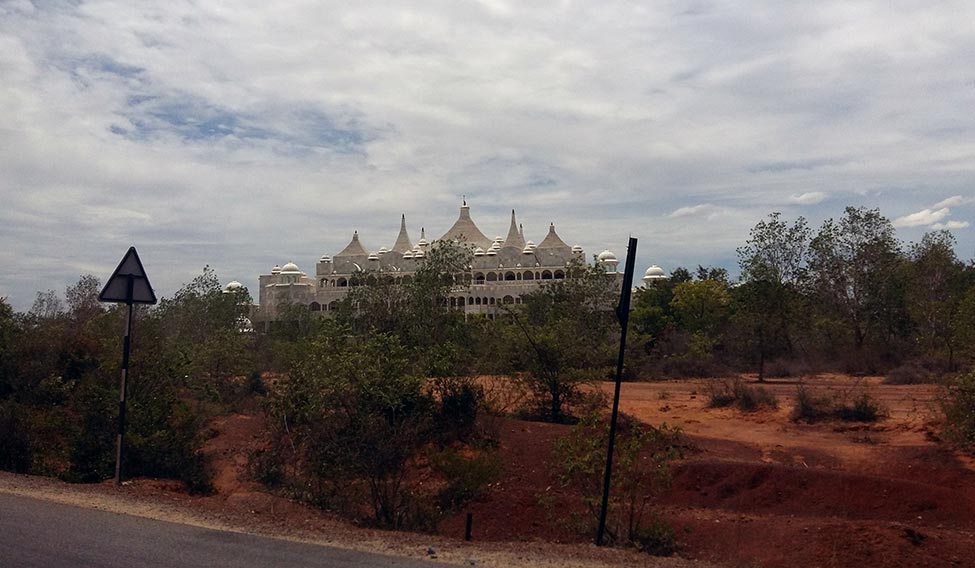 Sacred sanctuary: The Kalki Bhagwan temple at Tada in Nellore district of Andhra Pradesh. Justice Karnan stayed here on May 9, the day he was sentenced to imprisonment by the Supreme Court.
Were the police in Tamil Nadu involved in the arrest?
The director general of the Tamil Nadu Police, T.K. Rajendran, sounded angry on hearing my question. “Just ask the Kolkata Police. They would be the right authority to talk about it,” he said. Surajit Kar Purkayastha, DGP of West Bengal, too, refused to say anything.
I had travelled across Tamil Nadu, Puducherry, Andhra Pradesh and Kerala in pursuit of Justice Karnan. I flew from my base in Kolkata to Chennai on June 13, and was told that he had reached Puducherry on June 9 from the famous Srikalahasti temple near Tirupati in Andhra Pradesh. But by the time I reached Puducherry, he had left.
I then tried to get in touch with him through Malaviya’s mobile phone. Malaviya told me that the retired judge was scared. “He is afraid that he would be arrested if he talked to anyone outside,” said Malaviya. I told him that Justice Karnan was not easily scared and that he had taken on the Supreme Court.
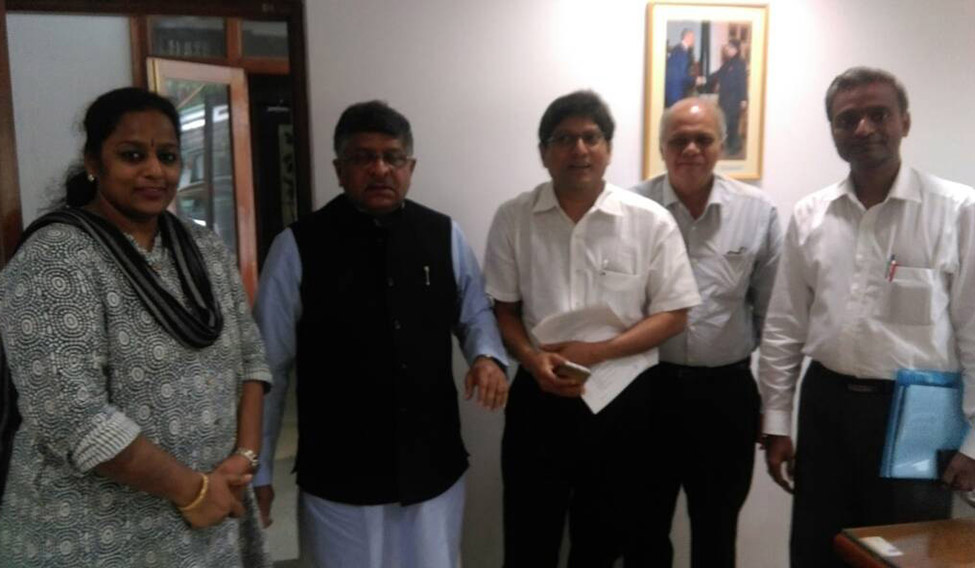 Twist in the tale: Justice Karnan’s team with Union Minister Ravi Shankar Prasad hours before he was arrested.
“Don’t worry, he will never be arrested,” Malaviya told me. “We have kept him at a secret place. Nobody can reach him.”
Although Sugen said his father was staying with their relatives, Nedumpara said Justice Karnan might have been running short of money. “Justice Karnan was spending a huge sum for his stay. So he had to shift from one place to another. He did not want to be at anybody’s mercy. But, at the same time, he did not want to spend too much, although he is rich,” said Nedumpara.
One of the early hideouts of Justice Karnan was Srikalahasti. The Shiva temple here has two sections. The first one, more than 500 years old, was built by the Cholas. The newer one was recently constructed by an organisation headed by Justice Karnan. “I was part of constructing the new temple as the old one collapsed in 2010. I wanted Prime Minister Modi to inaugurate the temple in January, but he did not come,” Justice Karnan told THE WEEK in May. The construction cost nearly Rs 90 crore. Some interior work was pending. He was raising money for it when he was caught in the legal tangle. [The construction company Navayuga Engineering Company Ltd later informed us that the “cost of rebuilding the temple was Rs45 crore and it had fully borne the cost. "Justice Karnan neither has any relation with Navayuga Engineering nor was involved in any of the reconstruction activities of the temple,” the company stated.]
I reached Srikalahasti on June 14. When I tried to step inside the temple, a devotee called Madhavan asked me to leave my mobile phone outside. I sought his help to meet the head priest. “For what?” he asked. I told him that I wanted to know more about Justice Karnan and the role he played in the reconstruction process. He became angry on hearing this.
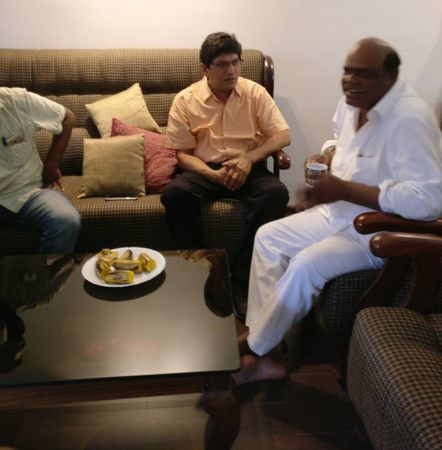 Time to unwind: Justice Karnan at one of his hideouts in Kerala.
“You will not be allowed. Just look at the new temple. Justice Karnan’s name is there on every inch of the temple. He played a key role by bringing money. He arranged it from different people. You people want to get him arrested. Shame. He has done nothing wrong,” he said.
After being denied the permission to meet the head priest, I went to the Kalki Bhagwan temple at Tada in Nellore district. But it was closed by the time I reached Tada. “No one can meet the Kalki Bhagwan, the living god of the temple, against his wishes,” a local person told me. As I stepped back, I noticed the temple guest house nearby. Justice Karnan had stayed here on May 9, the day he was sentenced to imprisonment by the Supreme Court.
I tried to inquire about the role played by the temple authorities in sheltering Justice Karnan. But no one spoke a word. Finally, a couple of outsiders indicated that he was seen at the temple premises on May 9 and 10. “But he did not stay for long. I think he left after a night’s stay,” said one of them.
The local people indicated that the two temples, Srikalahasti and Kalki Bhagwan, were major refuges for Justice Karnan. Back in Srikalahasti, I met Madhavan again. Pointing towards the heavy police presence in the temple town, he said Justice Karnan was no longer there. “Can he stay here while there is such heavy police presence?” asked Madhavan. Yet, Justice Karnan’s men asked me to wait there. With my legs aching, I checked into a hotel and continued my wait. But it turned out to be fruitless.
Back in Chennai the following morning, I turned to the legal community for help. What struck me was that most of them were quite supportive of Justice Karnan. Lawyers and retired judges from the backward sections were trying to help him. However, there were others who tried to take advantage of the situation. A self-styled legal adviser to Justice Karnan, who will go unnamed in this report, said he knew where he was. “I am in touch with him through his brother who is a state government employee. He wants Rs 10,000 for arranging a meeting,” he said.
I refused to pay, which upset him. “Then I am not interested anymore,” he said.
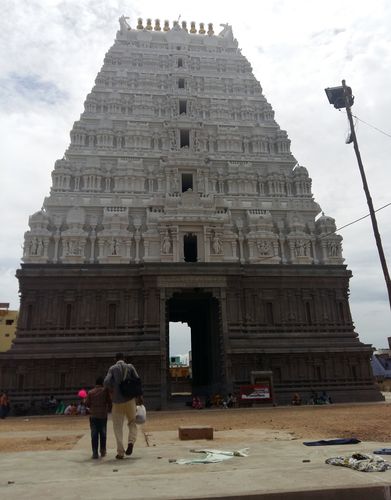 In god, we trust: The newer section of the Srikalahasti temple, which was recently constructed by an organisation headed by Justice Karnan.
Nedumpara said it was a horrific situation. “That’s why I believed that some people might get him arrested for money.” He said he was not aware of Justice Karnan’s whereabouts. He had initially met him at a location in Tamil Nadu in connection with a mercy petition on his behalf. But, later on, he was denied a chance to get in touch with Justice Karnan.
Finally, a source from the legal fraternity revealed to me that Justice Karnan was in Kerala. Many of them, in fact, wanted me to meet Justice Karnan as they felt he was no longer safe. Their idea was to keep him in secret locations till Chief Justice J.S. Khehar retired on August 27, and then to start afresh another round of legal battle. They even set up a WhatsApp group in my name to help me.
In Kerala, he stayed initially in Palakkad and, later on, in a resort near Kochi, where he stayed for a fortnight, paying about Rs 10,000 a day. I reached Kerala on June 17. Malaviya, however, decided to move him to Tamil Nadu saying it was quite expensive to pay Rs 10,000 a day and that the Kerala Police might be more aggressive towards him. A helpless Justice Karnan, who was not even given a chance to meet his dear and near ones, finally gave in. Malaviya hired a taxi and took him to Coimbatore, 190km northeast of Kochi. He was taken to a guest house owned by one of Malaviya’s friends, located next to the Karpagam University campus. Malaviya told Justice Karnan that his stay would be free of cost as the owner of the house was close to him. A source told me about the new hideout, and I took a taxi to Coimbatore on June 19.
I finally spoke to Justice Karnan on Malaviya’s phone and he agreed for a meeting. He also replied to some of the questions I put to him. “I am not at all perturbed,” he said. “These days, I spend time reading, especially the Indian Penal Code and the Code of Criminal Procedure. I hope the president of India would respond to my plea,” he said. “I will speak with you. Give me some time.”
I was, however, desperate to meet him as I felt the police were closing in. Purkayastha, the DGP, had formed a special team led by Director General of Home Guards Raj Kanojia and Deputy Commissioner (Headquarters) C. Sudhakaran, a Tamilian who knew south India quite well. Justice Karnan, meanwhile, asked me to meet him on the evening of June 20. But when I called up Malaviya that day, he said, to my surprise, that he was in Chennai and would arrange the meeting the following day. But before that could happen, Justice Karnan was arrested.
Justice Karnan did not realise that the West Bengal Police had reached Kerala the same day he had left the state. They were tracking Malaviya’s mobile phone locations, and finally traced him to the guest house in Coimbatore, from where he was arrested.
“Justice Karnan was moved to Coimbatore at the insistence of Malaviya,” said Nedumpara. A Mumbai-based lawyer close to Justice Karnan said, “How could the police track Malaviya’s signals although he was not in Coimbatore? Somebody, perhaps from the legal community, must have informed the police,” he said.
A day after his arrest, Justice Karnan was taken to Kolkata, where he was lodged in the Presidency jail after his pleas for interim bail and for the suspension of his sentence were rejected by a two-judge bench of the Supreme Court. He was asked by the bench—Justices D.Y. Chandrachud and Sanjay Kishan Kaul—to approach the chief justice after the vacations since the order against Justice Karnan had been passed by a seven-judge bench. Adding to the confusion, one of the seven judges, Justice P.C. Ghose, had retired on May 27, even before it could pass a detailed order in the case.
The legal and political repercussions of the case are unlikely to die down any time soon. Justice Karnan’s family members said they would move the Supreme Court. “The legal fight has begun. Let us see what happens in the future,” said Sugen. The arrest could snowball into a political controversy as it comes at a time when the BJP is fielding a dalit as its presidential candidate.
“The finance minister [Arun Jaitley] had given us an appointment for June 19, but he cancelled it at the last moment,” said Nedumpara. “His secretary then asked us to meet the law minister [Ravi Shankar Prasad]. When we met the law minister on June 20, he wanted us to keep the meeting confidential. We are surprised at the timing of the arrest. A day after a dalit presidential candidate was announced, they arrested a dalit judge.”
P.E. Thamizhiniyan, a lawyer and a leader of the backward communities in Tamil Nadu, said they had hoped that Arun Jaitley would defer the arrest till the president had decided on the mercy plea. He said Jaitley and Prasad had assured them that they would look into the matter. “Despite that, the arrest was made. I think it was done at the instance of the Central government.”
Thamizhiniyan said the backward political parties would launch a major movement in the coming days against Justice Karnan’s arrest. “We will not accept this. He never said anything against the Supreme Court. Raising an allegation against a judge is different from levelling allegations against the court and it cannot be described as contempt. This is gross violation of the contempt law,” he said.
Justice Karnan’s retirement was probably the most ignominious one in the history of the Indian legal system. He had to stay away from his High Court in Kolkata even on June 12, the day of his retirement. His pension papers have not been cleared as he was not present to retire formally. His retirement benefits, too, have not been cleared.
“Justice Karnan showed guts by raising corruption charges despite being a sitting judge,” said Arunava Ghosh, senior advocate of the Calcutta High Court. “The legal battles have not ended. If a person like him, who gave such remarkable judgments, is treated as mad, then we are all mad.”