



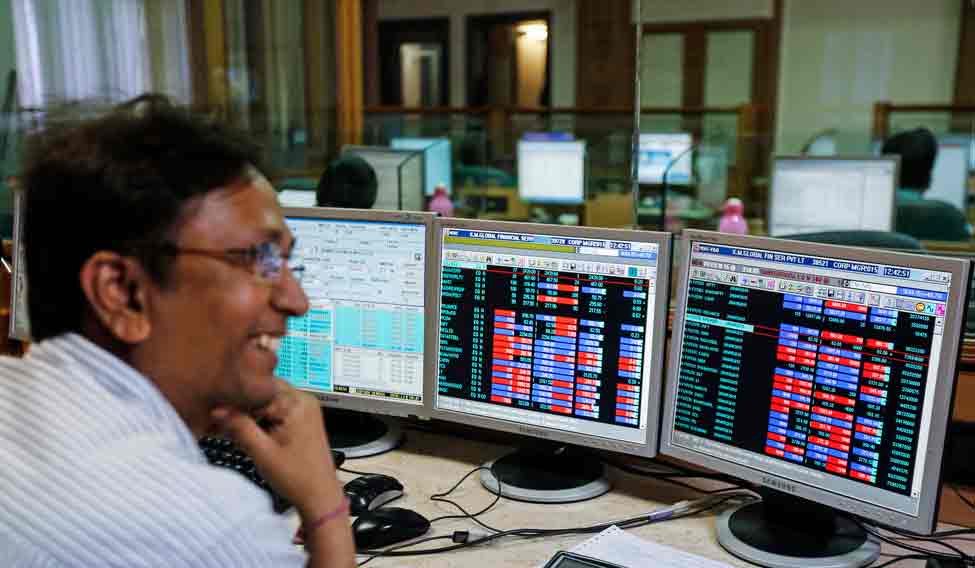
It has been a remarkable year for equity markets. A market rally that began in the early months of 2016, went on unabated in 2017 and barring a few corrections, benchmark indices continued to hit record highs, and analysts see the bullish trends continuing well into 2018, as corporate earnings continue to recover and India's economy gains momentum as the effects of demonetisation and the rollout of Goods and Services Tax fade.
The BSE Sensex crossed the 34,000 mark for the first time ever on December 26 and hit a lifetime high of 34,137.97, in intra-day trading on Wednesday, December 27. The National Stock Exchange's Nifty too scaled the 10,500 mark, before slipping. The Sensex closed at 33,911.81, down 99 points or 0.3 per cent, while the Nifty settled at 10,490.50, down 41 points or 0.4 per cent.
So far in the calendar year 2017, the Sensex and Nifty have accelerated 28 per cent, driven largely by strong inflows into equity mutual funds, while foreign institutional investors also remained net buyers for the year. The sovereign ratings upgrade by ratings agency Moody's and the government announcing a huge package of Rs 2.11 lakh crore to recapitalise public sector banks have also helped boost investor mood.
Due to various regulatory changes and post-demonetisation as returns in real estate and gold remained subdued, Indian investors took to equity markets in a big way. Between January and November, just the pure equity mutual funds saw inflows of more than Rs 275,500 crore, taking the total assets managed by these funds to over Rs 6.56 lakh crore at the end of November.
Several analysts have flagged rising valuations of India's equity markets, but admit that the huge liquidity will continue to drive the markets upwards in 2018. Although, some correction can not be ruled out, particularly if FIIs remained subdued in the wake of rising interest rates in the US, Europe also signaling end to easy money policies and rising inflation and pressure on fiscal deficit in India.
FIIs have invested Rs 48,699 crore in India's equity markets till December 26, 2017, which is more than double their investments in 2016. However, they have been selling stocks in three of the last five months. So far in December, they have pulled out Rs 8,436 crore from equity markets. Typically, FIIs book some profits in December before their annual Christmas holidays, and fresh allocations are made from January.
“The run up in the market has been quite impressive till date. However, macro economic parameters have slightly weakened than what they were in the beginning of 2017 and the expectation is that companies results will improve in the second half of 2018. Meanwhile, the US is on the improvement track and Europe is also slightly better. So, we can't have big money expectations as of now till the time we really see some improvement in the macros,” Anita Gandhi, whole time director at Arihant Capital Markets, told THE WEEK in an interaction.
“If we go by fundamentals, keeping aside the liquidity part, we expect some consolidation in the market as of now and a pickup after that,” added Gandhi.
Arun Thukral, MD and CEO, Axis Securities believes that India is still in a “long-term structural bull market” and any correction should be taken as a opportunity to buy shares.
The upcoming year will also be election heavy, with several states going to polls and that will also weigh on market sentiments. Although the BJP won the recent assembly elections in Gujarat and Himachal Pradesh, the close fight by the Congress in Gujarat, signals the Narendra Modi-led government will increasingly look to address issues across India's vast hinterlands like farm distress and employment generation, feel analysts.
However, earnings growth will remain a critical parameter to watch.
“The performance of Indian markets will depend on strong earnings growth due to normalisation of operating conditions in several sectors, favourable global commodity cycles and moderate domestic economic recovery that will support consumption,” said Sanjeev Prasad, co-head of Kotak Institutional Equities.
However, there was a possible risk of de-rating in certain sectors, given full valuations for the market, rich valuations for consumption sectors and if macro-economic conditions were weaker, added Prasad.
Over the last 18 to 24 months, bank lending as well as savings deposit rates have fallen as RBI cut interest rates.
However, with inflation surging in recent months, retail inflation saw its fastest month-on-month increase to a fifteen month high of 4.88 per cent in November from 3.58 per cent in October, analysts don't see RBI cutting interest rates further in 2018, rather the tone is likely to be more hawkish, if inflation remains above the central bank's comfort zone.
The RBI last cut its benchmark repo rate by 0.25 per cent in August and has since maintained it at 6 per cent.
“We expect slightly more hawkish rhetoric from the monetary policy committee in second quarter of 2018, when both growth and inflation are likely to be significantly higher, but we believe rates will be left unchanged through 2018,” said Sonal Varma, chief India economist at Nomura Securities.
Many foreign brokerages still expect India's equity markets to charge upwards in 2018, even after this year's record rise.
Goldman Sachs, for instance, expects the Nifty to hit 11,600 points by the end of December 2018 and Morgan Stanley expects the Sensex to touch 35,700 points by that time.
Foreign portfolio managers are bullish on India's structural reforms and a pickup in economic growth that is expected to drive corporate earnings recovery, going ahead.
“We expect strong economic growth in China and India to feed through to better corporate profits across the region. India’s ongoing structural reform efforts may create conditions for continued economic and corporate earnings growth over both the short and longer terms,” said Stephen Dover, head of equities at Franklin Templeton Investments.
However, most analysts agree that investors should look at stock specific investing, given that the broader valuations of the markets have risen. Among particular sectors, recapitalisation plans should give a fillip to state-owned banks, while infrastructure companies may stand to benefit from government's big infra push on developing ports, roads and railways.
“India has seen a concentrated period of economic reforms in the past 18 months and a gradual recovery from those bold measures is on the cards. Progress on banks' asset quality resolution, the extent of execution of government's infrastructure projects and the prospects for commencement of private capex over next few quarters are the key variables to watch out for,” said Manishi Raychaudhuri, head of Asia Pacific equity research at BNP Paribas.
BNP Paribas has a target of 37,500 on the Sensex by the end of December 2018.