



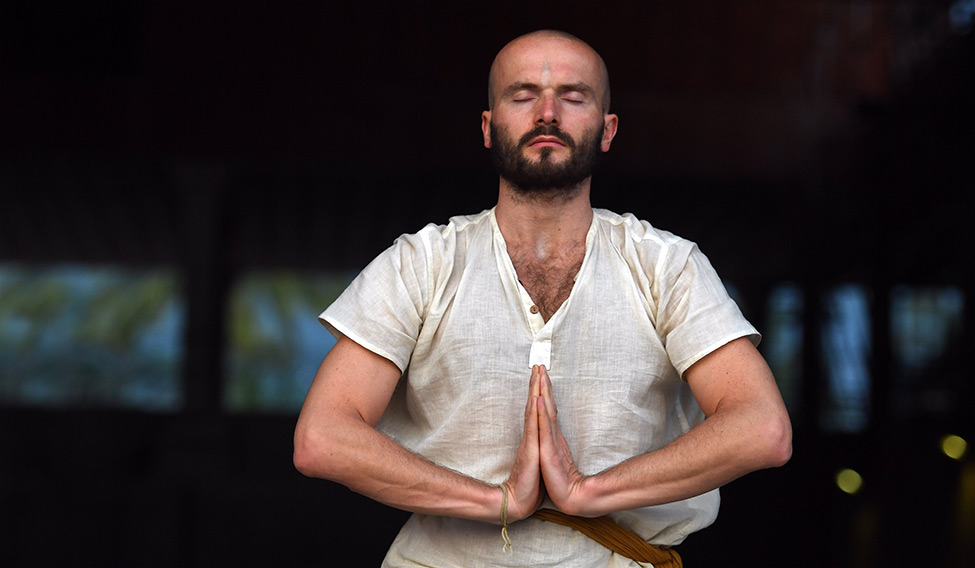

It is twilight, and all you have for company is the calming hum of mantras. As the chants permeate the air, you feel like you are back in an age of seers. An urban seeker doesn't really miss anything at the Isha Yoga Center in Coimbatore. It offers a pleasant blend of aesthetics, comfort and serenity to soothe tired souls. Meditators have a lot to explore and experience in this spiritual haven, nestled in the foothills of the Velliangiri hills. Dhyanalinga, a yogic temple in the ashram consecrated by Jaggi Vasudev, well-known as Sadhguru, is believed to be a powerful energy centre. “Take a dip in the theerthakund and then sit in the Dhyanlinga for one or two hours. Don't believe or disbelieve anything. It will change the way you are,” says Sadhguru. “You get into a deep state of meditativeness, without any instruction, without any external help or knowledge. Just by your own nature.”
Then there is the Shoonya meditation programme, which equals three hours of good sleep. “With Shoonya meditation what happens is that your metabolic activity drops by nearly 20-24 per cent, which is the highest drop that can happen in a conscious state. This means for 15 minutes you are almost in a state of hibernation. So the amount of rejuvenation that happens in the system, the amount of exchange of impurities that happens on the cellular level is tremendous,” explains Sadhguru.
Meditation is nothing but creating a distance with the activity of the mind so it doesn't bother you, says Sadhguru. “Body is here. Mind is out there. Be a little away from the mind. A little space between you and the mind—that is being meditative. If you create a distance with the activity of the mind, it will not bother you,” he says.
Include meditation in your routine; it will allow you to blossom, says Sadhguru. “Today, there is substantial medical and scientific evidence to show that if you go through 24 hours without a moment of anxiety, anger and agitation, your ability to use your intelligence can go up by 100 per cent,” he says.
Who doesn't want to be more intelligent! Among those who sit in a state of meditative bliss at the Dhyanalinga, there are millennials, scientists and researchers. People sitting with their eyes closed, in a state of meditative bliss, is a familiar sight in India, not just in ashrams but also in parks and local trains. The ancient art of connecting with one's inner self has become the lifeline for modern man. Busy CEOs and executives keep visiting ashrams. Some have quit their high-profile jobs and chosen to be full-time volunteers.
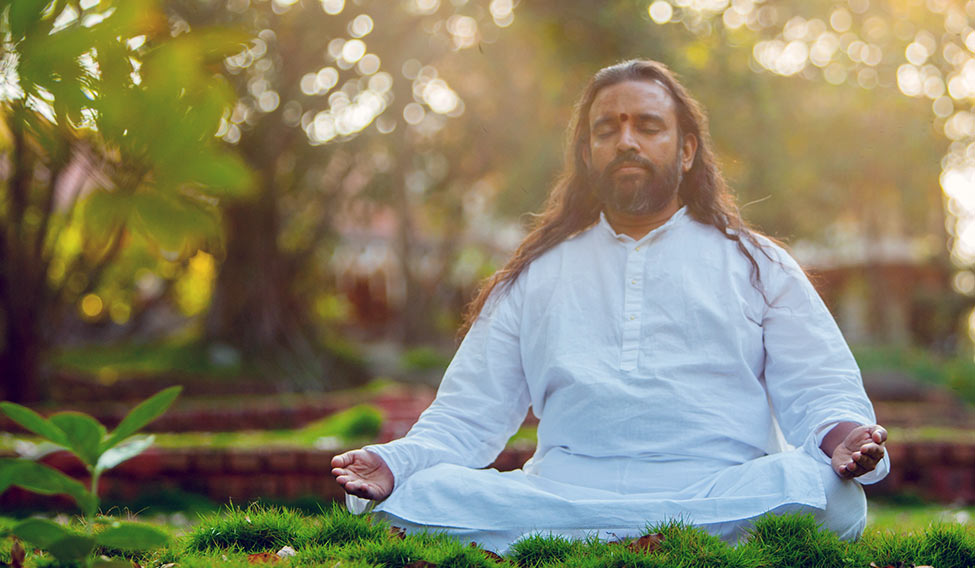 Dinesh Kashikar | Senthil M.
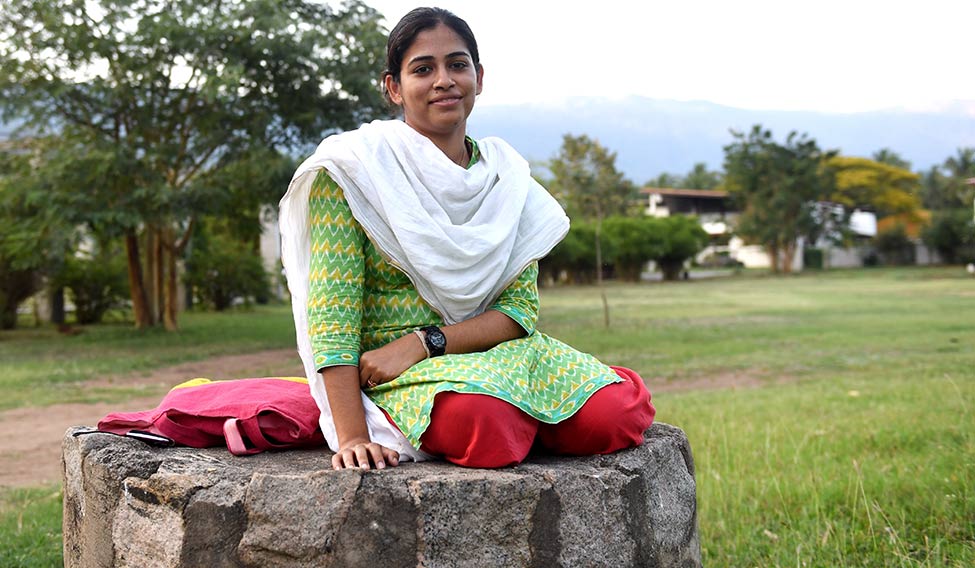
Minu Saroj, 23, from Pune who now lives in an ashram says that after she started doing the Inner Engineering programme, she no longer needs an external source to be happy. Earlier, she would go on a vacation and be happy for a few days. “Meditation made me realise that there is an ocean of bliss inside me,” says Saroj.
Why are people drawn to ashrams and exotic meditation destinations? What is it about meditation that fills people with bliss and a sense of well-being? Could it just be a placebo effect?
The Dalai Lama helped neuroscientists crack this riddle. He invited them to study the brain of Buddhist monks, following which Richard J. Davidson, a renowned professor of psychology and psychiatry at the University of Wisconsin-Madison, took Buddhist meditators from Dharamsala to his laboratory. Among them, there were monks who had more than 30,000 hours of meditation practice, novice meditators and lay practitioners. Davidson had electrodes strapped to their heads and did an MRI scan. The imaging studies showed that meditation had made structural and functional changes in the brains of long-term practitioners. Their brain scans showed cognitive and emotional benefits. Davidson enumerates the positive residual effects of meditation: “Scientific research on meditation clearly indicates that brain circuits important for the regulation of attention and regulation of emotion can be altered by meditation practice. These changes are associated with higher levels of well-being.”
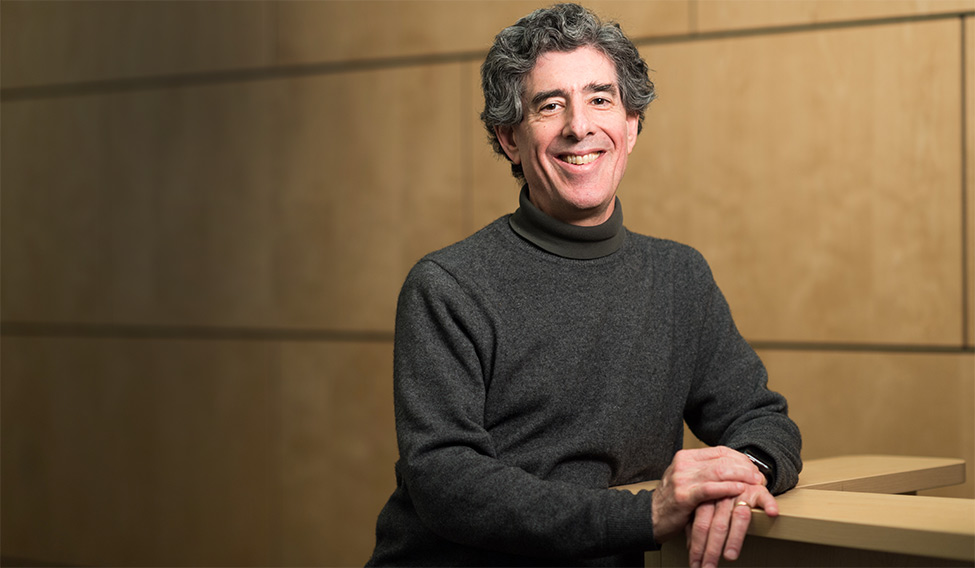 Richard J. Davidson
Davidson, who got interested in meditation in the 1960s and has visited India, did numerous studies on Buddhist monks that showed how meditation can change the brain. “Collectively these findings suggest that the neural circuits important for well-being exhibit plasticity and can be transformed through meditation,” he says.
For those who fantasy meditating at an exotic location, Ananda-In the Himalayas could be the perfect choice. This wellness centre in the foothills of the Himalayas, surrounded by greenery, lulls you into a meditative state and the clean mountain air fills you with energy. The meditation instructors here focus on techniques for relaxation and to improve well-being. “We teach Yoga Nidra. It is a psychic sleep where we guide the practitioner to relax the physical body and go into the deeper layers of the mind. That gives you a deep relaxation within half an hour. It is a beautiful technique that internalises the awareness,” says Sandeep Agarwalla, head, yoga and meditation, Ananda-In the Himalayas.
The art of well-being has a lot of relevance in modern life, says Dinesh Kashikar, 43, an IITian who has dedicated his life to teaching yoga and meditation. “Most of our work is intellectual, sitting at one place. So the mind wants a lot of rest. Hundred years ago, it was more of physical activity, wherein one had to rest his body only,” says Kashikar, fondly called Kashi. “Meditation is a deep sleep with awareness that allows us to be more functional in our day-to-day life. Earlier, without my eight hours of sleep, I would feel washed out. When I started meditating, I could cut down my sleep from eight to six hours. Twenty minutes of meditation gives me two hours extra every day.”
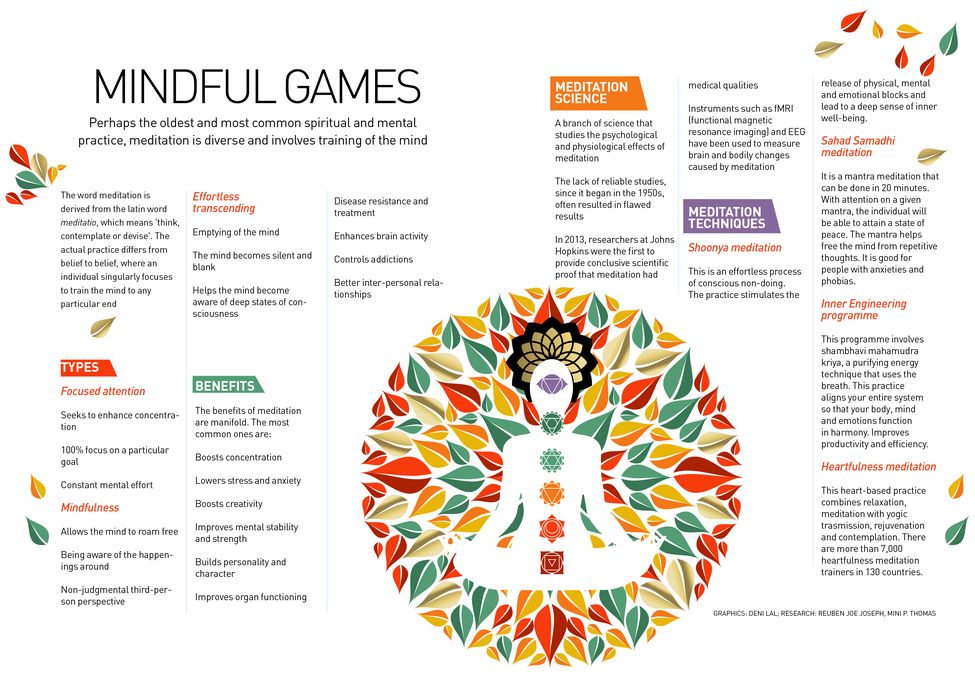
For people who are stressed out, Kashikar prescribes Sahad Samadhi meditation, that is based on a mantra. “In this meditation, you are given a small mantra and taught how to use it. The technique is similar and generic but the mantra is unique for each person,” explains Kashikar. “All you have to do is meditate with the mantra for 20 minutes in the morning and evening. You chant the mantra in your mind. Thoughts, sounds and vibrations, whether spoken or chanted mentally, have a deep impact on the body and the mind.”
Kashikar, a postgraduate in chemical engineering from IIT Bombay, realised the power of mantras and meditation while he was in his 20s. Material success never gave him a sense of fulfilment. He was constantly seeking something. “When I started meditating, I realised this is what I had been searching for. At a physical level, meditation gave me freshness of mind and relaxation. At an emotional level, it gave me stability,” he says. “After going through all the ups and downs of college life, I needed some technique to be stable. Meditation gave me the ability to handle my own emotions, to be myself. Spiritually, it gave me something to look forward to.”
Kashikar has been with the Art of Living Foundation for the last 21 years. “In one of my courses, someone asked me, 'You are so intelligent. You could have got a job. Why did you choose Art of Living?' I said, 'Because I am intelligent,' says Kashikar.
Meditation is a state of mind wherein you are free from agitation. To attain stillness of mind, it is important to prepare the body and mind and do the groundwork, says Kashikar. In Patanjali's Raja Yoga (Ashtanga yoga), organised in eight parts, meditation (Dhyana) is the seventh part. Yama (self restraint), Niyama (discipline), Aasana ( physical exercises) and Pranayama (breathing exercises) form the preparatory practices of meditation. Then the practitioner can move to the inner journey that includes Pratyahara (disconnecting oneself from the sensory inputs) and Dharna (fixing the mind on a sound or form). Dhyana is about concentrating on one thing. It can be a sound, mantra or a form like a pebble. You can even focus on your own breath or nirakar, the void. The last step is Samadhi, a state of realisation.
It was plain curiosity that brought Andrew Raas, 26, from South Africa to India. It took him a while to understand how sitting cross-legged and chanting some mantras with your eyes closed can make one calmer and healthier. Raas's journey inward brought him to the foothills of the Himalayas. At Rishikesh, he met sages who meditate in the caves, braving the snow and icy winds. Then he went to the Sivananda ashram on the banks of the Ganges and took part in the Christmas retreat. “The mantras are so powerful—I am more mindful now,” says Raas, sitting in the cold and damp floor in the ashram devouring a book written by Swami Krishnananda. “The erratic state that the mind gets caught up in, calms down when you meditate. Meditation helps allow that turbulence to reduce.”
According to masters of meditation, every thought involves an energy. Concentrating on mantras allows you to free your mind from unnecessary thoughts and reduces the drain of energy.
Sounds and mantras are powerful, so is silence. A silent meditation can make you more present, says Roopa Rao, an award-winning web series director based in Bengaluru. “It makes us aware of our senses like touch and hearing that we otherwise use less, compared to sight,” says Rao, who took part in a silent meditation programme for eight days in 2012.
Some meditations help cleanse your mind. For instance, Heartfulness meditation. It is based on the supposition that there is a divine light in your heart, the energy from which is emitted during the process of meditation. An important part of this meditation is cleaning. It helps wipe out all the stressful experiences you might have had during the day.
Heartfulness meditation is highly recommended for people having trouble sleeping. Researchers at Harvard University found that even novice practitioners who have had just one session of Heartfulness meditation could easily get to a sound state of sleep that non meditators may not get even after several hours of sleep.
For some like Om Swami, a Himalayan mystic, meditation is a way of life. “I no longer have to sit and do meditation. I don't know how to come out of meditation. I have deep sensations in my brain all the time. Scientists have studied my brain. They couldn't find a normal state in my brain; there was only the super state and the peak state,” says the 37-year-old management graduate who ran a software company before embracing spirituality. “I spent 13 months in the Himalayas, of which 100 days were in extreme solitude. I lived in absolute extreme conditions. Sometimes I would just eat snow. Sometimes, I stayed in a cave in the Himalayas. Then for seven months, I was in the deep woods. There were wild boars, rats, pigs and deer. That's where I meditated—in extreme silence and solitude.”
Om Swami has set up an ashram in the Himalayas, where, he says, there is a spiritual vibration that is just enormous. “I have seen the mountains of New Zealand, Australia and California. I have been all over the world. But the spiritual beauty of the Himalayas is nowhere else to be found in the world. That's my personal experience. I could be biased about it,” he says.
Om Swami claims that with intense meditation, he is able to develop supernatural powers and abilities. “One is the ability to go out of my body and see other planets. There is a planet 600 light years away from earth. It's a beautiful planet, two and a half times the size of earth,” he says. Swami then sits still and asks me to put my hand on his pulse. The pulse is missing! “I can shut down my heart beat, regulate the body temperature and change my blood pressure,” he says.
 Om Swami
Om Swami would meditate for 22 hours a day at the peak of his practice. “I didn't reach that state overnight. There is a structured way of championing meditation. It is like learning a musical instrument. In the beginning, you may not be able to play Beethoven's stuff. You should be happy if you are able to focus for five minutes. Then refresh your concentration and resume. The first one hour is so hard to get to. One hour to one and a half hours takes a long time. Once you cross 4 hours, then you make giant leaps,” says Om Swami, who recently came out with a book on meditation, A Million Thoughts.
Most novice meditators have problems with postures. Some find it hard to sit cross-legged. For Ramya Thimmisetty, a 28-year-old software engineer from Andhra Pradesh who joined an ashram five years ago, sitting still was a pain. “It took me about four months to get used to it. Now I sit in the temple for a long time and enjoy my meditation,” she says.
There are postures that can help loosen up the body so one can sit comfortably in the meditation posture. “Try butterfly and half butterfly postures and some squats and stretches. All these will help get rid of stiffness from your body,” says Agarwalla.
Those who want to learn meditation can start by listening to music. It helps train your mind to focus. Listen to every single word, every single beat, note and instrument mindfully for five minutes. Or, just observe your inhalation and exhalation; it relaxes and calms your mind. Meditation is a great way to cope with emotional and psychological trauma, too. Creating a little distance from the mind enables you to withstand the tempests of life. However, those in committed relationships should perhaps be wary as it could develop into detachment, which is what happened with Jan Novak, 39, from the Czech Republic. “I broke up with my girlfriend. When you aim for the ultimate, there is no chance for relationships,” says Novak, who runs a meditation centre in his country.
Novak says he is happier now. He first came to an ashram in south India early last year. “I did a basic meditation programme and went back home. Soon I decided to visit again. I went to the same ashram and did a three-week programme. Since then I have been practising for a couple of hours every day. Some of the kriyas I learnt at the ashram have really worked with my inner energies,” says Novak.
Novak calls his meditation centre in the Czech Republic an ashram. “It is just a small place in the middle of a forest. We have small groups of 30-40 people. I teach them basic things like breathing exercises and simple meditation techniques,” he says.
Novak believes these ashrams exude positive energy. Prof Ralph H. Wood, an American professor of mysticism who is known for his studies on native American practices, studied the consecration of the Adiyogi (Isha Foundation) in the US. He then presented a paper titled 'When Shiva Talks Back' at a conference of the International Association for the Cognitive Science of Religion, wherein he has explored the positive impact of consecration on human psychology and cognition.
“When the Adiyogi consecration happened, we measured the vibrations here right from the time before the consecration, using lecher antenna. On the day the consecration started, the vibrations were 10 million electromagnetic units. By the last day of the three-day consecration, the vibrations went up to 100 million units,” says Maa Vama of Isha ashram. “Staying in a consecrated space can work wonders for you. It aligns your body and mind.”
 Minu Saroj | Bhanu Prakash Chandra
Can meditation heal? “I have seen people coming out of ailments like asthma in one single meditation,” says Sadhguru. Disease is a state wherein there is no ease in the system, not just mentally or physically but on the cellular level as well, he says. “If there is an intelligence that created everything, it should be able to do the repair work also. But for it to work, you have to be in a certain ease. That ease is gone in most people. They think it is because of their age or the tensions of the world. No. It is simply because they are messed up. If you know how to sit at ease, total ease in the system, a lot of your problems are solved,” he says.
Scientists do not totally refute these claims, though they explain the mechanism of healing differently. They say that meditation can sometimes trigger self healing processes.
Cure or not, meditation does provide the much-needed calm amid the chaos that rules our world today.
The science of meditation
Studies by the Bengaluru-based Swami Vivekananda Yoga Anusandhana Samsthana (S-VYASA) analysed the changes that take place in the body during Om meditation.
The study found ''small but statistically significant'' reduction in heart-rate during Om meditation. This, according to the researchers, suggests a deep psychophysiological relaxation, which in turn increases alertness. The study also showed decrease in blood flow in the skin, which, too, is indicative of improved alertness.
Some studies based on the analysis of electroencephalographic (EEG) recordings have shown that mindfulness meditation improves relaxation. One study that looked at performance in cancellation tasks (a psychometric test of visual perception and vigilance) in 70 healthy subjects—some of them meditated before the task—found that performance in such tasks improves after meditation.
Researchers have demonstrated that meditation leads to positive changes in midbrain—associated with vision, hearing, motor control, sleep and alertness—whether one chooses to meditate on a single syllable or a series of thoughts. Transcendental meditation, which uses a sound or mantra, improves perception of hearing.
In the various studies done by S-VYASA on sleep and meditation, it is said meditation in many ways is similar to a deep state of sleep. Bodily sensation is voluntarily reduced in both these conditions. However, unlike in sleep, the level of awareness is significantly higher in meditation.