



Narendra Modi, most of us think, has come to treat state visits—incoming and outgoing—as photo ops. Oops, selfie ops. Many in the south call him Ulagom Sutrum Valiban or Globe-Trotting Dandy, after an MGR superhit of the 1970s. By September end, Modi will have trotted the globe from the east coast of the Pacific (Kyoto) to the west coast of the Pacific (San Francisco).
No issue. Diplomacy is as much about optics and photo-ops, as it is about peace pacts and trade treaties. Sometimes a visit is remembered more for a minute's video-moment than an entire clutch of MoUs signed, or for the pious declarations made in the joint statements. Does anyone remember any of the agreements that Rajiv Gandhi signed on his 1988 China visit? But we remember the full-minute handshake that Deng Xiaoping extended to him. Old man nearly plucked out his arm.
Problems arise when you overdo the optics. Modi often does it, like wearing monogrammed suits to summits, or taking too many selfies. That is when the public begin to wonder whether a summit is all about theatrics and not treaties.
The blame is as much on the diplomats as on the leaders. When a visit is low on substance, they tell us to look at the optics, while they do the playback. They spin yarns about symbolisms and metaphors where none exists, like the "time-tested ties" between Pataliputra and Patagonia, or the "close cultural contacts" between the Carnatic coast and the Catalan coast.
They even point to the "very good personal chemistry" between Vladimir Putin and Manmohan Singh, forgetting that Putin is a judo black belt and Manmohan is more than 80. Had such phrases been used in the Indira-Brezhnev era, she would have caused a few cluster bombs to drop.
Often, it is low-voltage visits that yield better results. Narendra Modi has been been visiting every port of call from Eldorado to Erehwon, but it was his last week's visit to the United Arab Emirates that, in the real reckoning, was the most substantial.
No great sheikhs, many may say. Just an overnight trip to a low-key state, one which has been selling us oil (for earning dollars), and employing our nationals (because they are short of skilled people), without any PM having had to visit them for three decades.
Indeed, India has not been engaging the emirs politically, and, yet, they have been doing all these. And, they would have continued to sell oil and give us jobs for another three decades, without any PM having to poke them with a selfie stick. But, then, without the prodding, the emirs would not have given us the strategic partnership that they have given Modi.
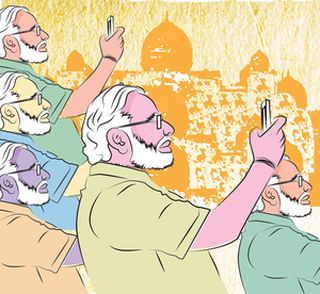 Illustration: Deni Lal
Of what value, one may ask. The emirs do not have fighter squadrons to lend us when the Chinese or the Pakistanis invade our skies. Indeed, they do not. But, the emirs have rendered us a much greater service. They have helped us break out of the Look-East spell that we were getting trapped in.
Every Indian ruler from 'Curzon to Nehru and after' has been saying that India's strategic perimeter extended from the Suez to Singapore. We got our chance to show our flag in those waters after the Cold War ended, but being friendless, penniless and powerless, we had to look to the east. The Americans came to exercise with us in the eastern seas, introduced us to their rich friends in the east, and told them to keep us engaged there. This suited their major non-NATO ally Pakistan, too. To placate our egos, they now and then asked us to escort a few of their boats through the pirate-choked Malacca Strait.
Look-East suited us, but we did not want to be tied down in the east. Vajpayee asked Clinton several times to let us exercise with the US in the western seas, but the answer was no.
Now the emirs have helped us break the eastern spell.
prasannan@theweek.in