



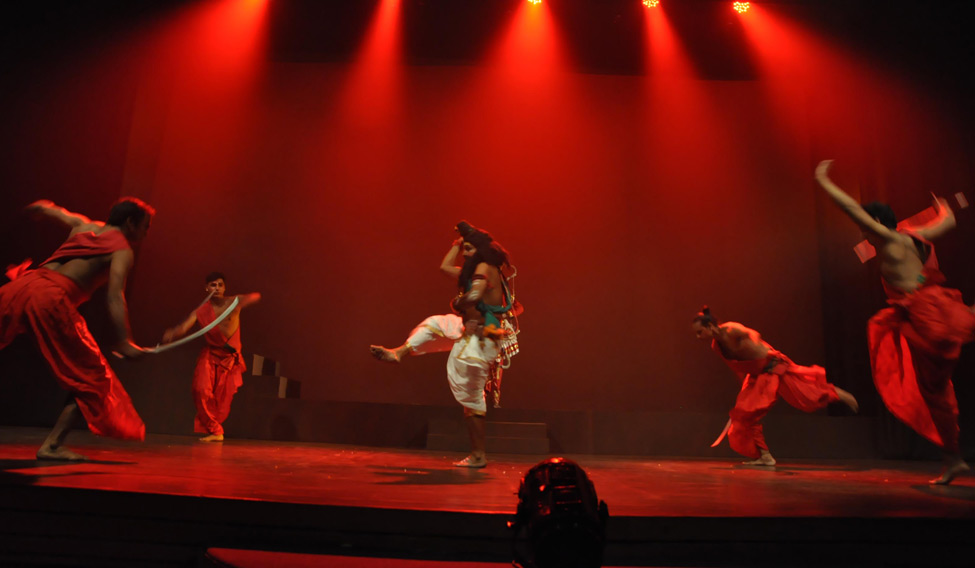
Kerala-born choreographer Shashidharan Nair, with five decades of experience in performing arts, has mastered several dance forms, including Kathakali , Mayurbhanj Chhau and Kalaripayattu. He uses a unique blend of Kalaripayattu and Kathakali in his dance performances that depict the stories of various characters in Indian mythology. At his recent performance in Delhi, Nair used the same art to enact Parashurama—the sixth avatar of Lord Vishnu.
Explaining his reasons to zero in on Parashurama, Nair says, “People don't know much about him, his childhood and his works towards the society. All they know is that there's a conversation between him and Lord Rama. This performance gave people an overview about the character and his role.”
Nair's popularity is not just confined to India; he has also conquered the hearts in Japan, Korea, Thailand, America as well as Canada where he has performed.
“We have taken our culture to different places across the globe. In mid 90s we did a production in Chicago called Mahishasura Mardini. Ramayana goes abroad a lot. We have taken it to Canada. 'The Wonder That is India', which showcases the rich cultural heritage of India, was done in France. Later we took it to Morocco and Italy. In 2013, we went to Indonesia to represent India at the Ramayana festival. There, we took our version of Ramayana to Indonesia. Other South East Asian countries also brought their own version of Ramayana to the stage.”
Nair's introduction to dance happened quite early in life. It was his grandfather who initiated him to Indian art and culture.
“I started learning at the age of eight. My introduction to Kathakali happened because of my grandfather who pushed me to learn dance. It was out of his interest towards Indian art and culture that I got introduced to it. I was training under K. Padmanabhan Nair. I feel the whole credit of nurturing me as a dancer goes to him.”
Since Kathakali required precision, Nair continued training till the age of 12 to get his mudras, eye movements and body movements perfect. However, the turning point in his life came at that age.
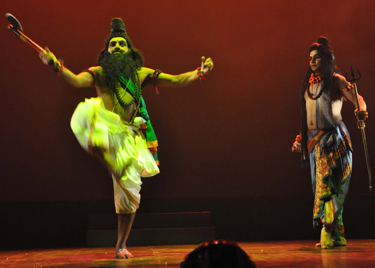 Shashidharan Nair performing 'Parashurama'
“At the age of 12, I got a scholarship and started learning from Akademi awardee Kavungal Shankaran Kutty Paniker for six years but I continued with my studies simultaneously. After that, I came to Delhi for six months. However, I was completely unaware about the other dance forms that existed. So in 1972, I went to Gwalior and at Rangasri Little Ballet Troupe, I started training there as a dancer for around 10 years in Mayurbhanj Chhau, Uday Shankar-style,” he says.
In 1981, Nair came back to Delhi and since then he has been performing from the national capital. He joined Bhartiya Kala Kendra as a dancer and gradually did his first production 'Sangharsh' for Sahitya Kala Parishad in 1989. Thereafter, he did Tripurantak and continued learning Odissi and varied dances from Akademi awardees. He continued with Bhartiya Kala Kendra for 30 years where he developed several new productions.
“At Bhartiya Kala Kendra, I did productions such as Krishna, Ramayana, Chakravyuha, Meera and Dance of Shiva which made me immensely popular,” he says.
Nair, for the last two years, has been working with Indian Revival Group. Having mastered several dance forms, he uses it to give different treatment to varied characters. Papiha Desai, choreographer, Indian Revival Group, who has worked with Nair on several productions such Rama, Krishna and Meera, thinks that it is this knowledge that works as an advantage for the prolific dancer.
“Nair expands within his vocabulary. In case of form-based production, emphasis is laid on the form and ways to bring out that form, but while we are telling a story, the focus is on the story, then we use forms that do justice to that story. Since he is trained in different forms, if a character requires softer movement, he relies on a particular form that allows that specific kind of treatment. If the character is very heroic and valorous, Kathakali goes well with it. However, for a female character, a softer form is used. There he uses the famine grace from Chau or Odissi,” she says.
Despite several stage performances and years of practice, Nair still connects with himself minutes before he heads to the stage. “I try to completely change myself into the character. I also try remembering the sequences that I am supposed to perform. This helps me get into the core of the character before I go live. However, when I am on stage, I am a that character and not Shashidharan.”