



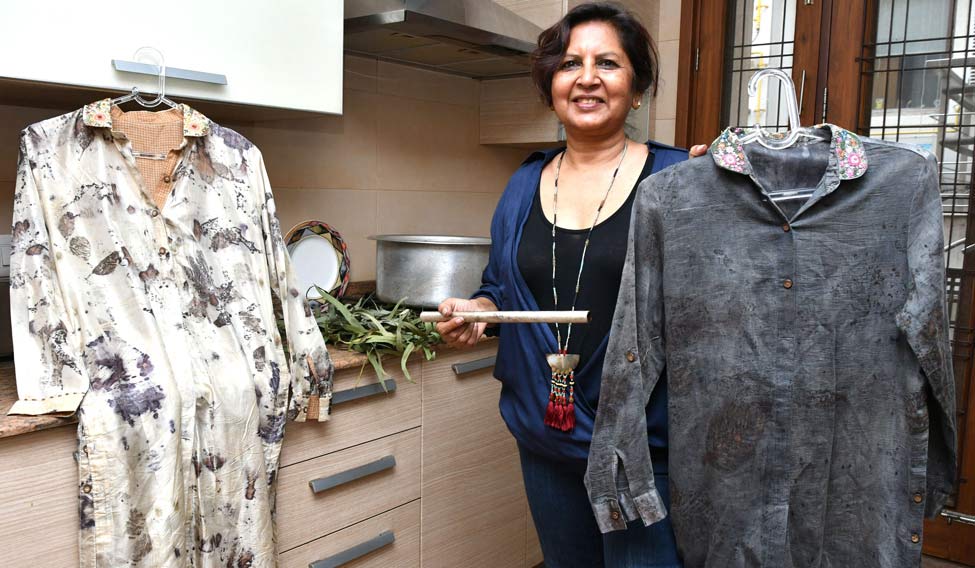
Designer Renu Gupta has been experimental throughout her life – be it her career or the passions she pursues. The 62-year old despite being working as a manufacturer of dolls’ clothing for 20 years after studying art and design from Columbus College of Art and Design, chose to be a therapist in counselling psychology. However, her love for designing never faded off and she continued the chase of learning new techniques to pursue her hobby. Today, she specialises in eco printing, a technique in which she uses different parts of plants and trees such as stems, leaves, flowers and so on for dyeing and printing purposes.
“Eco printing is all about colours, some are shadowy and others are defined. In India, I use teak leaves for their beautiful purple pink colour, guava leaves for their yellow colour, marigold flowers as well as eucalyptus leaves. Normally flowers do not print or make a clear picture, but give an impression. The impressions given by leaves also vary. Sometimes these are clearly defined; otherwise they are blurred or create a shadow. The technique involves a lot of experimentation,” she says.
In eco printing, dyeing and printing is done by using natural pigments present in flora. These pigments appear in different colours depending on the season and time of the year. This process helps the natural pigments to leave incredible details of form and colours on fabrics.
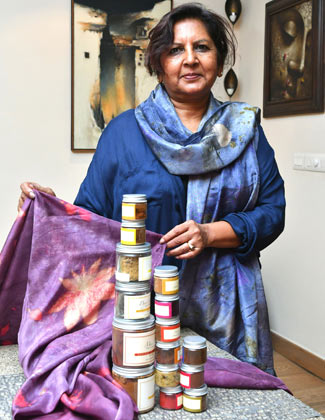
Eco printing as a process doesn’t look as easy as it seems. Gupta stresses that it requires finesse. Explaining the technique, she says, “This process is a one-of-a-kind art where no two pieces can be similar. With change in season, certain flora create impressions, while others don’t.”
The conditions in which the fabrics are dried, play a major role in deciding the outcome. The designer while explaining the process, says, ample factors play a major role in deciding what eventually happens of the fabric.
“First, the fabric is washed very carefully and thoroughly with soap. Then it is mordanted which means that the fabric is dyed in different colours. In this process, it is soaked in different solutions such as tea, indigo and so on. It is then spread out and is allowed to dry in the sun. Sun rays also play a major part in deciding the eventual outcome. A cloudy day may ruin the impression. Once dried, the fabric gets ready for dyeing and eco printing.”
For defined leaves, the designer does not colour the fabrics. She instead rolls them very tightly in order to ensure that the leaves come in contact with the fibre and make sure that it is properly imprinted. She either steams or boils them for three to four hours, depending on the leaf. “Boiling, results in diffused prints. The prints are more shadowy,” she says.
However, unlike other processes, eco printing is only possible on certain fabrics. “Eco printing is mostly done on protein fibres and less on cellulose. On cellulose fibres, the colours appear muted. The best absorption of colours is on silk and then on wool. So I normally use pashmina or pure silk. It’s only a very few times that I use cellulose or cellulose mixed fibre.”
Currently operating out of her studio at home in Delhi, Renu prints on fabrics as a hobby. However, if the number of pieces being printed go up in the future, she will sell them.