



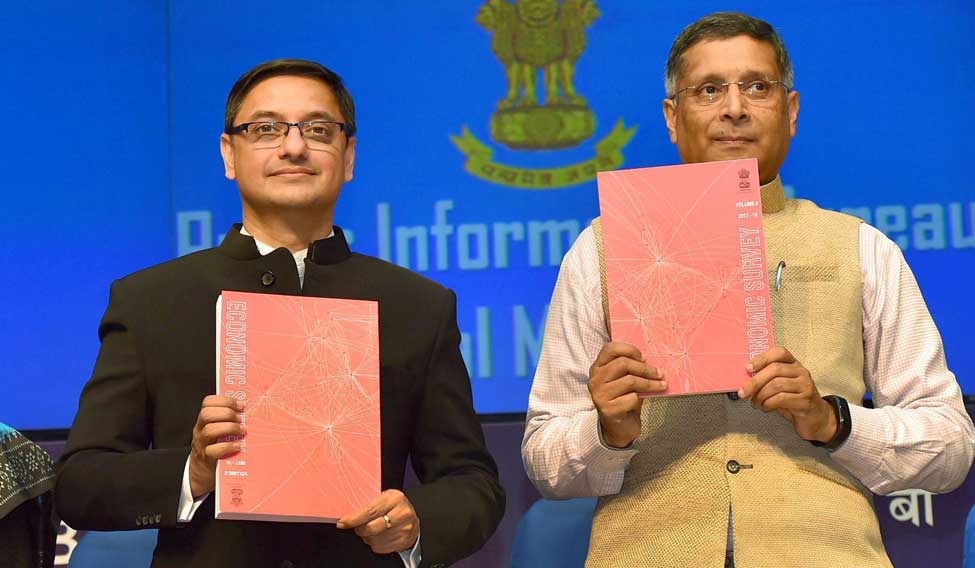
Pink is the colour of the cover of the twin-volume Economic Survey 2018-19. Showing it to media, Chief Economic Advisor, Arvind Subramanian said it was in support to women's empowerment “in our own small way”.
Among the many aspects of gender equality the Survey touches upon, the most unique one is what the Survey called as “son preference”, an issue that has been plaguing India for many decades now. The Survey mentions another phenomenon called “son meta-preference”, a word used to describe preference over preference, a phenomenon which involves parents adopting fertility “stopping rules” – having children until the desired number of sons are born. This aspect has been computed by studying the sex ratio of the last child – the number of girls per 1000 boys of the “last child” born – for example, fifth of 5 children, 7th of 7, 3rd of 3 and so on. And what did they find?
The Census of India had put the sex ratio at 933 in 2001. Things appeared to be improving when the Census in 2011 found that there were 943 females per 1000 males.
But in the Economic Survey's study of the 1000 “last borns” in 2005-06, only 394 were girls.
And in 2015-16, the number dropped to 390 girls!
India's sex ratio is getting more and more skewed as a family has more children.
Demographic Geographer Professor Swaranjit Mehta says, “Such a study is very interesting, throwing up more and serious dimensions of a problem we have known. The finding is very disturbing too. It reinforces the depth of son-preference. If a girl is a first born or second born she is lucky. If a female child is conceived as the last child, there is very little chance of their survival, going by this study,” she says.
Sex ratio is the number of girls born per thousand boys, something universally tilted in favour of the girl child at birth. But selective aboritions to get rid of the female foetus in son-preferring societies in many parts of India alter this ratio, such that there are fewer girls at birth.
The survey found that in 14 out of 17 aspects of gender equality – like women's right to take their decisions, their attitude and the outcome on a range of parameters, India's performance has improved. But there was no mention of women's security in public spaces – an issue that has rocked the country in the last few years.
In the period between 2005 to 2016, there was a 4.3 per cent improvement in women being able to articulate their preference to have at least one daughter, or as many daughters as sons. But they are less involved today than they were on the use of contraception. The percentage of women who are employed has come down from 36.3 per cent to 24 per cent during this period.
Other improvements include – a 12.2 per cent increase in women being involved in decisions about their health, 20.4 per cent rise in them having a greater say in large household purchases, and 14.1 per cent improvement in them being able to decide which relatives they will visit.
But women who are earning, have not progressed one bit in the last 12 years with regard to spending their own earnings.
The Survey highlights gender issues in the backdrop of government's gender-centric programmes including the “Beti Bachao, Beti Padhao”. The survey says gender equality is a multi-dimensional issue. But that is stating the obvious.