



In India, road-kill of animals is so neglected that there is hardly any statistics that could help in assessing the magnitude of the problem. Over the past few years, there has been a steady rise in the number of national and state highways passing through national parks and wildlife sanctuaries in the country, resulting in alarming rise in the number of incidents of wild animals, including small mammals, amphibians, and reptiles, being run over on forest routes.
Environmentalists in India have been relentlessly working towards spreading awareness and initiating practical solutions such as creating wildlife crossings to mitigate road kills in India. Also known as animal bridges, wildlife corridors or ecoducts, these structures allow animals to cross human-made barriers safely. In a broad sense, wildlife crossings could be anything from underpass tunnels to overpasses and bridges to amphibian tunnels to fish ladders to green roofs.
Though many plans are in place to identify animal trails across the country and develop wildlife crossings as part of road development projects, India is still a long way from materialising it. What started as an infrastructure solution to ensure safety of passage to wild animals by European countries such as the Netherlands, Germany, and France in 1950s, has now become increasingly common in Canada and the United States. Let's take a quick look at some of the most interesting and innovative wildlife crossings from around the world:
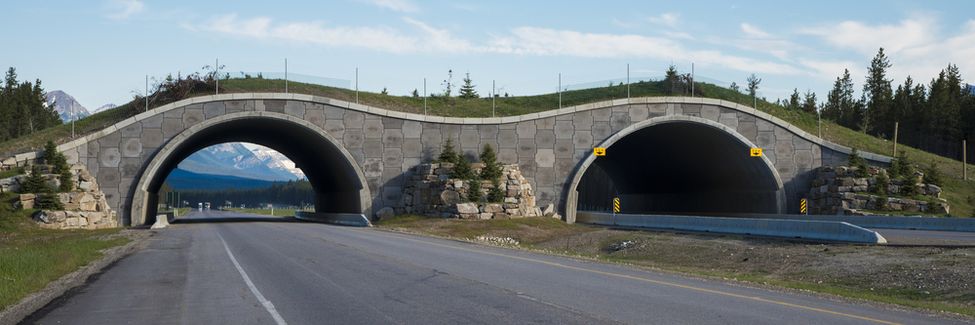
Wildlife crossings in Banff National Park, Canada
Canada’s Banff National Park boasts of the most numerous and varied wildlife crossing structures in the world. As of January 2014, the park had 38 wildlife underpasses and six overpasses on the 82-km stretch of the Trans-Canada Highway, which passes through the national park. These wildlife crossings connect vital animal habitats and provide safe passage for animals such as grizzly and black bears, wolves, deers, coyotes, cougars and moose, among others.
A crab bridge in Christmas Island National Park, Australia
Every year during October-November, the Australian external territory of Christmas Island witnesses a spectacular migration of adult red crabs to the sea to spawn. During this time, large areas of the island is covered by millions of bright red crabs, making most roads impassable. To counter the situation and ensure safe passage for crabs, wildlife rangers have erected several plastic barriers to direct the crustaceans away from the roads and into 31 crab underpasses that lead them to the sea. The island also has a five metre-high crab bridge across one of the busiest roads, which in itself has become something of a tourist attraction.
Elephant tunnel in Kenya
The 15-feet-high tunnel that sits in the rolling hills below Mount Kenya connects two wilderness areas in Kenya and allows two distinct elephant populations, from either side of the region's major highway, to mingle. Opened in December 2010, it is Africa's first elephant underpass. The $250,000 tunnel was built with donor funds and took ten years to complete. The underpass reconnected elephants from wilderness areas on Mount Kenya's highlands with those from the lower forests and plains.
Fish Ladder Park, Grand Rapids, Michigan, US
Built in 1974, the angular maze of concrete in Grand Rapids may seem to be a public installation for many onlookers, but it is also a ladder that helps fish travel upstream. Designed by artist Joseph Kinnebrew, the public art allows fish to travel upstream but jumping out and over the water in short bursts over the concrete steps that are set up to create a small waterfall. Many species of fish can be seen jumping their way up to their destinations during different times of the year.
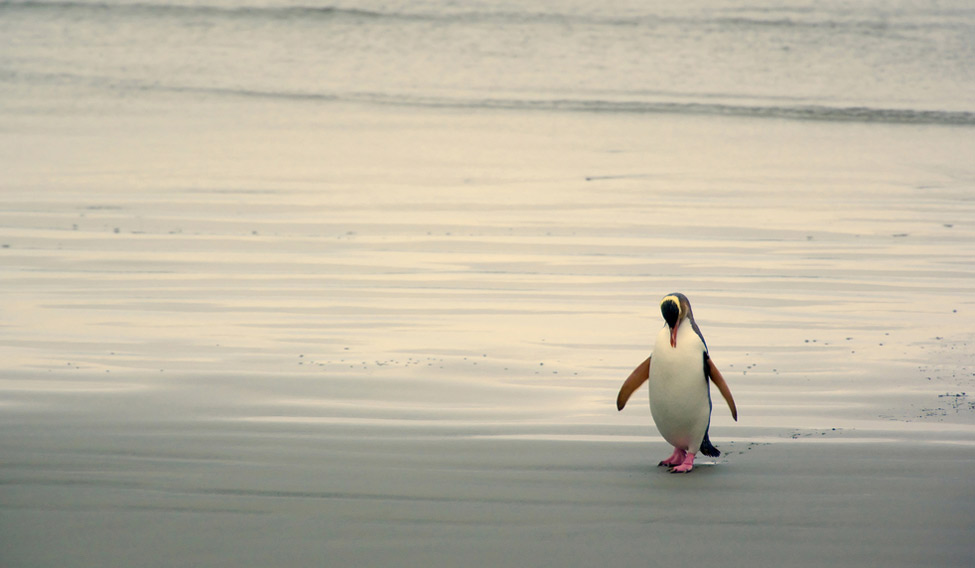
Blue Penguin underpass in New Zealand
In November last year, a small town in New Zealand, Oamaru, created the first penguin underpass in the country to help Little blue penguins, or Kororas, cross the busy road that lies between their nests and the sea. Without the tunnel, the world's smallest penguins were forced to cross the busy road to reach their nests every evening, protected only by a "penguin crossing" sign.
Turtle tracks in Kobe, Japan
In November last year, Japanese railroad companies installed an innovative track for turtles to cross train tracks without running the risk of either being overrun by trains or getting stuck between railroad switches. The ditches under the tracks close to the switch points allow turtles to cross the tracks safely as they head for the sea during summer months. The track was developed in a partnership between Suma Aqualife Park in Kobe and the West Japan Railway Company.
Rope ladders on Hume Highway in Victoria, Australia
Installed in 2007, rope ladders supported by three wooden 'glider' poles on the Hume Freeway in north-east Victoria has provided squirrel gliders in the region a safe way to cross the four-lane interstate freeway. The rope ladders bridge the gap between trees on either side of the highway, allowing free and safe movement of squirrel gliders and intermingling of two distinct populations of these marsupials. The glider poles in the centre median and roadsides replace missing trees and act as a stepping stone for squirrel gliders trying to cross the road. Studies have revealed that there has been a considerable increase in the size of 'Hume hybrid' population of squirrel gliders with parents from both sides of the road.