



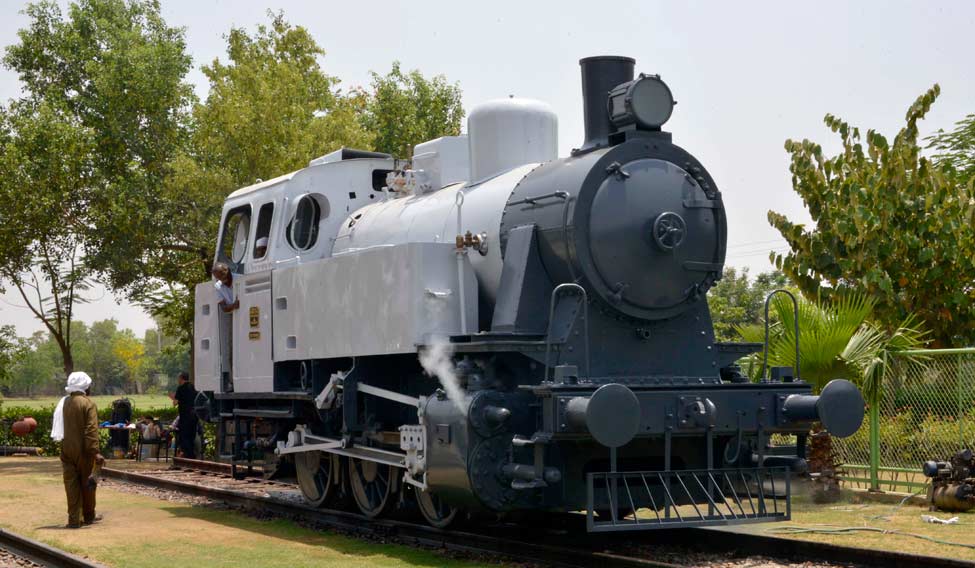
Amidst the colossal farms and industrial warehouses, stands a rare gem that tells a tale of India’s colourful transportation history. Heritage Transport Museum is built on a three-acre complex in Taorou, Gurgaon, and houses the rarest of the rare modes of transport. The museum recently added another marvel by unveiling the restored 1953 Jung Steam locomotive in its complex that was built by the Arnold Jung Lokomotivfabrik, a locomotive manufacturer established in 1885 in Germany.
Standing tall at 12.5 feet and 31 feet long, the engine operates on a 5 '6”-track gauge and carries 1,320 gallons of water. The museum acquired the steam engine locomotive from the Indian Railways after the latter located it at Rohtas Industries, where it was lying in a derelict condition for the past couple of decades.
Tarun Thakral, Founder and Managing Trustee, Heritage Transport Trust, says, “Nobody operates a steam engine in this country except for Rewadi locomotive shed. This is the only functional locomotive now which was acquired from the Indian Railways after being in touch with them for four to five years. They located two steam engines in Dehri-on-Sone in Bihar in a scrap condition. We laid the tracks for the operation and then got a team of engineers from Chennai headed by M.S. Rangaswamy, who came and helped us restore the Jung steam locomotive. The idea is to help people experience steam locomotives of the bygone times.”
Incidentally, the Jung steam locomotive has not undergone many changes and modifications and is fully authentic. “The steam valves were old and which could not be re-used. So, we replaced them with modern valves but they are again steam valves,” he says.
The restoration of the other steam locomotive, a 1921 Kerr Stuart, will begin this winter since its boiler is completely damaged and required thorough repair. With the completion of the restoration work of the Jung steam locomotive, the museum not only plans to run the engine on special occasions such as Republic Day, Independence Day and other festivals, but also on special requests.
“It is expensive to run the engine every day. But, if you want to have a function here tomorrow and you want to light up the engine during the celebrations, on a fee, we will light it up at any time,” he says.
Heritage Transport Museum is a sight for people from all walks of life, who are enthusiastic to learn about the history and evolution of the transport heritage in India. With over 2,500 curated objects on display, the museum is categorised into pre-mechanised and heavy mechanised transportation, two-wheelers and popular as well as tribal art section. It was born out of the passion of Thakral’s love for old modes of transport.
About the conceptualisation of the museum, Thakral says, “I was out of the country for a couple of years. When I came back in 1994, I fell in love with the old modes of transport. After 1994, I started collecting and suddenly the collection became so big that it was difficult for me to manage it. So, I requested Government of India to help me with some finances since I had both the land as well as the collection with me. Together with the government and donors, the museum was created.”