





It is unlikely that Jigar Shah will ever forget June 8, 2017. As he woke up at four on that Thursday morning in a friend’s vacant apartment in Surat, waves of memories swept his mind. Each wave heaved with images of his only son, Varshil, who would no longer be his son. One wave brought memories of him taking baby steps. Another carried the fragrance of flowers. “Our neighbours called him Galgota; it means bouquet of flowers,” Shah told me later.
Varshil had already woken up, so had his mother and sister. Affectionately, Shah patted his son, who had topped Gujarat state in Class 12 exam a few days before. Then he led the teenager, all of 17, to the chariot—a decorated horse-drawn cart—waiting outside the apartment. Their relatives and friends were forming a procession behind the chariot. It would be the boy’s last journey on wheels. The chariot would take him to a hall where he would renounce the world and take diksha as a Jain monk. It would be his last journey as the son of his parents.
THE NAME VARSHIL means ‘one who brings rain’. “It rained, after a long gap, on the day he was born in August 1999. That is why we named him Varshil,” said Shah, 49, who is an income tax officer.
The Shahs live in Ahmedabad, in a two-bedroom flat in Amrapali Society in Paldi, an affluent locality known for the National Institute of Design and Le Corbusier-designed Sanskar Kendra museum. “Eighty of 140 flats in Amrapali Society belong to Jains,” said Shah. “So we have a Jain temple on the ground floor.” In a big room next to the temple, children gather every evening to play games and learn the basics of Jainism through stories told by an elderly lady.
In another big room on the ground floor, Jain nuns are staying. “They live here, praying and meditating, till the monsoon ends,” said Shah. “They do not travel during monsoon.” Asceticism has seeped deep into the place where Varshil grew up.
For an upper middle class society, Amrapali betrays few signs of wannabe elitism. I saw children playing cricket in the open space, one ball hitting a window, another lofted drive falling on a car’s windshield. No one shouted at the boys, not even the watchman.
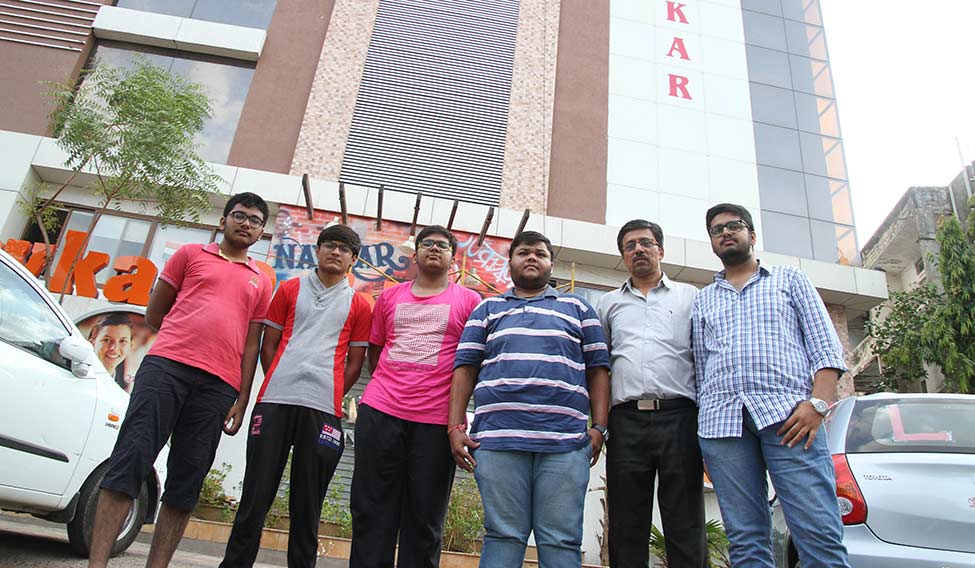 Five of the Magnificent Seven friends and teacher | Janak Patel
Almost all the flats had their doors open, displaying no fear of theft. Shah’s flat on the second floor had no television, refrigerator, washing machine, air conditioner, cooler, music system or tape recorder.
“Our monthly electricity bill is less than Rs 100,” Shah said. “We use the ceiling fan only in the room where my mother sleeps. She is old. All of us have our dinner before sunset so we don’t need electricity even in the kitchen, except for the mixer.”
Varshil’s mother, Amiben, 45, explained that a lot of living organisms are killed in the process of generating electricity. Earlier, when Shah had returned from office, he had promptly switched on the fan in the living room. “We don’t want to force our beliefs on you. Please feel comfortable,” he had told me. The room had just a wooden bed, a cupboard and a plastic chair for furniture.
When Varshil was a child, he ate whenever he wished. But when he was three years old, he told his mother that he would also not eat after sunset. One day Amiben forgot to give him dinner as she was busy attending to her father-in-law, who was unwell. At night, she remembered the lapse and cooked food for Varshil. “But he said he would not eat as the sun had set,” Amiben recalled.
Amiben said Varshil observed austerities of chaturmaas—four rainy months of July-October—right from the first standard. “Six years ago he began sleeping on a thin woollen mattress and having only one meal a day,” she said. The family goes to bed at 8.30pm and wakes up at 4.30am.
Varshil grew up on a steady diet of stories, most of which ended with the main character taking diksha (initiation into sanyas). “One day, after I had finished telling him a story, he asked me why I had not taken diksha,” recalled Amiben.
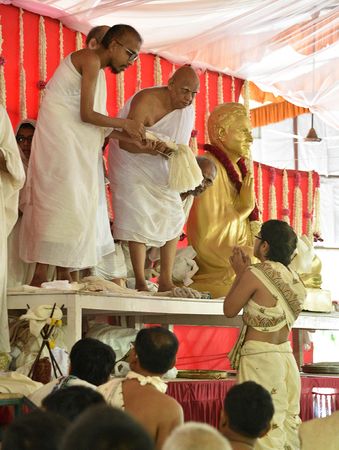 Prince who chose to be pauper: Varshil at his first diksha on June 8.
Shah spoke of two advanced calculators that Varshil lost in school. Someone had stolen them. Perplexed, Varshil asked his father why someone would think of taking away something that did not belong to him. Recalled Shah: “He did not use the word stealing as he felt it was wrong to accuse someone. He simply could not understand why. He never even looks at things belonging to others, as it is prohibited in our religion, since it may give birth to a desire for acquiring that thing.”
Shah bought a Maruti Zen when Varshil was nine, and the family went to watch a film at an open-air theatre. When they reached the venue Varshil told them that he was not interested in the film. “So we bought three tickets while Varshil sat praying in the park,” Shah said. Varshil’s friend and neighbour Neel Parekh said they had watched a few films together, such as Captain America, Dear Zindagi and Piku.
Varshil topped his school in the tenth class. “He concentrated hard on his studies, and had great respect for his teachers,” said his sister, Jaini. “He would say you may work hard but if you do not have blessings of your teacher, it is of no use. He genuinely believed it. He was very fond of mathematics, accountancy and Sanskrit.”
Jaini herself scored 99.99 per cent in her 12th class (HSC) and topped the state in commerce in 2011. She was delighted that Varshil scored exactly same marks and topped the state. Narendra Modi, who was chief minister, had felicitated her. “My daughter wore a sari for that function and Modi-ji appreciated it very much and praised her. She has never worn jeans,” said Shah. Bespectacled, she was in a simple Punjabi dress when I met her.
Jaini is studying Jain scriptures herself. She turned to religion and Sanskrit after she could not clear the final CA exam in the first attempt. “If passing CA exam was my destiny, it would have happened in the very first attempt. It did not happen, it is fine with me, I will continue to study religion and Sanskrit,” she said.
Varshil attended Sharda Mandir School, an English medium school in Ahmedabad. But he went to a Sanskrit scholar to learn the language. “All our scriptures are in Sanskrit and Prakrit,” said Shah. “His mother and sister know Sanskrit very well. So they also guided him.”
Varshil is the first in the Shah family to take diksha. His cousin, son of his maternal uncle, took diksha two years ago, soon after Varshil had written his 10th class (SSC) exams. “He went to Surat immediately after the exams and stayed at the Upashraya with his guru and cousin who was about to take diksha,” said Amiben. [Upashraya is a place where Jain monks and nuns live, in separate apartments.] “He was unwilling to return, but we persuaded him. After his 12th class exam, too, we forced him to stay with us for a month. Then he went to Surat, on April 21. When his results were out we wanted to celebrate but he did not come.”
Navkar Public School in Ahmedabad is a reputable institution. A former coaching centre for CA, ICWA and company secretary exams, it became a school two years ago. Varshil was in the first batch.
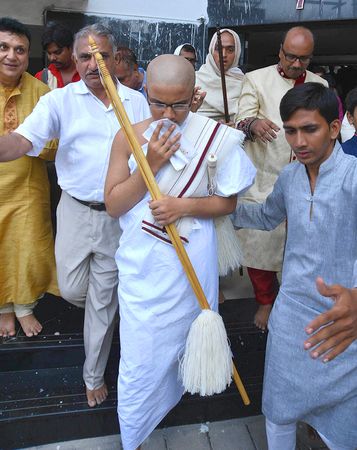 99.99 per cent monk: Varshil Shah at his first diksha in Surat on June 8, after his hair was plucked.
The principal Vrajesh Parikh, a PhD in chemistry, spoke of a group of magnificent seven students of C-1 division. The brightest of them was Kamlesh Gupta, who often scored a mark or two more than Varshil. “Still they were best friends. I have never seen Varshil being upset because Kamlesh scored a mark more,” said Parikh. “There was not an ounce of jealousy among these boys. Varshil stood out because I have never seen him fight or argue with anyone.”
On the day the results of Gujarat HSC board exams were declared, Parikh was informed that Varshil had topped the state in the commerce stream and scored 99.99 per cent. “We kept everything ready for the newspapers; his photographs and marks scored in each subject. Not only had he topped in commerce, but he had also topped in Gujarati language paper,” said the principal. “But Varshil did not come to collect his mark sheet or the school award. He was already in Surat with his guru. A few days later, his parents collected the mark sheet and the award.”
The class teacher Apurva Agarwal said it was Varshil who wrote ‘Thought for the Day’ on the blackboard every day. Said Agarwal: “Whenever he met teachers he would say ‘Namaste’ with folded hands. He said ‘Good Morning, Sir’, at start of the day, with a certain decorum and dignity. Despite being intelligent, he kept a low profile. He never desired any special attention.”
Agarwal said Varshil came second or third in class; Kamlesh was the topper. “Kamlesh, even if he missed one mark, would be upset. Varshil was content with his rank,” said Agarwal. “He was exceptionally good in computers, and never held back anything while solving doubts of others. I am not exaggerating: Varshil gave the highest respect to all members of the faculty. We were never ‘Sir’ to him, we were his ‘guru’ . When I heard his speech before he took diksha, I was moved to tears. I will bow before him when I meet him.”
In that speech, Varshil said: “When I met my Guru Maharaj I experienced the real happiness…. I wanted to taste the real life, real happiness and I became firm that I will take diksha…. The happiness I am enjoying now, I cannot express in words. You have to experience it yourself.
When Varshil said he wanted to renounce the world and take diksha, his father was shocked. Shah had seen it coming but never thought it would be so early. “Whenever I saw anyone taking diksha, I would see in my mind my children taking diksha. Still, when he told me about his decision, I was shocked,” said the father. “I tried hard to dissuade him, told him to take diksha after he had completed his education. But he had made up his mind.”
He reminded Varshil of an expensive bike that he had promised to buy him; Varshil used to ride his father’s bike occasionally. Instead of riding the promised fancy bike, the boy chose to walk an austere path.
Varshil’s friends, too, tried to persuade him not to take diksha so early in life. Kamlesh was confident that he would prevail. So, on June 6, the six friends went to Surat to meet him.
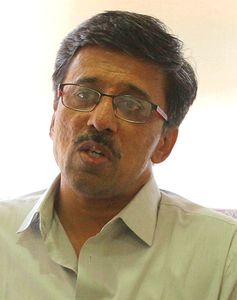 Class teacher Apurva Agarwal
Kamlesh had met Varshil in Navkar school two years ago and they became best friends. “It did not make any difference to him that I came from Hindi medium,” said Kamlesh.
On their first day in school everyone had to say what they wanted to become. As Varshil’s turn came, he said wanted to be a PhD in Sanskrit. “I was stunned,” said Kamlesh. “Everyone comes here wanting to be a CA, CS or ICWA, and this boy talks about PhD in Sanskrit! He made it clear in those two sentences that his pursuit was different from ours.”
Neel Parekh, the friend and neighbour, recalled that after returning from school Varshil would go to the derasar (Jain temple) to learn scriptures from his guru. “Every day he spent more than two hours at the derasar in the evening. He has been doing so for the past five years,” Neel said.
Varshil carried a chessboard to school for playing during recess. “He liked to learn new things. He learnt to ride a bike, a Splendor, very quickly. Recently he was learning how to drive his father’s car,” said Darshan Panchal, a classmate of his. Panchal recalled that Varshil did revision of the entire computer lessons in two days flat for the class, before the board examination.
Kamlesh said he had sensed more than a year ago that Varshil was on his way to take diksha. “He was getting too deeply involved with religious learning. He would go to meet his guru in Surat whenever we had vacation or even a small holiday for a couple of days.”
Neel said Varshil had gone to Surat after writing his HSC exams. Some time later, his mother and sister went to the Upashraya where he was staying with his guru. “It was then that he told his mother that he had made up his mind and did not want to come back,” said Neel.
All of Varshil’s friends are believers but none of them performs daily puja or any other ritual. Kamlesh said he did not believe in following anything rigidly. “For me, my parents are my bhagwan [God],” he said.
So when they came to know about Varshil’s diksha, the friends went to Varshil’s parents. Kamlesh told them they wanted to meet Varshil and ask him to opt out. Without comment, Varshil’s father took them to Surat.
Said Kamlesh: “When we met Varshil in Surat all of us started crying. I told him to come back, complete his studies, achieve something and then take diksha if he still wished so. He said, ‘Kamlesh, you have stood second in the state but are you really happy and satisfied?’ I told him ‘No’ and how I wished I had scored full marks in accountancy. He asked, ‘Would you have been happy and satisfied if you had scored full marks in accountancy?’ He said even if I had been the state topper instead of him, I would have still felt unhappiness somewhere, so how will I lead a peaceful life? ‘Human mind is not stable, it keeps demanding more and more, so what will help you lead a peaceful existence?’ he asked.”
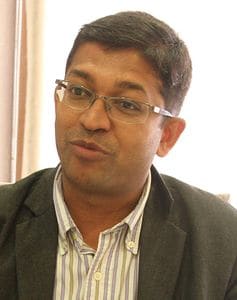 School principal Vrajesh Parikh | Janak Patel
The friends told him that he had a duty to his parents who were growing old. Varshil replied that life after marriage involved ever growing demands, arguments within the family, between wives and in-laws, and sons and parents. “He told us to look around in society. He said, ‘Don’t you see elderly parents being moved to old age homes? Can you say with certainty that you will be able to fulfil your duty to your elderly parents? If my parents are feeling sad now, they will feel even bad if I fail to fulfil my duty towards them. This sadness is better than the bitterness that may come in the future.’”
One of the friends, Dharmik Meheta, then suggested that none of them should get married so that they could fulfil their duty to their parents. “Varshil merely smiled,” said Dharmik. “He told us to meet him 20 years later and tell him whether we could fulfil our duties to our parents and whether we were happy in the material world.”
Varshil Shah belongs to the Derawasi Shwetambar Jain sect. A person who aspires to take diksha is called mumukshu, one who seeks moksha (salvation). There is constant interaction between the seeker and the guru, who keeps assessing whether the seeker is really ready for the path ahead. When the guru feels that the seeker is ready, then he chooses an auspicious muhurat for the seeker to urge the guru for diksha. The seeker has to make this request after careful thought. The guru may accept or reject it.
This is the first diksha ceremony. Three or four weeks later, after further assessing the seeker, the guru orders another diksha ceremony. This is known as vadi diksha (the bigger or final diksha).
Varshil’s first diksha was on June 8. Before leaving for that ceremony he had performed rituals such as vayna in which he was given sweets to eat. In the ritual vidai he expressed his gratitude to elders; he washed their feet with milk and showered akshata (unbroken rice) on his parents. In turn, his parents showered unbroken rice on him.
“The person taking diksha is dressed like a prince, in finest clothes and ornaments. He gives it all away to his mother, and throws away money, indicating that it holds no meaning for him anymore,” said Shah.
In the diksha hall, Varshil performed a puja for Mahavira, the last of 24 Jain teerthankaras, with flowers and ornaments. He then performed a puja for his guru, Kalyan Ratna Vijayji Maharaj, with sandalwood powder. After doing pradakshina (circumambulation) three times, with a coconut in hand, he gave up his fine clothes and ornaments.
Varshil was then given an ogho (a wool broom) to clear his path, so as not to harm to any living thing. Then, the seeker is taken for his final bath, the antim snan. Henceforth, there would be no more bath for Varshil. He may just sponge his body if it accumulates too much dirt.
Varshil will no longer use any footwear and wear only one piece of white cloth. After the final bath, his hair was plucked and given to his mother.
Varshil’s vadi diksha was at Western Somchintamani Society in Surat on July 3. Three others had the big diksha on that day. All of them were under 18, the youngest being 9-year-old Jinang from Deesa, near Palanpur, in Gujarat. Jinang’s father, jeweller Maheshbhai Shah, looked very happy. I asked him how his son could take diksha at the tender age of nine. Maheshbhai said it was a family decision and there was no coercion. I was sceptical, but he reminded me that Adi Shankara renounced the world at the age of nine.
The air vibrated with Gujarati devotional songs. Sanyam maaro shwas, sanyam Prabhuno ehsas (Restraint is my breath, Restraint is the feel of God), so went one of the songs.
All these devotional songs had the tunes of old Hindi film songs. One song described the respect that a Jain monk commanded. Its tune was that of the old Hindi film song Aaj purani raho se, koi mujhe awaaz na de. An apt choice.
Then appeared a young woman, Armikumari, 22, to take her first diksha. She had completed her education and then decided to renounce the world. Her parents, Dilipbhai and Mallikaben, took vows of celibacy, along with her—perhaps they will also take diksha soon.
Along with the diksha ceremony, they conduct chadhao, an auction of things that a Jain monk or nun is allowed to carry. For instance, the Pothi (the book of knowledge) that was to be given to Armikumari fetched 172,000 in the auction. The rosary, called navkar mantra mala, fetched Rs 81,000. The money thus collected goes to Jain charities or is used for construction of Jain temples.
Varshil’s father, who had obtained permission for my presence at the diksha, told me that the minimum amount to be collected at Varshil’s chadhao ceremony was Rs 2 lakh. “Varshil did rigorous meditation in the 24 days between his two dikshas. Today he gets his guru’s permission to study the wealth of knowledge in Jain scriptures,” he said.
I had requested Shah to help me meet Varshil’s guru, Kalyan Ratna Vijayji Maharaj. He said, “I could get you this far. Now it is entirely up to Maharaj Saheb whether to meet you or not.”
After waiting for three hours, I got a message that the guru was meeting devotees and I could sit among them in front of him.
A much respected figure in the Jain community across India, Kalyan Ratna Vijayji Maharaj is in his mid 30s. He took diksha at age 18. Though soft-spoken in private conversations, he is a great orator who explains the scriptures in simple yet powerful words.
“Diksha is the beginning of a cleansing of the soul,” he told the devotees. “If your body is damaged but the soul is clean and pure, you will be happy. But if your soul is damaged, you will not be happy in any circumstances, however fit you may be physically. Diksha also means sarva sanga parityaga (renunciation of everything material). Tyaga is only temporary, whereas sarva sanga parityaga is forever.”
He told me that diksha ceremonies were organised only twice or thrice in a year. Then he turned to the topic of my interest, Varshil Shah.
Varshil had been in touch with him for more than two years. They met regularly and Varshil often posed questions and expressed deep interest in the way of life of Jain monks.
“He was not happy with his success. He always told me that he missed contentment. ‘I am restless,’ he would tell me every time he came to meet me. Given his academic background and intelligence, I felt that he was not an ordinary boy. To me, Varshil came across as a Truth Seeker, a satya shodhak,” said the guru. “His intelligence and inner strength will be of great help in following true religious path and both are needed for life after diksha.”
He said that the aftertaste of worldly experiences was like a green chilli; the teachings of Jainism were like jaggery. “You can experience both and decide for yourself. What I can tell you for sure is that our jaggery has no side effects.”
Jain monks live a hard life. They walk barefoot, wear only white cotton cloth, and eat just one meal a day. A monk visits one house in a day, seeks food and accepts it in his cupped palms. The food thus collected is handed over to the guru. He mixes all the food brought by his disciples and distributes it.
The monks are not allowed to take bath—this is to safeguard the life forms in the water. At the most they can sponge themselves using boiled water.
During chaturmas, which coincides with the monsoon, they live in Upashrayas. After chaturmas, they set out for vihar, travelling to places chosen for them by the senior-most monks. During vihar, they cannot spend more than one day in any village on the way. Bodily excretions are managed in open spaces in villages, but Upashrayas in towns have toilets. “The life is very tough. It is like chewing iron nuts with teeth of wax,” said a person who attended Varshil’s diksha.
My eyes were searching for Varshil all the while. He was nowhere to be seen in the Upashraya hall where I sat. After my interaction with his guru, I was told that he was reading scriptures in one of the rooms. I wanted to hear from him why he took diksha.
I could not meet him, but a good soul, a layman, agreed to be a go-between. I sent him WhatsApp and text messages, which he read out to Varshil and then sent back the boy’s replies. Did Varshil miss his family and friends? I asked. “All the world is my friend and relative now,” came the reply, promptly. “I wish to spend my life under the guidance of my Guru and without harming any small or big living being. There is a lot to be learnt on my path and it is difficult to explain all the things that we study. What I can say is that I do not wish to waste time, as life is short and I have to gain a lot of knowledge.”
By then Shah and his family were getting ready to return to Ahmedabad. Ever since Varshil took diksha, his father, mother and sister were eating only one meal a day, like him.
Shah had told me that his children had persuaded him not to accept a promotion, saying work in the income tax department involved temptations and sins. “One can never know when one falls prey to the lure of the material world,” Varshil had told him four years ago. Shah went by his son’s advice.
July 3 was the last day Shah could call his son by name. Now, in his text messages to me, he refers to Varshil as Suvirya Ratna Vijayji Maharaj Saheb, his new name. “It is like Varshil has had a new birth,” Amiben had said a few days after his first diksha.
I could see that all of them missed Varshil, even though his mother said she was happy he had made the right decision. The father admitted that he missed the son. “Every day when I returned home after office, I would call him and say, ‘Beta Varshu, paani’ (Get me water, dear son),” he said. His eyes were moist, as he kept staring at the photograph of his son, now Suvirya Ratna Vijayji Maharaj.