



The two ruled the silver screen in their own states. The two were at the peak of their career when they became chief ministers of their respective states. Marudur Gopalan Ramachandran and Nandamuri Taraka Rama Rao became chief ministers of Tamil Nadu and Andhra Pradesh respectively riding on their popularity wave; their political personae were mere extensions of their cinematic selves. And years later, after their demise, both their families could not reap what they sowed in cinema and politics. In Tamil Nadu, MGR’s political legacy was carried on by Jayalalithaa, who was his co-star and who acted in 140 films from 1961 to 1980. There wasn’t any need for her to convert her fan following into loyal party workers, rather there was a well-built organisation structure in the All-India Anna Dravida Munnetra Kazhagam when she took over.
And now, three decades after MGR and NTR succeeded in their respective states, Tamil Nadu is all set to witness yet another set of superstars with political ambitions. Of course, cinema and politics have always been bedfellows in the state. The two Tamil matinee idols, superstar Rajinikanth and Ulaganayagan Kamal Haasan, are using their three decades of experience in the film industry as a stepping stone into the world of politics. While the former has been dropping hints for years about his imminent entry into politics, the latter has already set the deadline. Yes, Haasan will enter politics in just 100 days from now, as he announced in a television interview on September 21.
In a state like Tamil Nadu where politicians identify with Tamil pride and rationalism, Haasan seems to be on the right path. His views on wearing black, saying, “Black has all colours in it,” and his insistence on being anti-saffron has already impressed many. His series of tweets and the fresh salvos against a non-existent, non-performing Tamil Nadu government, and against the growing Hindu activism in the country has got him into the limelight. While his tweets were the trigger for his fans, his statements began setting the stage for his political entry.
A month ago, addressing Dravida Munnetra Kazhagam supporters during the Murasoli platinum jubilee, he hinted that if he loses the present opportunity to get into politics, he would be a fool. “When I asked whether my friend Rajini would come to the event, they (the organisers) replied in the affirmative but noted that he would remain a spectator; I said I, too, wanted to be a spectator without taking the dais. Then I stood before a mirror and saw my image. I thought to myself, ‘hey fool! What an important function this is! What an opportunity you are going to fritter away’.”
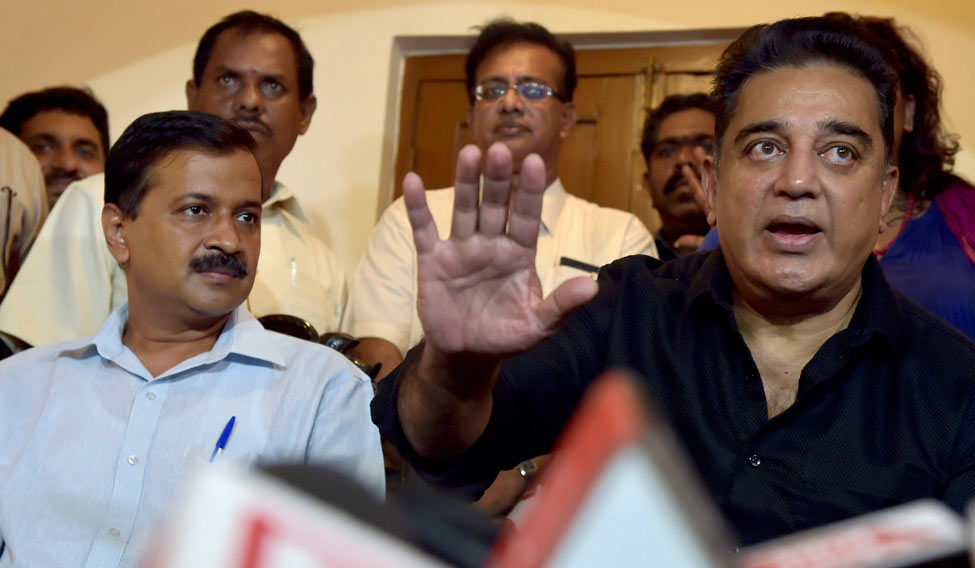
And, once again, after calling on Kerala Chief Minister Pinarayi Vijayan, he called it a “learning curve”. The next—the luncheon with Delhi Chief Minister Arvind Kejriwal—was an open statement. “The reason why we got together is the purpose—it is singular. He has a great national reputation of fighting against corruption and communalism. I, too, have a similar reputation and it is no wonder that we decided to have a dialogue on the existing situation,” he said. Later in the day as Haasan spoke at length to a television channel, he said he will launch his own party, with the aim to lead the state. He did not rule out alliances with other parties in future, but said he will go it alone for now.
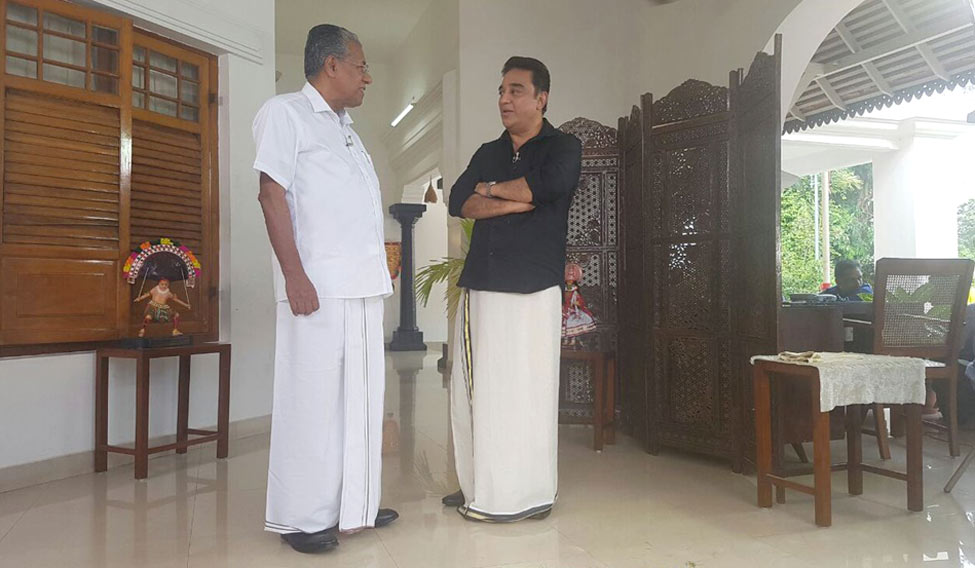 Haasan with Kerala Chief Minister Pinarayi Vijayan | Twitter
A vocal Haasan has definitely stolen a march over Rajinikanth. But, for Haasan, the political path might not be easy like MGR’s or Jayalalithaa’s. Wearing a black shirt or talking Periyarism in the age of social media might not work for him in the long run. The rhetoric—anti-corruption and anti-communalism—might not hold water for long, like how it worked for MGR. In fact, MGR started his political stint by identifying himself with Periyar and former chief minister C.N. Annadurai when they spoke on social justice, anti-Hindi movement, rationalism and Tamil pride. But the voters have gone beyond this rhetoric now.
In fact, when MGR broke away from the DMK, it was easy for him to convert his fan clubs into party wings as he had already knew from experience the organisational heft a political party requires. More than the fan clubs, senior leaders and party cadres who were upset or disappointed with DMK leader M. Karunanidhi, backed MGR and walked out with him. The task wasn’t much challenging for Jayalalithaa, too, as she toed MGR's line. In fact, she got the rhetoric right—to oppose the DMK, as the AIADMK’s basic ideology was anti-Karunanidhi and anti-DMK. But MGR’s wife Janaki supported Karunanidhi in her public speeches, which, ultimately, led to her departure from the party.
Apparently, in the Dravidian land where Tamil pride and rationalism have always determined the leader, Haasan’s challenges are greater than the two. He might emulate Mahatma Gandhi in opposing corruption, and Periyar in opposing communalism, but his lack of connect with people at the grassroots will hurt him. His following on Twitter would not help him here.
Politics is, essentially, a combination of strategies and publicity stunts. MGR was regarded as the leader of the masses; he never played a thug or a villain in any of his films. He was the saviour of women. He was never seen smoking or drinking or stalking girls in his films. He was always the saviour of mankind. His films always—subtly—projected his party ideology. The villain in his films was clearly defined as the Brahmin from the north. Violence was never MGR’s USP, but, in his films, he used it to tame the wrongdoers. The same cannot be said about both Haasan and Rajinikanth.
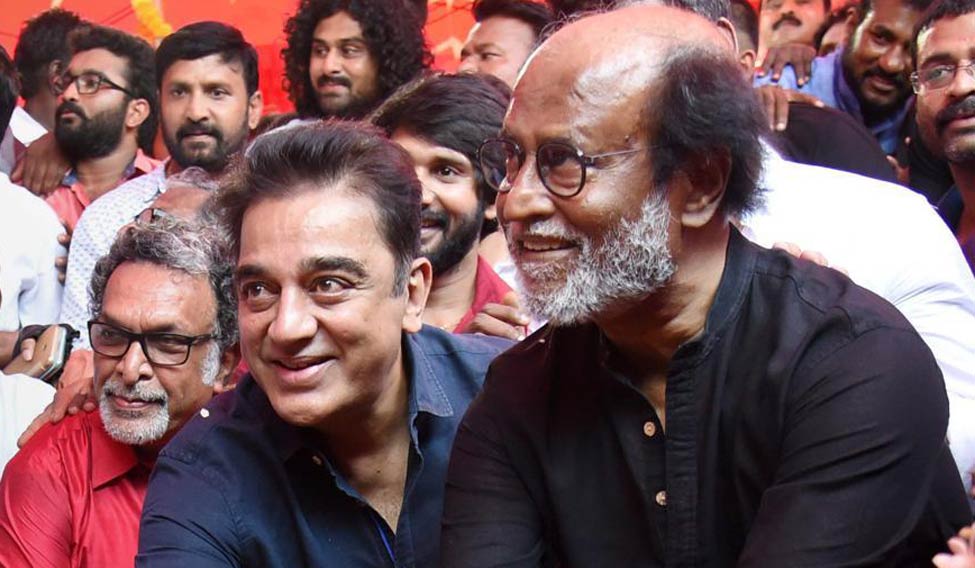 Haasan with Rajinikanth
The AIADMK might be split now, but tapping into the party's votes will not be a cakewalk for even Haasan. Also, neither Haasan nor Rajinikanth are known to tolerate criticism. For instance, Haasan’s emotional outburst when his Viswaroopam was in trouble, saying that he will leave the country, does not bode well for his political future. And he is no Karunanidhi, who had always been inclusive, building a pedestal for himself with all the brickbats critics aimed at him. He can’t be a Jayalalithaa, as she was a woman known as much for her arrogance as for her quick decision-making skills.
For all Haasan’s talk about fighting corruption, the moot question is whether he can actually eradicate corruption as promised. Also, being an alternative to the two Dravidian powers—the DMK and the AIADMK—isn't easy, as actor Vijayakanth found out. He launched Desiya Murpokku Dravida Kazhagam in 2005 and projected himself as an alternative to Karunanidhi and Jayalalithaa. But he failed miserably, struggling to win elections on his own.
Apparently, like Vijayakanth, his counterpart in Andhra Pradesh, Chiranjeevi, too, could not conquer the political space in his state despite a huge fan following and the sizeable crowds he attracted during public meetings. In nearby Karnataka, too, matinee idol Rajkumar could not find his feet in politics.
The reason, probably, was that progressive thinking had entered the psyche of the state during the days of Rajkumar itself, in the form of novels of R.K. Narayan and U.R. Ananthamurthy, and plays by B.V. Karanth and Girish Karnad. Likewise, over the years, Tamil Nadu, too, has been witnessing modern beliefs replacing traditional thought bit by bit. Moreover, the days of a one-man show, as seen during the times of Annadurai or MGR, are on the wane. So, it would take more than star power and rhetoric to not only enter the political space in Tamil Nadu, but to remain there in years to come.