



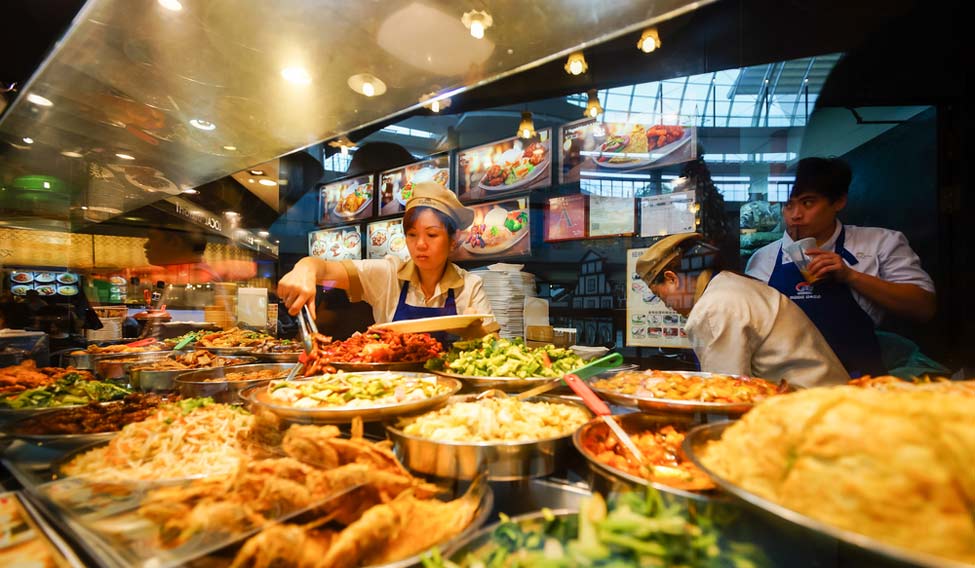
If you are a foodie, then the delights of the Lion City go past the regular tourist attractions, into the heart of Singapore's food scene which thrives on a hybrid cuisine unique to the island. Anywhere you go, what mostly finds its way into your plate would be flavours from Malaysia, China, Indonesia, India and beyond. That means you get to explore the food from almost all parts of Southeast Asia in one place. But how do you choose what to try and what not during a short visit to the island? Only a true foodie can understand the dilemma of having to pick and choose from the sea of unexplored food and flavours. Having been there and gone through that, here's a comprehensive list of five dishes you must have in Singapore and why:
 Hainanese chicken rice
Hainanese chicken rice
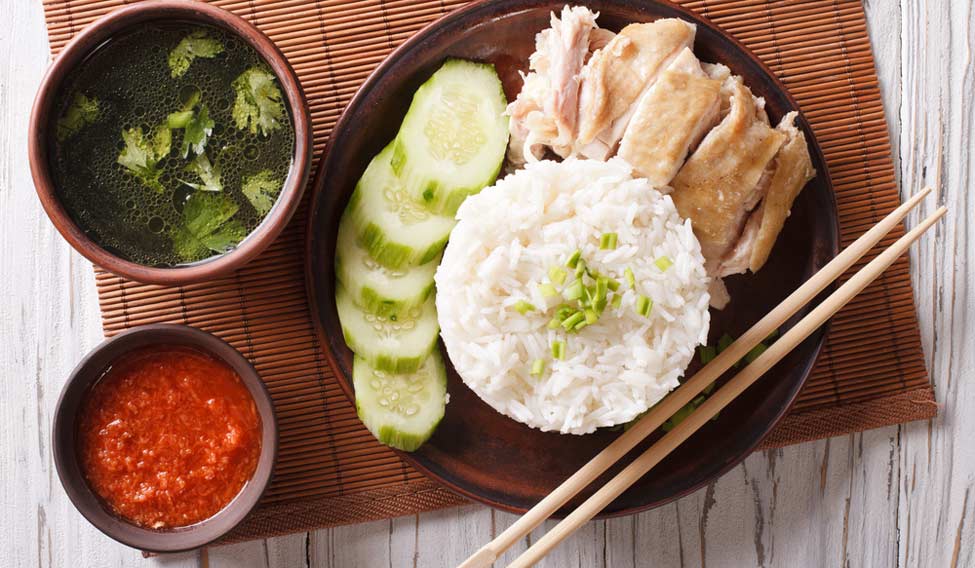
Considered to be one of the national dishes of Singapore, Hainanese chicken rice is a comfort food for the locals, almost a staple for lunch. It is a plate of poached chicken served with white rice cooked in chicken fat, with clear chicken soup, chilli garlic dip and soy sauce. A bite of the tender, juicy chicken that melts in your mouth with a spoonful of fragrant, well-flavoured long-grained non-glutinous rice with mild ginger sauce and a zesty chilli sauce is enough to keep you going back for more.
Brought to Singapore by early Chinese immigrants, the chicken rice has its origins in Hainan, a small island off southern China. Originally, the dish was made with Wenchang chicken—a smaller and bonier variety of chicken raised in the tropical environment of Wenchang in Hainan. However, as the recipe travelled far and wide in Southeast Asia, Wenchang chicken was replaced with more popular white cut chicken.
Though the dish is available in almost every nook and cranny of Singapore, Tian Tian Chicken Rice at Maxwell Food Centre holds the reputation of being the most popular destination for a delicious serving of Hainanese chicken rice. The place owes its popularity to its local customers and international chefs and famous television personalities, Gordon Ramsay and Anthony Bourdain, who on multiple occasions have rested their faith on Tian Tian Chicken Rice to be the best.
 Chilli crab
Chilli crab
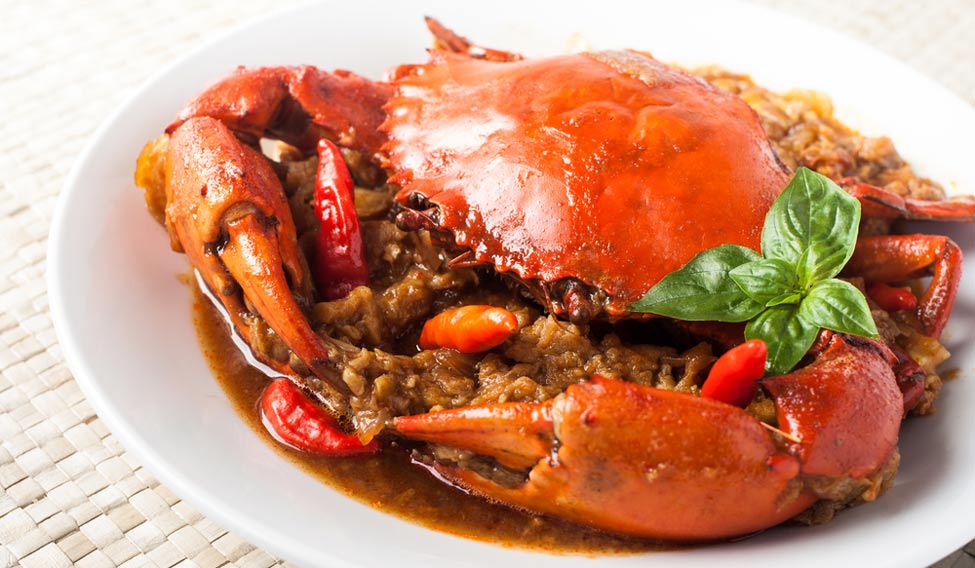
Imagine a huge hard-shell crab, partially cracked and stir-fried in a spicy paste, its succulent flesh coated in a thick, sweet and slightly spicy chilli sauce—a treat to senses made of chilli paste, tomato paste and beaten eggs, among other spices. The crab meat is cooked to such perfection that it melts in your mouth, leaving behind a zesty aftertaste. If you like your food sweet and spicy and do not mind messy fingers covered in the luscious sauce as you crack open the crab shells, then this dish is for you. For a foodie in Singapore, nothing comes close to the experience of relishing a portion of chilli crab. Adding to the texture and flavours, the dish is usually served with fried or steamed buns, called mantou, to soak up the sauce. The classic chilli crab typically uses mud crabs that have naturally slightly sweet and juicy flesh.
It is widely believed that the chilli crab's journey to global stardom began in the 1950s from a pushcart run by a couple. In an attempt to offer something different than steamed crabs to the customers, Madam Cher Yam Tian developed the recipe from the scratch when she first stir-fried crabs in tomato sauce, before turning to chilli sauce to add more stronger flavours to the dish. The recipe was such a hit that it enabled the couple to open their own restaurant called Palm Beach. The dish got its present form, texture and flavours under the watchful eyes of chef Hooi Kok Wah, one of the four "heavenly kings" of Chinese cuisine in the 1960s. He improvised the recipe by using sambal, tomato paste and eggs to cook the gravy instead of bottled chilli and tomato sauces. Since then, it has become the most commonly accepted recipe for chilli crab.
Though it has been over five decades since Palm Beach Seafood was opened along Upper East Coast Road. Now located at One Fullerton, it remains to be the most sought after destination for a classic chilli crab. For a more tomato and egg-rich gravy, head to Jumbo Seafood, for sweeter gravy try chilli crab at Red House Seafood.
 Pandan chiffon cake
Pandan chiffon cake
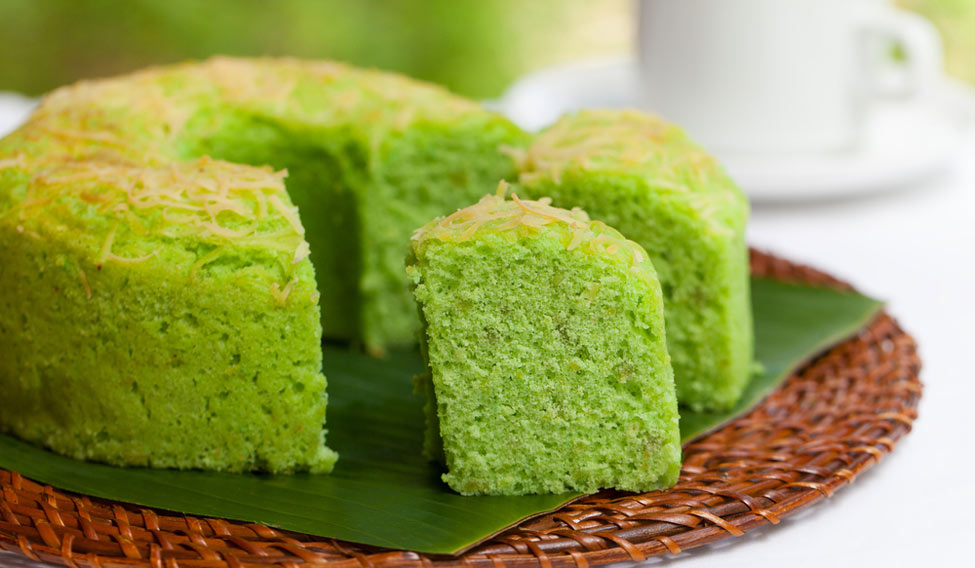
Recently voted Singapore's (and Malaysia's) national cake by CNN, the soft-as-clouds pandan chiffon cake is a rich, yet super light cake that can be had at any time of the day, as a dessert or a snack. The cotton soft cake gets it signature green colour from the juice of pandan leaves, also known as screwpine leaves. Known as kewra in India, pandan is a tropical plant with long, palm-like leaves that lend a unique floral fragrance and vanilla-like flavour to food. Pandan leaves are used extensively in South and Southeast Asian cooking. The cake also has generous portions of egg and coconut milk, making it creamy and rich.
The history of pandan chiffon cake remains to be vague. Broadly believed to be an import from Indonesia, the baking method and recipe hint at American culinary influence on this part of the world. Apparently, the chiffon cake was invented by a California caterer, Harry Baker, in the late 1920s. After he kept the recipe a secret for over 20 years, he sold it to General Mills which spread it to the world in the 1940s and 1950s. Most likely the recipe made its way into Southeast Asia on the boxes of imported cake flour, inspiring some home cooks to improvise by adding locally popular flavouring agent, juice of pandan leaves, to it. The result, pandan chiffon cake, which remains popular even today.
Though the cake can be found in almost all bakeries in Singapore, the most popular destination for a pandan chiffon cake is cake and pastry franchise Bengawan Solo, counters of which can be found at Changi airport as well. The cake can also be carried home (on an aeroplane) in its safe cake box and can be refrigerated and savoured over days.
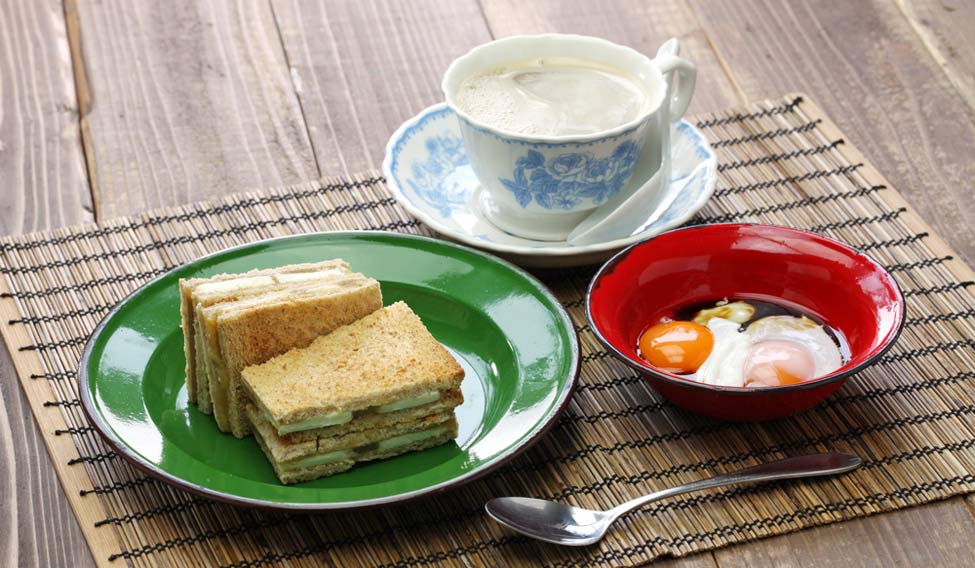 Kaya jam toast with soft-boiled eggs dashed with soy sauce and a cup of white coffee
Kaya
Kaya is Southeast Asia's answer to peanut-butter lovers all over the world. In Malay, 'kaya' means rich, and that is exactly what the creamy, sweet coconut jam is. Kaya is a confiture made of eggs, coconut milk, palm sugar and honey, infused with the unique flavour and aroma of pandan leaves. Popular variety includes kaya with a higher proportion of pandan leaves, which can be easily recognised by the yellow-green hue of the otherwise caramel-coloured jam. Traditionally spread on crust-free charcoal-toasted bread, kaya toast is a breakfast staple at kopitiams, or coffee shops across Singapore, Indonesia, Malaysia, and Brunei.
The kaya toast is usually served with soft-boiled eggs, with runny yolk and soft white, with a dash of dark soy sauce and a pinch of powdered white pepper. The right way to eat kaya toast is by dunking the toast into eggs before biting into it. This softens the crunch and peppered eggs balance out the sweetness of kaya. While you relish the kaya toast, do not forget to ask for a cup of traditional kopi, or coffee to pair your toast with. Standard kopi is a smooth, thick, syrupy coffee mixed with sweetened condensed milk. And there are other varieties, too.
Though the history of kaya is hard to trace, legend has it that kaya was first created by Hainanese sailors who worked as cooks on British ships in Singapore, giving them a chance to explore Western cuisines. It is widely believed that kaya was made using local ingredients such as coconut, eggs and pandan leaves as a substitute for fruit jam which was a popular breakfast item on ships then. Kaya became so popular among local sailors that it eventually made its way to Hainanese-run kopitiams across the island. If you are as much a fan of history as you are of food then head to Killeney Kopitam on Killiney Road, near Orchard Road, for a fulfilling kaya toast experience. It was originally established as Kheng Hoe Heng Coffeeshop by an immigrant from the island of Hainan in China in 1919. It was renamed Killiney Kopitiam after a former broker of Hainanese origin took ownership in 1992. However, the change in ownership did not impact the popularity of its traditional charcoal-grilled white bread toast, coffee and tea. In fact, Killeney Kopitam remains to be a popular destination for breakfast, especially for its fresh kaya that is painstakingly made every day.
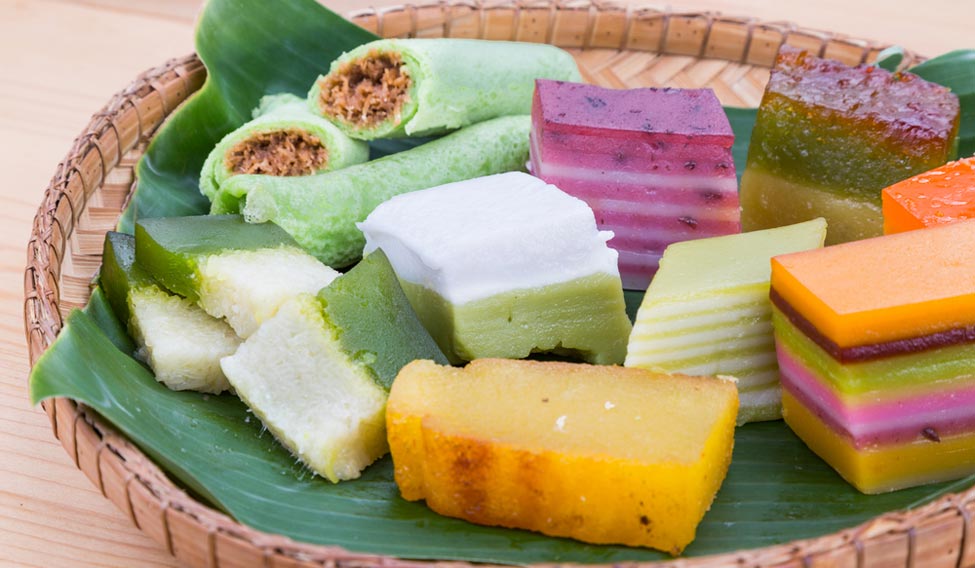 A Nyonya kueh platter
Nyonya kueh
Nyonya kueh is not a dish. Instead it is an assortment of bite-sized snacks and small desserts, usually had with tea. 'Kueh' in Malay means dessert. Nyonya kueh includes delightful and vibrant-coloured sweets and savouries of many types—baked, steamed, grilled, rich and thick, smooth and light, some are even spicy and fragrant—a delicious takeaway from Nyonya or Peranakan cuisine. Peranakans are the descendants of early Chinese migrants who settled in Malaysia and Singapore and inter-married with locals, bringing two different cultures, traditions and cuisine together. Peranakan and Malay cultures and cuisine are so closely intertwined that it is difficult to differentiate between the two. And so is the case with each kind of Nyonya kueh. Though known as Nyonya kueh, some of the recipes are Malay and some Peranakan.
Most of the local kueh are made from local ingredients such as glutinous rice, rice flour, tapioca, cornstarch, plain flour, palm sugar, pandan leaves, durian and natural edible colours such as from the pea flower that lends a bright blue hue to food.
One of the most popular local kuehs, seri muka, which literally means "pretty face" in Malay, is a treat to the senses. The two-layered steamed cake has aromatic, chewy base made of pandan leaf juice, coconut milk and glutinous rice, topped with a thick layer of rich and creamy pandan custard that adds an interesting contrast to the savouriness of the base. To get a taste of the national fruit of Singapore, you could try seri muka durian, in which pandan custard is replaced by pulpy durian custard.
Popular pandan cake destination Bengawan Solo also offers a wide range of delicious kuehs. However, for more local varieties and flavours, you could try Lek Lim Nonya Cake Confectionery on Bedok North Street 4, among other local shops. Not a new name for Nyonya kueh lovers, Lek Lim is known for its freshly made kuehs that are value for money.