



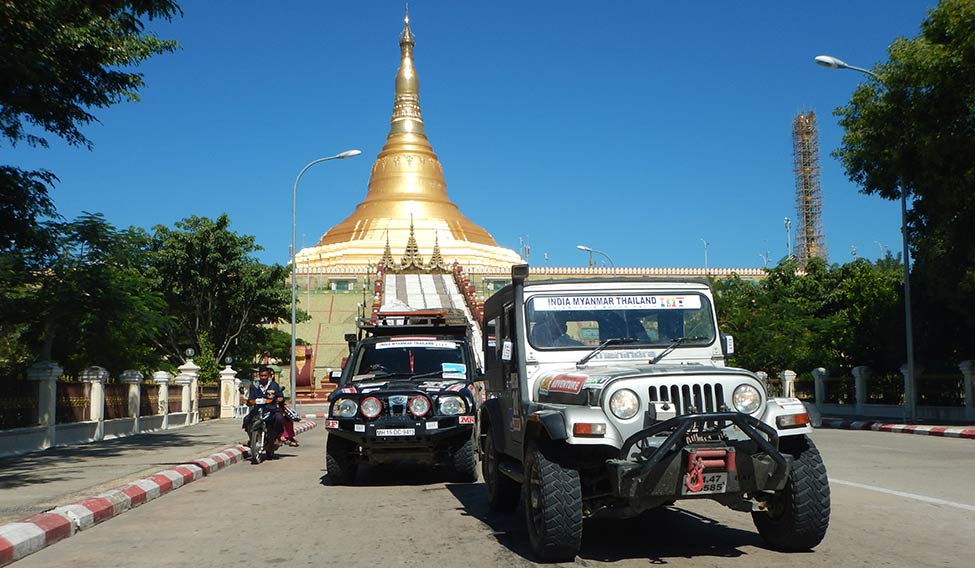
At the border checkpoint in Tamu, Myanmar, the immigration officer was surprised. Lined up outside his office were 21 cars, waiting to enter Myanmar from Moreh, Manipur, after crossing the Friendship Road. The India-Myanmar-Thailand (IMT) rally, which started from Delhi mid-November last year, was attempting to reach Bangkok by early December. The rally was aimed at forging road linkage and fostering goodwill, trade and cultural exchange among the three countries, thereby reconnecting India with its southeast Asian neighbours.
The immigration officer was at his wits’ end. One of the 60 rallyists, Myo Hun from Myanmar, had a tough time explaining his decision to fly to India and to drive back home. The officer said he had never seen a Myanmar national return to his country by road. Finally, he was satisfied after he checked the passports of the other rallyists—six from Myanmar, seven from Thailand and 46 from India. While the immigration process was on, local traders offered parking space for the cars, and residents laid out a spread of unlimited fruits and jasmine tea. “We are extremely happy that you have come. We depend on trade with India. Our customers come from there,” said Htet Soe, an office-bearer of the Tamu Chamber of Trade and Commerce.
But trade at Tamu’s thriving market had been badly hit by the economic blockade in Manipur. No tradable goods landed in the state; only goods of daily necessities and those for personal consumption were allowed. “Traders in Manipur bring goods made in Myanmar and also goods from countries like Korea, China and Thailand. In exchange, we send agro-forestry products and also products manufactured in India,” said M. Chandra Kishore Singh, vice president of North East Federation on International Trade.
The blockade also put a halt to entertainment. CDs and DVDs of Hindi films banned in Manipur would find their way into the state through Tamu. Hindi films have a huge audience in Myanmar, which gave India Helen, who sizzled her way to Bollywood.
Trade between the two countries had been robust for centuries. The Cholas of south India had flourishing dealings with the Phyu dynasty traders in the 12th century. Later, the Chettiar bankers thrived in Burmese trade towns, and in the 19th century, business improved with the shipping connect between Calcutta and Moulmein and later Rangoon. But these trade contacts died out in the 1960s when the military junta seized power in Myanmar. Human rights excesses, drug trafficking and insurgency in Myanmar made India shun one of its closest neighbours, even as the United States imposed sanctions to isolate the junta.
It was only in the 1990s that India started making attempts to revive relations with Myanmar. The idea of a road from Manipur connecting Kale and Kalewa towns in Myanmar was first mooted by J.N. Dixit, former Indian foreign secretary and national security adviser. In 2001, external affairs minister Jaswant Singh visited Myanmar and inaugurated the Friendship Road, built by Project Sevak, a contingent of Indian Army’s Border Roads Organisation. Today, it is the only road between the two countries.
In 2012, Manmohan Singh visited Myanmar, the first Indian prime minister to do so in 25 years. He said the stability along the 1,600km-long Indo-Myanmar border depended largely on economic stability and planned development, and therefore India was committed to put in place missing road and rail links in Myanmar.
“It was first decided during this visit to initiate steps to build 70 bridges and upgrade road sections to make the trilateral highway, connecting Moreh in Manipur to the international trade hub of Mae Sot in Thailand,” said A.D. James, deputy secretary, ministry of road transport and highways. The idea, he said, was to make India a part of the larger Asian highway network. And, the work on it began a year later. “The IMT rally was an experiment of the government of India, under the leadership of Prime Minister Narendra Modi, to ensure that it is possible to tranship goods and people between India and Myanmar via road,” said James, who now monitors the trilateral highway project.
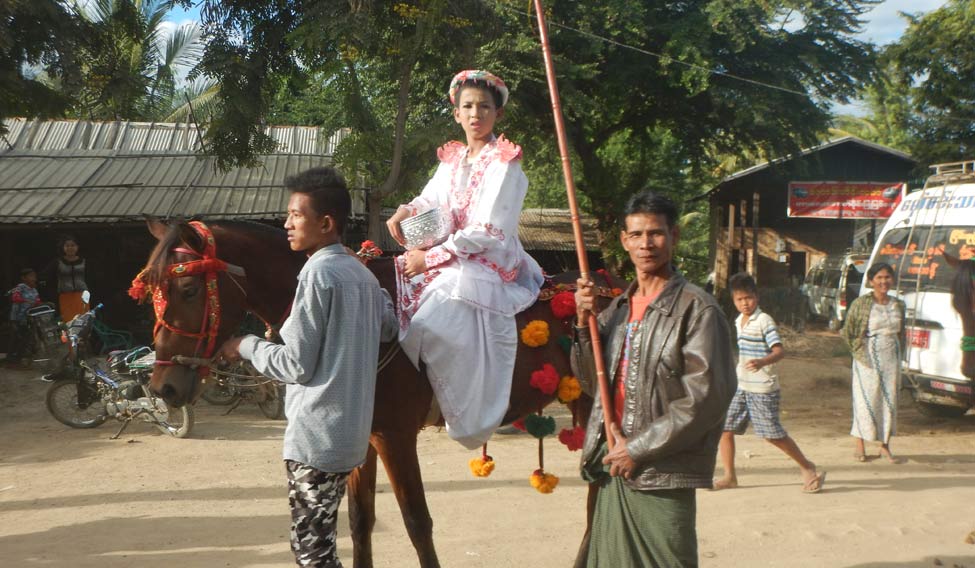 A village procession in Myanmar.
After inviting global bids, India’s ministry of external affairs conducted a detailed project report for constructing a 120km road between Kale and Yargi and to build a connect with the river port town of Sittwe, a transshipment point for Indian goods emerging from Mizoram’s Zorinpui border town.
Soon after the survey reports were submitted in July 2014, the ministry found a huge flaw in the plan. A flood earlier in the year had changed the terrain and course of a river. If the design was not corrected, not just the highway but also the Kaladan Multi Modal Transit Transport Project would have suffered. “The original plan of the project involved a 225km-long waterway from Sittwe Port till Kalewa and a road component of 62km from there up to Zorinpui, which was subsequently changed due to actual geographical conditions on the site, resulting in 158km of waterways and 109km of surface route after shifting the transshipment point on the Kaladan River from Kalewa to Paletwa,” said the ministry of external affairs in response to THE WEEK’s queries.
The ministry also upgraded the specifications of road component from intermediate to double lane, to match specifications of the road being constructed by road transport ministry in Mizoram. The estimated cost, therefore, shot up from Rs 1,560 crore to Rs 1921.05 crore, which was approved in October 2015.
The existing road network between India and Myanmar is also being upgraded. The highway project has been divided into two parts: construction of 69 bridges on the 150km Tamu-Kyigone-Kalewa section and construction of the 120km road on the Kalewa-Yargi stretch. The construction of the bridges, including approach roads, was approved in December 2015, with a budget of Rs 371.58 crore. Ircon Infrastructure & Services Limited has been appointed as the consultant for the project. The tendering process is in the final stages and the work is to be completed by 2020. The construction of the Kalewa-Yargi section, to be implemented by the National Highways Authority of India, was approved in June 2016 at a cost of Rs 1,459.29 crore. “The road could be completed in another three years,” said Ashish Tandon, managing director of Aegis India, a French engineering firm that conducted the feasibility study.
Minister of State for External Affairs V.K. Singh said: “It is a project that we as a country are committed to do and we will finish it. Yes, there had been some delays, but things like this do take time.”
Following last year’s visit of Myanmar’s foreign minister Aung San Suu Kyi to India, Modi has offered India’s cooperation for setting up businesses in banking, power, oil and gas and telecom in Myanmar. Also, the country’s agricultural exports to India, chiefly pulses, have gone up in the recent years. “They are using primitive methods for agriculture. Our intention is to train people here in modern agronomics and introduce alternate cropping techniques. Agriculture still holds a big promise in Myanmar,” said S.L. Mehta, resident adviser of Advanced Centre for Agricultural Research and Education, based in Nay Pyi Taw, Myanmar’s capital. The institute is again a result of Manmohan Singh’s 2012 visit.
Once complete, the Kaladan port in Myanmar and the highway would also act as a conduit for people and goods from the northeast to Thailand and vice versa. Till the 16th century, ships from India would dock at Aayutthaya (derived from Ayodhya), the Siam capital city on the Chao Phraya river. The present-day Thailand kingdom, as well as the language and cultural traditions, owes its roots to Aayutthaya. Lying in ruins 90km from the present capital, Bangkok, Aayutthaya remains the sentimental capital for many, including the ruling monarchy of Thailand. With Aayutthaya’s subsequent fall to a series of wars by Burma’s Taungoo dynasty, the centuries-old relation between India and Thailand came to a halt.
An effort to revive trade ties is now shaping up. “There are close to 30,000 to 35,000 visitors from Thailand to India, mostly for visiting Bodh Gaya and the Buddhist circuit. Once India completes work on the highway, there would be trade as well as tourism traffic to India, especially to the northeast,” said an official from Thailand’s foreign ministry.
Thailand has prepped up its Mae Sot customs point to accommodate traffic from India. India’s Land Ports Authority is already building an integrated customs checkpoint at Moreh to allow vehicles from Myanmar and Thailand. Looks like the IMT rally’s tagline, ‘Man made borders not to limit itself, but to have something to cross’, will soon become a reality.
The author’s travel with the IMT rally was facilitated by the Indian Chamber of Commerce, Kalinga Motor Sports Club, Indian embassy staff in Yangon & Bangkok and the government of India.
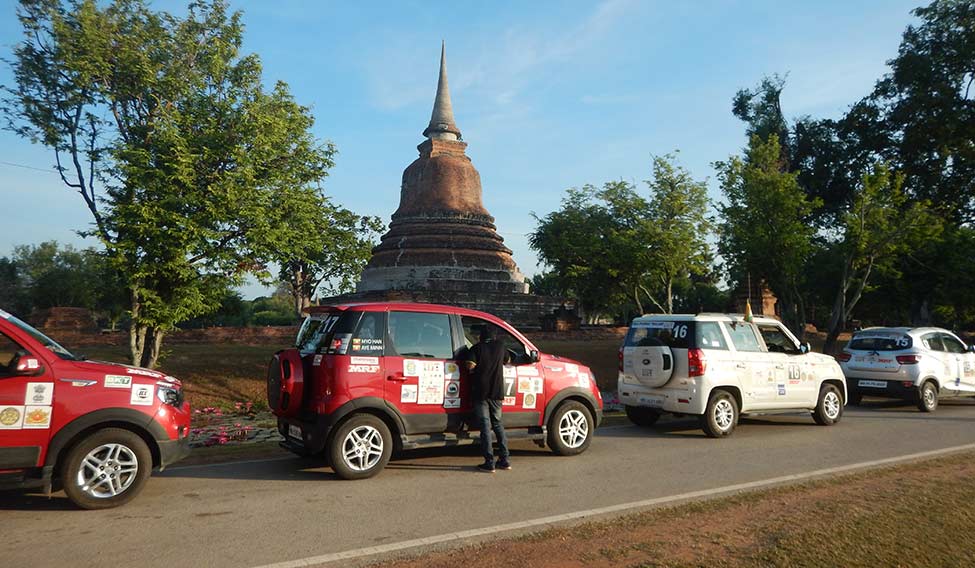 Path to alliance: The IMT rally at Thailand’s ancient capital of Sukhothai.
Rally ho!
The India-Myanmar-Thailand (IMT) car rally acted as a reality check for the trilateral motor vehicle agreement between the three countries. “The rally was an experiment in seeing how trilateral traffic agreements could be observed and if at all it is possible to do so in a cohesive manner,” said A.D. James, deputy secretary, ministry of road transport and highways.
Also, the car rally is a good way of reaching out to people, said Odisha legislator Praveen Bhanjdeo, who is president of the Kalinga Motor Sports Club—one of the rally organisers. Rallyist Myo Hun, president of the Xtreme Motor Sports Club in Myanmar, would agree. “In Myanmar, people would like to deal more and more with people from India than with the Chinese. We should find a way to improve cross-border trade and tourism with India,” he said.
And, that is where the IMT motor vehicle agreement comes in. “The rally will facilitate the signing of the agreement. A major benefit of this will go to the people of northeast,” said Rajeev Singh, director general of Indian Chamber of Commerce—chief organiser and one of the rally sponsors.
As Uttar Pradesh Chief Minister Akhilesh Yadav said, the motor vehicle agreement will also bring development to heartland states like his.