




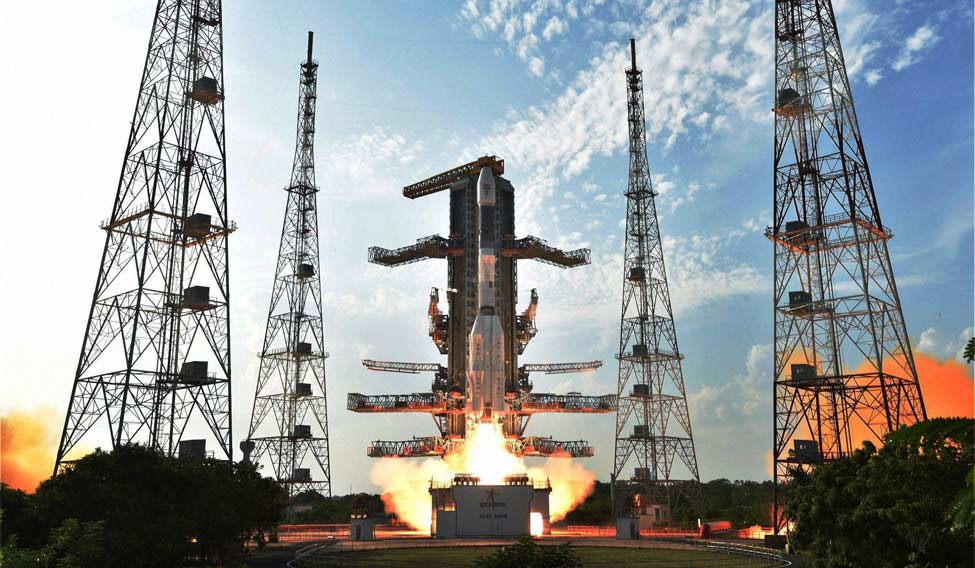
If things go according to plan, June 5 will be a red-letter day for India in the field of space research. After the historic launch of the South Asian Satellite called GSAT-9 on May 5, Indian Space Research Organisation (ISRO) is gearing up to launch the heaviest rocket in its history—the 640-tonne Geosynchronous Satellite Launch Vehicle-Mark III (GSLV-Mk III) on this day.
The country has been using the French Ariane-5 rocket launched from Kourou in South America to place its four-tonne class of communication satellites in the geosynchronous transfer orbit (where a satellite orbits earth at the same speed as the planet is rotating).
While the successful launch of the GSLV-Mk III will be a giant step for India towards attaining self-sufficiency, let's take a look at some interesting facts about ISRO's 'fat boy':
It is an completely indigenous rocket and the ISRO has been developing it for around two decades, during which more than 200 tests were done.
It’s first developmental flight, D1, will carry GSAT-19, a communication satellite, when it lifts off from Sriharikota in Andhra Pradesh. It will be the first time India will be attempting to launch a four-tonne satellite using an indigenous launch vehicle.
It is said to be as heavy as 200 full-grown Asian elephants, and is 43m in height.
It is capable of carrying humans into space. If it materialises, India would become only the fourth country after Russia, the US and China to have a manned mission.
It is a three-stage vehicle with two solid motor strap-ons (S200), a liquid propellant core stage (L110) and a cryogenic stage (C-25).
The indigenous cryogenic engine CE-20, which powers the upper stage (C-25) of the GSLV-Mk III, will be tested on a fully functional rocket for the first time. The cryogenic engine uses liquid oxygen and liquid hydrogen as propellant.
The two boosters (S200) are the third largest solid rocket boosters in the world.
An experimental flight of the GSLV-Mk III launcher, with a passive cryogenic third stage, was successfully carried out on December 18, 2014.