



In July 2016, a Supreme Court bench comprising Justice Dipak Misra and Justice Rohinton Nariman was hearing a plea made by Congress rebel MLAs from Uttarakhand. The legislators had been disqualified from the Assembly; the counsels pleaded for interim relief. The lawyers on the other side forcefully argued against any relief.
As the situation turned tense, Misra said he wanted to share a story. Known for his profound knowledge of Indian mythology, Misra retold a tale from the Mahabharata. He said when Veda Vyasa dictated the epic to Lord Ganesha, the latter asked the sage to do so without a pause. Vyasa said that he would do so, provided Ganesha took down only what he understood.
Misra told the lawyers that the bench, like Ganesha, had heard them at length and was ready with its decision. He then dictated the order, not granting the MLAs any relief.
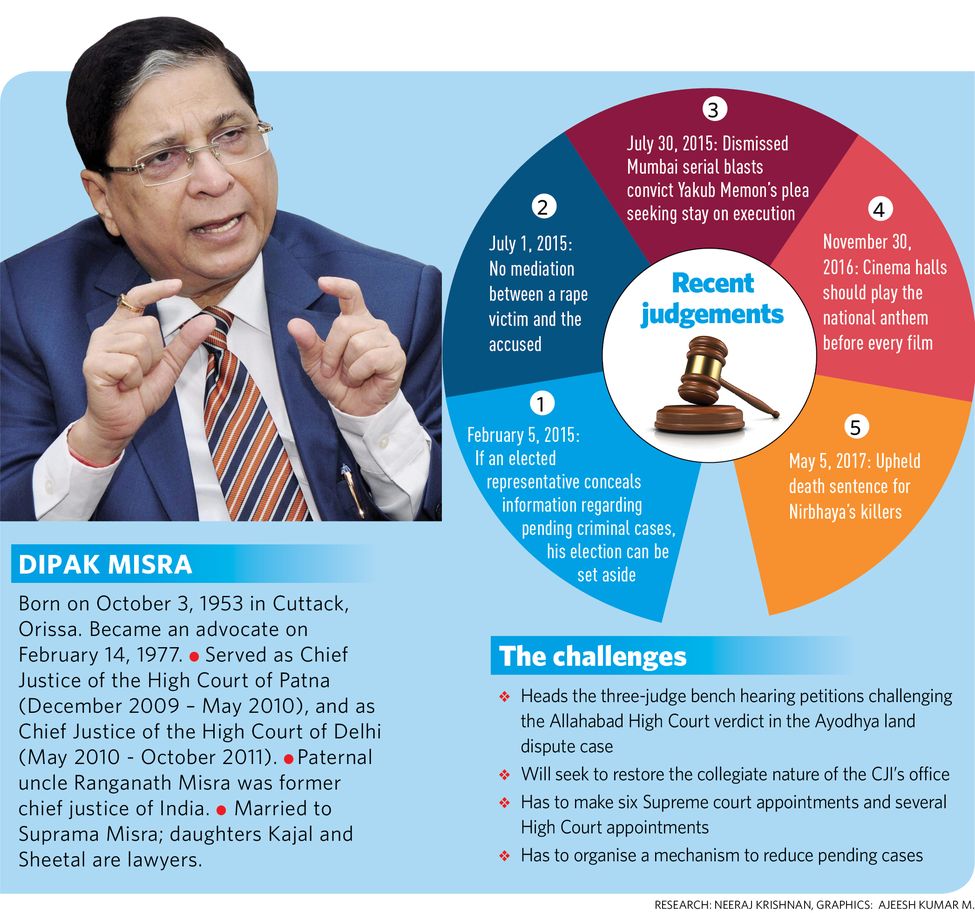
When he is sworn in as the Chief Justice of India on August 27, he will be the third from Odisha and the second from his family (his paternal uncle Ranganath Misra was CJI from September 25, 1990, to November 24, 1991). Misra is known as the poet-judge, as he infuses judgments with references to literary classics and mythological tales, either to defuse the tension or to get his point across. His court is always a crowded place, with many present just to listen to his stories.
The literary streak in Misra comes from his paternal grandfather, the renowned Oriya poet Godabarish Misra. Coming from a prominent Brahmin family in Odisha, the CJI-designate is well versed in Hindu mythology and the Shastras. Misra has a keen interest in English literature and has authored six books.
Some feel Misra’s judgments are at times heavily loaded with literary references or even legalese. Those in legal circles often refer to a 129-word sentence in his judgment, saying it could probably be the longest in a court order in India.
Known to be affable and polite, Misra is seen by lawyers as a relief-oriented judge. However, he is firm on the point of safeguarding the Constitution. Misra says often that he is “wedded to the Constitution.” He does not like cases that he feels waste the court’s time. When a PIL challenging the title of the film Dhobi Ghat came to his bench in the Delhi High Court, he dismissed the matter and fined the petitioner.
Misra’s judgment that made it mandatory for the national anthem to be played in cinema halls was hotly debated, especially since it was seen in the backdrop of the dominant narrative on nationalism. However, those who know Misra well say that the order should be seen in the light of his commitment to the symbols of the Indian nation. From his student days, they say, Misra was extremely particular about showing respect to the symbols of the Indian nation.
With Misra’s term as CJI spanning over 14 months, there are expectations from him on tackling issues such as pendency of cases and filling up of vacancies in courts. His ex-colleagues in the Delhi High Court recalled how he went in for bunching of cases to reduce pendency. The Supreme Court collegium under him will have to fill the vacancies in the higher judiciary. There are four vacancies in the apex court at present, and six more will arise during his tenure. More than 40 per cent of the posts of the judges in the high courts are vacant.
Said Ashok Parija, senior advocate in the Orissa High Court, “The judiciary is going through a transition, and various issues such as appointments, early disposal of cases and reforms in lower judiciary are in focus. In his 14-month tenure, he will definitely address these issues.”
It will be up to Misra now to try and end the stalemate on the new memorandum of procedure (MoP) for appointment of judges to the Supreme Court and the high courts. “He can be expected to make sincere efforts to resolve the impasse over the MoP. There has to be a rational give and take, while not compromising on the independence of the judiciary,” said Justice R.S. Sodhi, who was Misra’s colleague in the Delhi High Court.
Some high-profile cases are likely to be decided by Misra as CJI. These include the sensitive Ayodhya case, the plea seeking access for women to the Sabarimala shrine, the case for bringing in greater transparency in the working of the BCCI and the Sahara-SEBI case. However, threatening to make Misra’s elevation to the top judicial post less than perfect are allegations of irregularities with regard to allocation of land to him by the government in Odisha and also the alleged mention of his name in the suicide letter of Kalikho Pul, former Arunachal Pradesh chief minister.
Senior jurist Shanti Bhushan protested against Misra’s elevation in the light of the allegations, writing, “Should such a person become the CJI, even if he is the senior-most judge?” Punjab MP Harinder Singh Khalsa has filed a writ petition in the Delhi High Court challenging Misra’s appointment as CJI. The International Council of Jurists has sought a probe in the alleged corruption in land allocation. Said Khalsa, “The CJI should be a man of impeccable integrity, without any blemish. It will be my endeavour to reveal to the people the truth about their new CJI. I have approached the Delhi High Court against his appointment (as CJI). I have also written a letter to the prime minister regarding it.”
Misra’s supporters suspect the timing of the protests. Said senior advocate Rakesh Tiku, “Some people, who have no serious stake in the institution, start spreading these rumours. More than the man, they will damage the institution.”
Away from court, Misra is a family man. He has often described his wife, Suprama, as his pillar of strength. She, it is said, really worries for her husband’s safety. This, after he was issued a death threat when a Supreme Court bench he was part of refused to give relief to Yakub Memon, who was convicted in the Mumbai serial blasts case. Suprama had ordered a lock down of their residence every evening. Misra’s two daughters, Kajal and Sheetal, have followed their father into the legal profession.
The poet judge now has his task cut out to restore balance in the relations between the government and the judiciary.