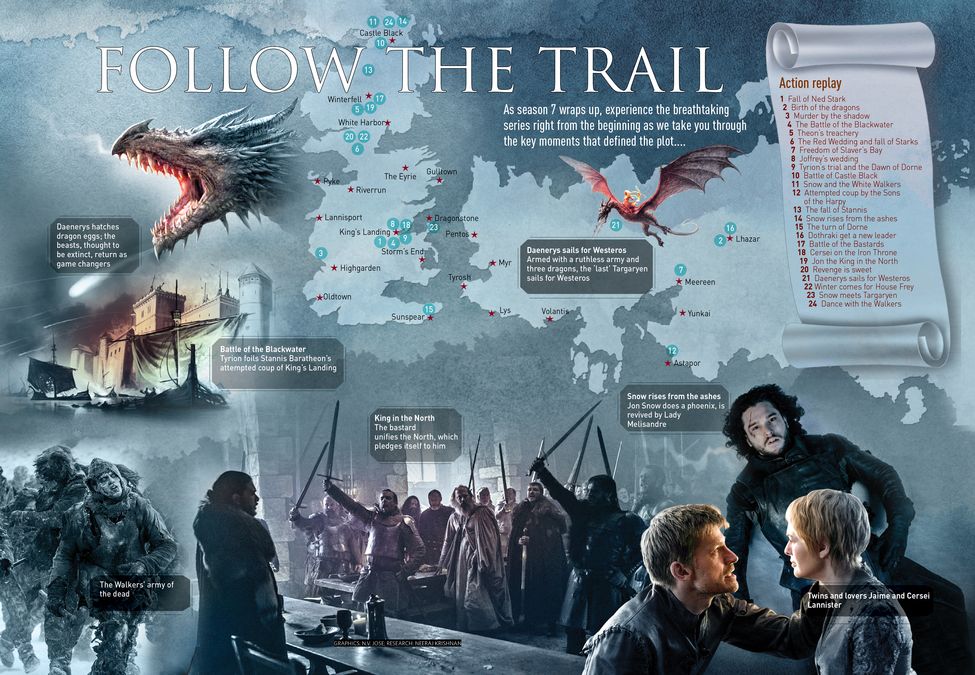




These are funny times. So many of our friends and colleagues are talking in strange tongues, uttering totally incomprehensible phrases like Valar Morghulis or Dracarys. Sometimes, they speak in English, but that doesn’t make the utterances any clearer. “Winter is here” is right now the oddest greeting in India, which is sweating under monsoon-induced mugginess. Have you noticed how this phrase lights up eyes and brings a smile of camaraderie on certain faces? But, try telling these people someone is “sending their regards”, and see what happens.
Only the completely insulated would not understand what is happening. Season seven of the hugely popular television series Game of Thrones (GoT) is on air. While the GoT-ers are living in an alternative universe, populated by medieval kings and queens battling for an uncomfortable Iron Throne, the non GoT-ers among us are putting up with this fan craze with amazing fortitude. This too will pass, they sigh, only too glad that this season is an abbreviated one, with just seven episodes.
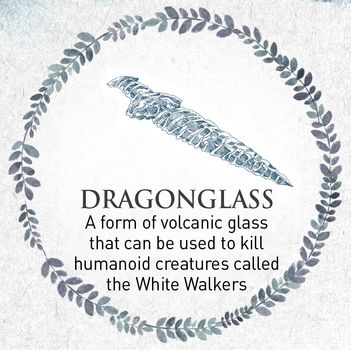
Tuesday mornings are perhaps the worst, when, fresh from viewing the latest episode, this burgeoning fan base discusses the developments in fictitious Westeros and nearby lands. “Will Valyrian steel be more effective than dragonglass in the war against the White Walkers?” becomes the discussion during lunch break. The series is screened on Tuesday nights in India, but only a handful actually sit up till 11pm to view the sanskari version. True gratification comes with watching the uncensored one—replete with blood gushing off slit throats and a delectable selection of bare breasts and buttocks. On Monday morning (which is Sunday night in the US, shortly after it has been aired), the episode gets uploaded on the internet. GoT is reportedly not just the most watched television series, but also the most pirated one. The official figure of 25.1 million viewers for last season, therefore, may be a far cry from real numbers.
And no, dissecting the events goes beyond swapping review notes on the last episode. People actually spend an amazing amount of time and energy trying to understand stuff like what causes Greyscale disease, a fictitious ailment created by the American author of the series, George R.R. Martin. He describes it as a skin infection, creating scabs over painful pus secretions. The bodily damage is slow, but the patient loses his mind rather rapidly.
In the GoT fan world, people have sat down with actual doctors, trying to diagnose what pathogen can cause the infection. One doctor, noting the symptoms and method of spread, has concluded it is viral in nature, not bacterial. Another fan, inspired by a particularly gross sequence—the highlight was an acolyte peeling a scab off a patient and cleaning the suppurating sores—actually posted pictures of a Greyscale-inspired dessert she rustled up. This dessert is a tart with a dark, scaly exterior, from which, on puncturing, oozes a yellow custard. Tempting or appetite killing, it’s anyone’s call.
It is a sign of the times that the Bengaluru City Police Twitter handle uses examples from GoT to drive in its message about safety. Don’t be overconfident, always wear a helmet, is one such message, with the image of the dishy actor Pedro Pascal aka Lord Oberyn Martell. Spoiler alert: He was killed in a fight he was winning as he hadn’t worn a helmet.
Even Union Minister Smriti Irani couldn’t resist drawing parallels between Jon Snow of GoT and Mihir Virani, a character in the once popular Kyunki Saas Bhi Kabhi Bahu Thi, which was Irani’s ticket to stardom. Both Snow and Virani came back from the dead.
Just what is it in this make-believe world created by Martin, and served on the idiot box through the genius of David Benioff and D.B. Weiss, that has driven otherwise intelligent people crazy? Fantasy is not a new genre. From J.R.R. Tolkien’s medieval magical realms to sci-fis Star Trek and Star Wars, there are enough alternative worlds around us. Even everyday London reveals its magical streets—Diagon and Knockturn Alleys—for those who follow J.K. Rowling. If fantasy isn’t the novelty, then is it the generous servings of sex and violence? “Seriously, if it was just sex, why could I not sit through Fifty Shades Darker?” asks S. Aishwarya, an ardent GoT follower based in Delhi. The film, sequel to E.L. James’s Fifty Shades of Grey, released this year without making a ripple. And, there is enough violence everywhere, adds Aishwarya.
Richa Madhukar, a software professional based in Delhi, says, “I think the appeal is that GoT pushes the boundary of our perceived values. You grow up with a certain set of ideas, what is bad, what is not allowed, and here, you are in a world where everything is different. How you love, how you kill, is like nothing you thought before. The show appeals to the raw primate in you.”
Says Canada-based homemaker Surabhi Dhondiyal, “Before GoT, I cannot remember a time when watching television was more interesting than going to the movies. Before this show, you didn’t get to see such cinematic resonance on television, in terms of the breadth and scope of the story, though now there are many. It was like watching a raunchy version of the Mahabharat.”
Indians love to compare GoT with desi epic Mahabharat or even the new craze, Baahubali. But, there is a fundamental difference. Whether in Mahabharat, Baahubali or for that matter even Harry Potter and ancient Greek epics, there is a common thread, good and evil are clearly defined. There is punishment for wrong, even if that wrong is just vanity (remember Narcissus?). GoT is free of any such shackles. In fact, one begins questioning just what is right and what is wrong. A doting brother who spent a lifetime to avenge his sister’s murder and rape gets his head “crushed like a duck’s egg”, while his assailant, who is sadistic without explanation, lives on to kill others. “It’s nothing like what I’ve seen before,” says Madhukar, who also watches programmes like Breaking Bad and Westworld, which, though good, “aren’t addictive”.
“Each character is layered, neither saint nor devil,” says Sudha Nair, a Delhi-based HR consultant. She was introduced to GoT through her teenaged daughter, Anushka, who complements the serial with the books. “You never know who is going to do what. Everything is so unpredictable,” says Sudha. The plot is best described in a famous quote from the series itself: “In the game of thrones, even the humblest pieces have wills of their own. Sometimes they refuse to make the moves you plan for them”.
Martin, 68, observed the 20th anniversary of his first book of the series, A Song of Ice and Fire last year, which sold well, but took off when the first season opened on television in 2011. Its makers knew that a story of this scale couldn’t be dealt with in a film; it needed the length and continuity of television. Although India had a niche following for years, with a fan base from Jodhpur to Guwahati, GoT blazed into public consciousness when Star and HBO had a tie-up in December 2015 and all the seasons were aired one after another before the worldwide debut of season six. In the wait for season seven, several entrepreneurs had learnt to cash in on this pop craze.
Cousins Kamran and Omar Nissar, GoT fans, opened a cafe by Dal Lake in Srinagar last December and predictably named it Winterfell (after a castle in the series). “It’s the best place in the north,” quips Kamran, amazed at the response they’ve got to their themed cafe, complete with an Iron Throne. “The name was half the marketing,” he says. Pressed by an equally crazed GoT clientele, he is now planning to source GoT merchandise and even replace the crockery and cutlery to resemble what is seen in GoT taverns. I ask him whether he also serves Arya’s speciality (the child assassin killed her enemies and served them up as meat pies), and Kamran laughs, “No, no. We draw a line there.” Kamran has now written to HBO about his cafe; he does not want to be flouting a copyright. In Delhi’s Lajpat Nagar, another cafe, Westeros, had opened shop, though its reviews are not too encouraging.
The current season has also revived interest in the books. Nagaraj Krishnan, head of the international division at HarperCollins India, says GoT is among their top five brands, with over half a million copies sold. What is the profile of the GoT fan? “Just about anyone over the age of 16,” says Nagaraj.
Martin, who, it is said, wrote the books to be free of the restrictions that writing for television imposed, might not have realised what he was in for. After his books were adapted for television, they took on a life beyond imagination and he hasn’t been able to keep pace. The demands of continuity on television and the reality that the child artistes were rapidly growing up meant that the series had to take off on its own, the books could come later. Season seven is unknown territory, there is no book reference to fall back on. This season, thus, has a nail-biting quality to it. Understandably, all actors have signed non-disclosure bonds.
Thus, the financial stakes were high when hackers breached HBO servers (it reportedly took them six months) and stole, by some accounts, 1.5 terabytes of data. They leaked episode four online, and also some scripts. The producers have been asked to pay up, in bitcoins, a ransom of $6 million. Star India leaked episode five of the current season in early August. Mumbai Police arrested four persons in connection with the leak.
The leaks, as well as regular piracy, have cost the producers dearly. The show is an expensive one, the scale of production amazing. Shooting is spread across scenic locales, from Ireland to Spain to Iceland. Google Earth didn’t miss a chance to showcase the actual locales where the scenes were shot. When the UK voted for Brexit last year, one of the concerns was how it would affect the shootings. Then there is the computer graphics imaging of the fantastic creatures—fire-breathing dragons, dire wolves and the White Walkers. India has its own connect with the series, with the costumes designed and weapons forged in desi factories. Even the dragons were created in Mumbai. With two actors of part-Indian origin this season, Indira Varma and Staz Nair, the Indian touch is complete.
David J. Peterson has his own role to play. He creates artificial languages for television and films. With only a smattering of phrases provided by Martin, Peterson has created two fantastic languages, Valyrian and Dothraki, each with extensive vocabularies. Like Klingon, which was created for Star Trek, these two languages have a burgeoning following. The Wiki of Fire and Ice, created by GoT fans, provides as much background material on the places and characters as you would have on Achilles or Hercules.
Not all, however, are impressed by the GoT craze. “It is interesting to juxtapose the success of such programmes with the reality in the world. Game of Thrones on television and Donald Trump in the White House, a changing Europe, too,” says Niranjana P., a researcher on contemporary culture. “There is a clear white supremacy being reinforced, and such stuff gets popular in the US, which lacks its own mythology. White America is creating a heritage through pop culture.” She compares it with the works of Indian author Amish, “where again, there is the attempt to create a certain type of macho hero.” Such works, according to Niranjana, do well with a certain section of society. “I would not call it a rage. There are many other issues which have occupied the youth, but which do not get reported. I would call it a very smartly made programme meant for television success.”
But, once all the seasons are wrapped up, how long will GoT be remembered? Observers feel that while the craze may ease, the steady fan base will continue. Fan fiction has ensured that GoT has gone beyond the life and world created by Martin, and Weiss and Benioff. But there is always need for new stuff to draw in newer fans. “The Lord of the Rings films revived interest in Tolkien’s books, which were written decades ago, as did the Narnia films with the works of C.S. Lewis,” says Krishnan. Even the Mahabharat needs a regular re-telling. So, will there be edgier reinterpretations, sequels and more? To quote from GoT itself, “Old stories are like old friends. You have to visit them from time to time.”