



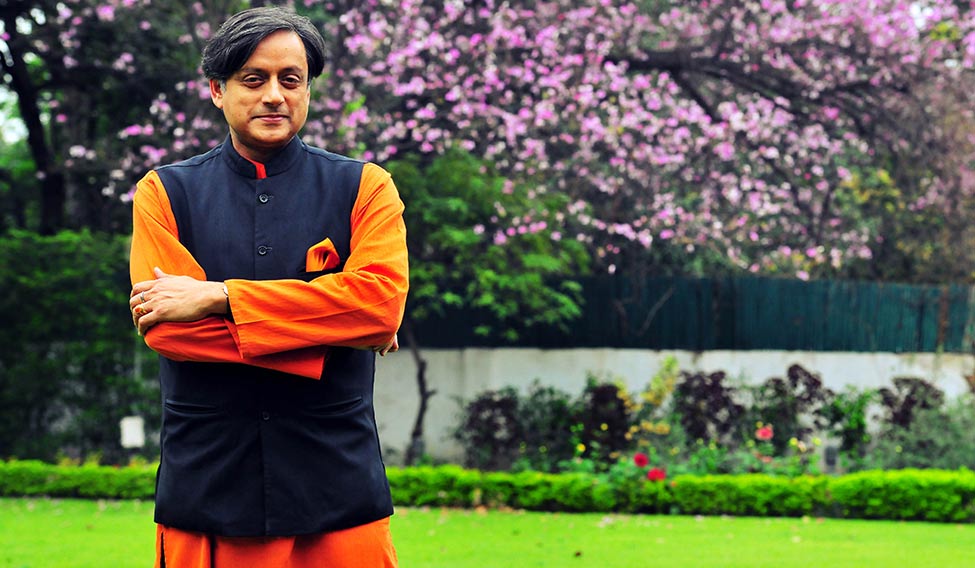
Shashi Tharoor has a sore throat. On his table in his study, which looks out over a lush green garden fringed with palms, are packets of lozenges. A cup of steaming hot tea arrives. Tharoor, known for his gift for words, even when his throat is not on his side, takes a sip and then launches passionately into his latest book.
An Era of Darkness is an attempt by Tharoor to spread light. It was born out of his speech at the Oxford Union last year, which went viral that even months later, Tharoor had people coming up to him to praise it. The book has received a similar response. “It is about the past,’’ he says. “It is how the British have been portrayed. There has been a lot of myth-making by the British, especially in recent years, that I felt needed to be dealt with.”
An “obnoxiously” good student is how Tharoor describes himself—in a way that is matter-of-fact, slightly bashful and without being smug. He had the facts, but converting the speech to a book meant that he had to expand and bolster his argument. He did so—the footnotes run into 20-odd pages—to make a detailed, damning document of the systematic British plunder of India. “I have actually gone into the recent scholarship, and cited it, so that scholars can verify what I am basing certain assertions on,” he says. “It has not been written to be a scholarly work. I have not pretended to be an equivalent of a professional historian. But I have tried as an amateur, if you like, to marshal arguments about history, which I believe are quite important for educated Indians to be aware of.”
For a student of history, Tharoor has done all the legwork. He has read all the books, dug up all the references and put them together in the form of a book that can be “picked up at an airport and read on a plane”.
Filled with details, the book gives Indians a glimpse of the prosperity that existed before colonisation. Some details, like the fact that Indians were famed for their steel, even surprised Tharoor. As early as the sixth century, Indians forged a crucible-formed steel that was the stuff of legends. “It was known as wootz, a corruption of the Kannada word ukku,” he says. Indian swords were of higher quality than that of the British. And in early battles, English soldiers would swap their own equipment with the Indians they defeated.
The facts and figures in Tharoor’s book demolish the myth that the British were a civilising influence in India. The book is also about the glory of a time gone by, when India was the fabled golden bird at the dawn of colonisation.
Doesn’t the book align itself with the version of history that is being propagated by the rightwing? “I would like to argue that this unites left, right and centre. I was chatting about this to Sitaram Yechury on the plane. Yes, I don’t use Marxist jargon. But the Marxist critique of history isn’t very different from the rightwing critique or the Congress party’s mainstream critique. We are all basing them on the same sets of data.”
The book, he believes, should not be portrayed as “entering contemporary political divisions”. Ask him why history then becomes such a divisive force, and he says, “That’s because there is a segment of our society that wants to revenge itself upon history. The Ram Janmabhoomi agitation [and] the destruction of the Babri Masjid were about undoing imagined wrongs from the past and history became part of lived politics. I think the echoes have not completely died down.”
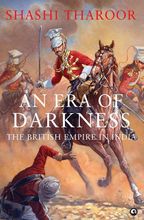
His reason for entering this “minefield” is quite different. “We should all care about our past,” says Tharoor. “If you don’t know where you are coming from, you don’t know where you are going. To my mind, this knowing, where you come from, holds value.”
An Era of Darkness: The British Empire in India
By Shashi Tharoor
Published by Aleph Book Company
Pages 360; price Rs 699