



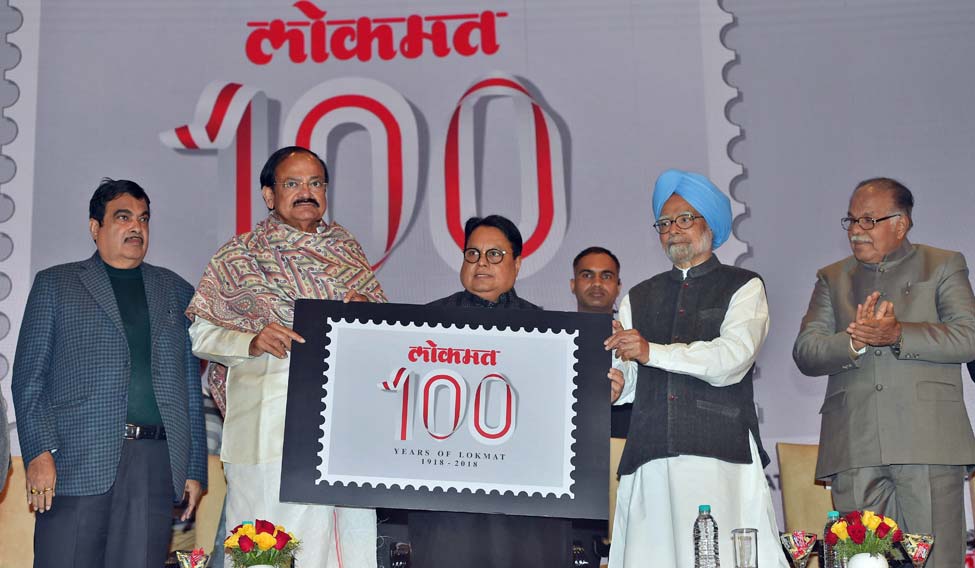
Vice President Venkaiah Naidu was pained by sensationalism that crept into media in view of thousands of channels competing with each other, and said truth had become a casualty. Observing that regulation of the media should not become strangulation, Naidu in his characteristic alliteration-loaded one liners, called for self-regulation instead.
The vice president was speaking at the launch of the Delhi edition of Maharashtra’s leading daily, Lokmat. While he remotely had the press rolling, former prime minister Manmohan Singh rolled out the centenary celebrations of the Marathi daily that completes a 100 on Friday.
Leaders from Maharashtra, including Chief Minister Devendra Fadnavis, Union Transport Minister Nitin Gadkari and Human Resources Minister Prakash Javadekar, attended the function. Present on the dais also included Rajya Sabha Deputy Chairman P.J.Kurien, Steel Minister Birender Singh Chaudhary, Law Minister Ravi Shanker Prasad and Delhi Chief Minister Arvind Kejriwal.
Congress leader from Maharashtra Shivraj Patil, former Punjab Congress president Pratap Singh Bajwa, former SP leader Amar Singh, National Conference president Farooq Abdullah, K.C Tyagi of JD(U) were also present at the event. Mani Shanker Aiyer, who was recently suspended from Congress, made an early exit. Present in large strength were also well wishers from the media companies, come from different parts of the country, to congratulate former MP and Lokmat owner-editor Vijay Darda and his brother and editor Rajendra Darda.
The vice president, who started his speech in Marathi, urged Indians to speak in their mother tongue at home, as it provided for best expression in terms of language and feelings. “I am not opposed to other languages, but I believe mother tongue should come first. The years of British rule has left us with a sense of inadequacy if we cannot speak in English. But I went to a Telegu medium school, and see, I have reached here,” Naidu said, amidst cheers.
He reiterated that mother, motherland, mother tongue were worthy of the highest regard, and with the multiplicity of languages, they gave the unique ‘goodness’ of unity in diversity to India.
Urging the owners of the 100-year-old Marathi daily to live up to the expectations of their forefathers, particularly father, Naidu pointed out that Lokmat had been given its name by freedom fighter Lokmanya Bal Gangadhar Tilak, and had played a valuable role in India’s freedom struggle.
Naidu pleaded for a strong national outlook in all media channels and publications, in addition to projecting the idea of 'one nation one people'. The progress of the country and the people is as much the task of newspapers as of government and political parties, the vice president said.
Press is not about commission or remission, it is a mission, and should serve the society, the vice president said, urging the media to cover the rural sector and agriculture sector as well. He cautioned the media against paid news, which he said was a ‘menace’.
In a very brief speech, former prime minister Manmohan Singh acknowledged the role of the Lokmat daily and viewed it as an auspicious day when it was making its presence in the capital. ‘media has a very important role, more so when there is pressure on the freedom of the press’. Invoking Walter Lipman’s famous line that 'facts are sacred and opinions free', he was confident that the Marathi daily from Delhi will live up to that.
Naidu also launched the website, lokmatnews.in, which will initially be in Marathi and Hindi, and eventually other Indian languages. A commemorative issue to mark the centenary year was also released by the vice president.
Delhi Chief Minister Arvind Kejriwal, welcoming the Marathi paper to Delhi, pointed to the challenges before independent newspapers. He was confident that Lokmat would overcome the challenges to present the truth before people.
Transport Minister Nitin Gadkari, who shares his home town Nagpur with Lokmat, lauded the daily for its role in educating and building awareness among people, thereby strengthening democracy. Marathis in the capital will have a daily in their own tongue, he said.
Vijay Darda traced the blazing history of Lokmat that was founded at Yavatmal in Maharashtra in 1918. A weekly then, it became a daily from Nagpur in 1971, under the leadership of veteran freedom fighter Jawaharlal Dara—‘Babuji’ to their family. It was Babuji’s dream that Lokmat should have its presence in the financial capital of Mumbai, as well as the national capital, to spread the message of secularism, and to fight communal forces. “We rededicate ourselves to the values and principles of patrakarita parmo dharma (journalism is the highest dharma),” he said, speaking of their brand of journalism.