



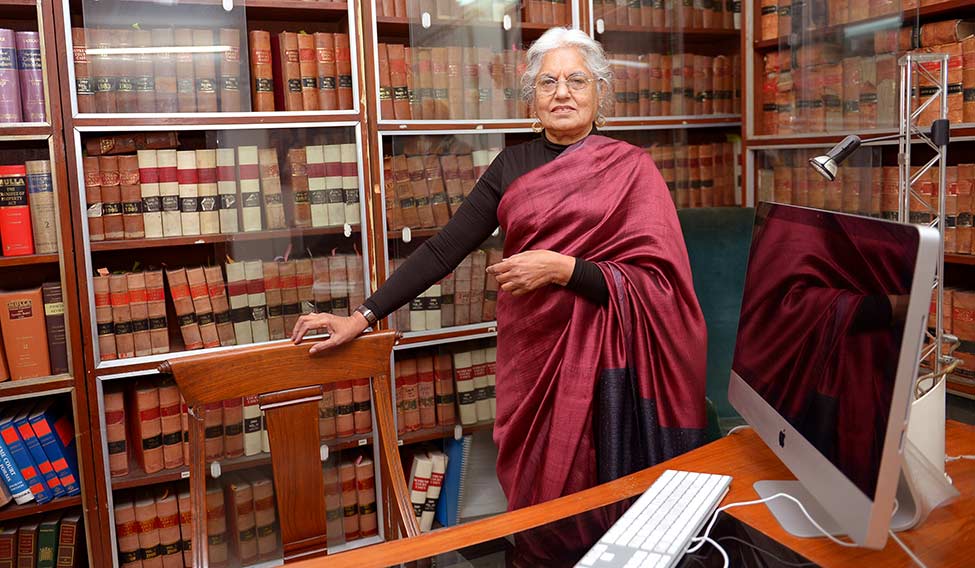
On Independence Day this year, senior lawyer Indira Jaising declared she was starting a 'Gown Wapasi' movement. In a tweet, she said that with effect from August 16, she will shed her senior counsel gown as a “symbol of discrimination.” She also wrote: “Why do we need two classes of lawyers with different uniform?”
Jaising was the first woman to be designated a senior advocate by the Bombay High Court in 1986. However, she has given up the senior counsel gown, and is appearing in court in a junior advocate's gown since August 16.
Jaising is protesting against the “discriminatory” procedure of designating lawyers as senior, as also the “class of undesirable elitism” that it creates. She had filed a Public Interest Litigation in the Supreme Court in July 2015, in which she termed the present system of designation of senior counsels by the apex court arbitrary, non-transparent and discriminatory, and in violation of the rule of equality under Article 14 and notions of diversity under Article 15 of the Constitution. She said the system needs to be made more democratic. An undesirable outcome of the procedure, she contended, is that it leads to the monopoly of a few senior counsel at the bar and has made legal services by senior lawyers unaffordable and out of the reach of the ordinary litigant.
“I have given up my senior gown. No law says seniors and juniors have to wear different gowns. These obnoxious symbols of discrimination must go. I am who I am with or without a senior gown,” Jaising told THE WEEK.
Under the present system, the full court considers applications by lawyers, and decides on the senior counsel designation by taking into account standing at the bar, knowledge of law and court craft. There are no rules laid down, but a set of norms are followed. And the lawyer has to give an undertaking that he or she shall not draw pleadings, affidavits, advice on evidence or do any drafting work of an analogous kind.
This system, according to its critics, is arbitrary and opaque, and leaves the decision-making dependent on the likes and dislikes of the judges involved as there are no well-laid down criteria to grant the designation.
Jaising had, prior to filing the PIL, filed an application under the Right to Information, seeking the resumes of the lawyers who were designated in May 2015. Her aim was to show that there are no clear, well-defined criteria laid down for the designation to be given. “The hierarchy in this profession needs to be challenged. Merit is not recognised. Contacts and networking is what it is about,” she said.
There are complaints that the present system encourages lobbying by lawyers desirous of getting the senior designation. It is also riddled with nepotism, it is said.
The Gujarat High Court Advocates Association has also made a plea in this case to oppose the senior designation, calling it the “red beacon of the legal profession”. Its petition says that the designation should be abolished.
“The conferment of the designation of Senior Advocate to only a few arbitrarily chosen advocates is quite akin to the privilege of red beacons on the car of the dignitaries which needs to be abolished in the like manner,” the association said in its written submission before the court.
The argument against the present system is that it fails the test of Articles 14 and 15, as it cannot stand the reasonableness of the classification that is being sought to be achieved by designating some lawyers as senior.
“...it is absolutely improper to create two classes of lawyers and confer undue privileges and advantages to Senior Advocates when on all aspects they possess the same/equivalent educational qualification,” the association has argued in its submission.
So, while the process of designation is being debated, the outcome of it, which is creation of two classes of lawyers, is being criticised.
'Senior' is used as a prefix in court proceedings and in public hearings in court. It also adorns the visiting cards, letterheads, official plaques and invitation cards sent by the High Court or the legal department. Senior advocates are seated in the front in functions, have first right of audience in court proceedings, and are separated by their gown and collar.
“The title is seen as a mark of eminence or honour. And even litigants believe that they are better off if they have hired a senior counsel,” said Advocate Asim Pandya, President of the Gujarat High Court Advocates Association.
It is believed that senior counsels charge fees that are more than three times that of non-designated lawyers. In the Supreme Court, the top 20 senior advocates are said to charge in the range of Rs 3,50,000 to Rs 11,00,000 per appearance per case.
It is felt that the court also tends to treat senior lawyers in a different manner, giving them more time to make their point. “Some judges tend to take senior counsels more seriously. The seniors get a more patient hearing, and it becomes really frustrating for the junior lawyers,” said lawyer Gaurav Bansal.
Defending the designation, senior advocate Vijay Hansaria said that a lawyer, after acquiring sufficient knowledge and experience, is supposed to devote more time in reading of jurisprudence and engage in development of law. “This is possible only if they detach themselves from client interaction, drafting of pleadings and doing registry work,” he said. Hansaria, however, said the present system should be made more transparent, based on objective criteria and there should be a set of guidelines for the designation.
Advocate-on-record in the Supreme Court Sneha Kalita feels that the senior designation is not in violation of Article 14 as it has been founded on intelligible differentia.
“Though the Act (Advocates Act, 1961) does not lay down elaborative criteria which entitles a lawyer to the designation of senior advocate, one must possess sufficient experience and knowledge in law and sufficient years of practice as an advocate and years of standing at the Bar,” Kalita said.
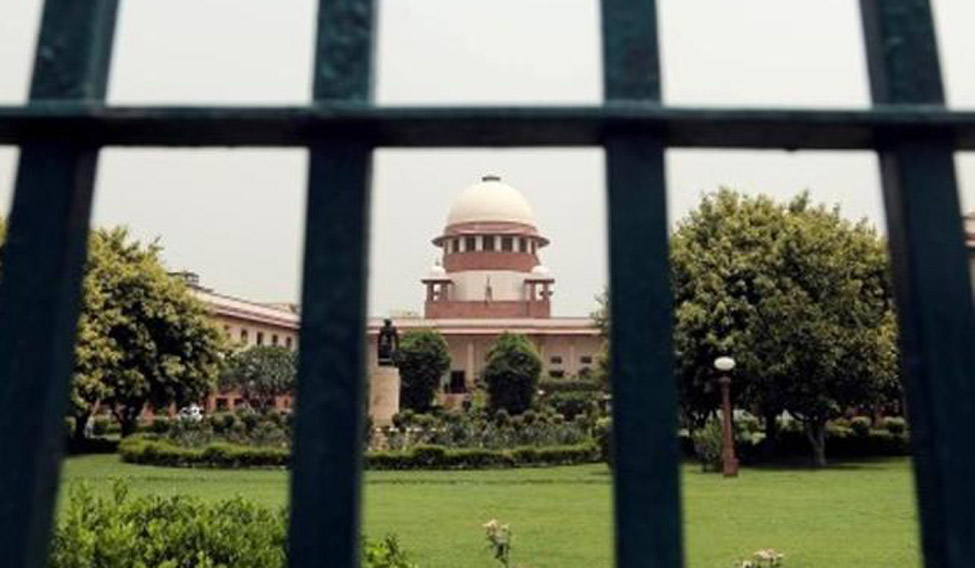
As a result of the PIL, the court has, since July 2015, put the process of senior designation on hold. A three-judge special bench of the court comprising Justices Ranjan Gogoi, R.F. Nariman and Navin Sinha is expected to deliver its verdict on the issue by the end of this month. It has to decide on whether the process is unconstitutional, as argued by the petitioners, and if it is not, whether it requires any reform.