



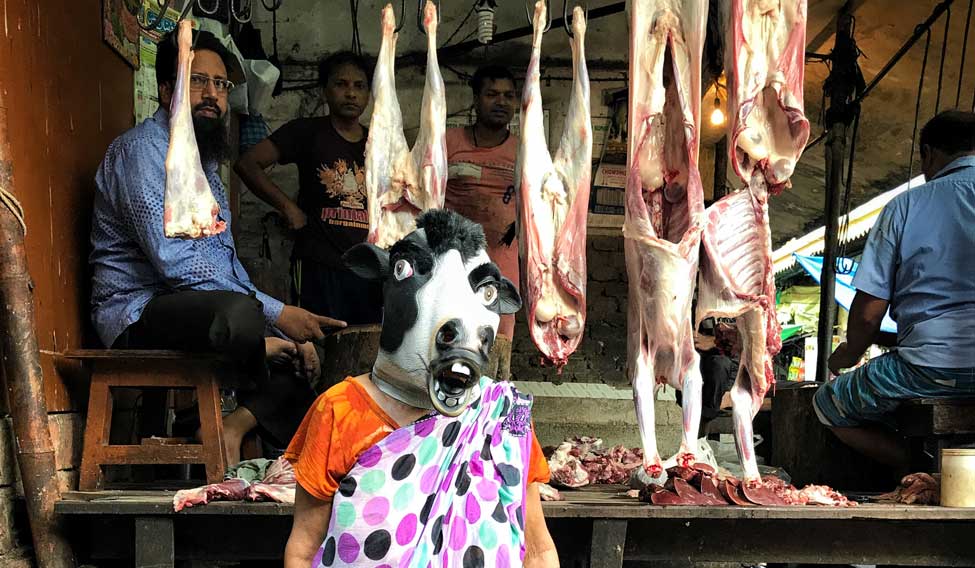
According to reports, majority of rape cases aren't turned into formal complaints. However, if there's any report of cow meat being eaten or a cow being slaughtered, the person guilty of the act is immediately punished. While many of these sexually assaulted women get justice after months and maybe years because of delays in the courts, the cow or gau mata gets defended almost immediately. Sadly, the safety and protection of women haven't been debated as much as cow slaughter has been.
Sujatro Ghosh, a Delhi-based independent photo artist, has released a series of photographs where women are posing wearing cow masks. This is an attempt by the 23-year-old to urge women to reclaim the streets of India and raise the question whether they and their safety are less important than a cow.
“The thought behind the project is very simple— it is women's right and women's protection. We all are aware of the socio-political situation in the country (with regard to cow protection while women's rights being sidelined). It is simply the portrayal of the current situation and what we see around us. It is the portrayal of what is happening around us, from my view point,” says Sujatro.
“This issue is always something I have been concerned about. It is something I really want to stand up for. And so, instead of calling it a campaign, I would like to call it a collaboration with women. A lot of these women are those I know personally; some of them are acquaintances. And the project wouldn't have been possible unless they cooperated,” says the photographer, who picked up the cow masks from a party store in New York.
Sujatro, who moved to Delhi in 2014 to pursue post graduation from Jamia Millia Islamia, feels the kind of attention the photo project has got has taken a political turn and the core issue is being hampered. “This is a trend we all see,” he says. “Deferring from the real problem has been happening for years. In the end, it always gets converted into a political statement. But my intention was never to mock a particular party. It is about a more deep-rooted thing. This has been triggered due to events over the years.”
The photo artist chose to shoot the project in Delhi as it is the hub of politics and religion; even most of the debates start here. “If you take a closer look at my pictures, you will see that it is void of any religious references, and of region, caste or creed. It is a project purely meant to highlight the condition of women,” says Sujatro. "At a deeper level, though, it might say 'Who is the government to decide what I consume,' but it is secondary."
Sujatro credits his liberal upbringing and all the women he has been attached to, including his mother, for shaping his thoughts. He says, “This is an issue that needs to be addressed at the grassroots level. We, the people sitting in the metros might be raising our voices for women's rights and women's protection, but it is women who live in rural areas who need to be heard, as the problem is deep-rooted.”
He strongly feels that while so many great things are being said about India in other countries, they should also be talking about these issues. Naturally, Sujatro has gotten both negative and positive reactions to his project. While the positive ones have motivated him, he does not let the negative ones bother him much.
The artist hopes to travel across India with the project and spread his message of making streets safe for women again. And he has started a crowd-funding platform for the same. Here's hoping that the message is spread widely.