



Right through our graduate days at Hyderabad’s Nizam College not a day would pass without my friends and I sharing a cup of milky and sugary dark brown tea at an Irani café outside the college campus. One of the speciality teas was called pauna, a cup only three-fourths full but with milk liberally added. Over shared cups of tea—“1-by-2 pauna” as the waiter would announce—we argued about ideas and ideologies, about politics and films and which guy got a smile from that girl at the bus stand.
Narendra Modi, India’s famous chaiwallah-turned-prime minister, would have much to discuss over cups of Irani chai during his visit to Tehran this month. Iran’s cultural influence is ubiquitous across India. Through religion (Parsi/ Zoroastrianism and Islam), language, cuisine, music and architecture, Persia and Iran have left a deep imprint on India. Not surprisingly, therefore, these civilisational neighbours have maintained excellent diplomatic relations in their new democratic avatar, despite the ups and downs of Asian geopolitics.
Hyderabad’s Irani cafés had a large portrait of the Shah of Iran adorning their walls till the Shah was dethroned. Overnight, a portrait of Ayatollah Khomeini appeared on the same wall. Life went on, and India-Iran ties did, too. Helpful traders, like the Hinduja brothers, who had excellent relations with the Shah’s regime made sure they also had friends around the Ayatollahs. They played their part in sustaining the bilateral relationship.
During India’s negotiation of the civil nuclear energy agreement with the United States, there was a storm in the teacup. Iran was upset with India’s stance on its nuclear programme. India took the view that both countries have had their agreements and disagreements and should be able to live with them. Each time an Iranian diplomat pointed to the unfriendly Indian vote at the International Atomic Energy Agency (IAEA), we would point to unhelpful Iranian votes at the Organisation of Islamic Cooperation (OIC) on Kashmir. Tit-for-tat and that was that.
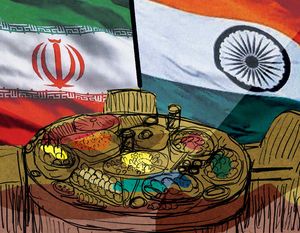 Illustration: Bhaskaran
In the midst of the brouhaha on the nuke deal, I was invited to a meal by the Iranian ambassador in New Delhi. Conscious of how delicious an Iranian meal would be—pulao, kebabs and sweets—I was keen to accept the invitation. Being the prime minister’s media adviser, I had to first take the PM’s permission. Prime Minister Manmohan Singh readily approved the idea. But, he instructed me to let the ambassador know that the government was not happy with his diplomats “meddling in domestic politics”.
It was an open secret that Iranian diplomats were encouraging criticism of the India-US nuclear deal by politicians and journalists critical of the PM’s foreign policy. While intelligence agencies kept track of Indian politicians meeting Iranian diplomats, I kept track of unfriendly journalists who would be sent by the embassy on junkets to Iran, only to return and criticise the PM.
Both countries have come a long way from those days of mutual suspicion. The last time I had a meal at the Iranian ambassador’s home, in my avatar as a writer on geoeconomics, the conversation was all about connectivity and trade—about speeding up construction of port facilities at Chabahar and building road and rail links from there that would enable Indian goods to get to Afghanistan, Central Asia and beyond, all the way to Europe. Prime Minister Modi is expected to speed things up on that front.
India’s balanced outreach to west Asia, engaging Saudi Arabia, the Emirates, Iran and Israel, is a new win-win game and, so far, all sides seem to welcome it. India has moved away from the ‘zero-sum’ mentality of its old west Asian strategy, wherein wooing X meant unfriending Y.
Of course, US President Barack Obama has made it easier for India to engage all in the region, given his Middle East policy. That is one set of equations that Obama got right and Modi is doing it right, too, with the Shias, Sunnis and the Jews.