



In the autumn of 1977 an official of the government of India spent long hours to draft a five-year plan for funding India’s armed forces. After weeks of hard work a date was fixed for defence minister Jagjivan Ram to present it to prime minister Morarji Desai and his senior cabinet colleagues for their approval. The day before the scheduled meeting Desai was involved in a helicopter crash in the northeast. When Desai joined his colleagues at the meeting everyone wished him a long life. The PM went on to provide a detailed account of the accident and his providential escape. An hour went by, the PM was told that he had another meeting to attend.
As the PM and his ministerial colleagues left the room, the officer who had drafted the report asked cabinet secretary Nirmal Mukherji if another meeting would be scheduled to discuss the report. “Not necessary,” said Mukherji. “We can record that the meeting happened, there was a discussion. No one objected to the report. So take it as approved.”
No government has since tried to draft a five-year plan for defence spending. A standard line about defence spending that appears in the budget speech of almost every finance minister over the years, after the budget estimate is presented, goes like this: “Mr Speaker Sir, needless to say, any additional requirement for the security of the nation will be provided for.” Thumping of desks!
This year there has been more than usual interest in the defence budget for three reasons. First, the controversy created by the demand for one-rank one-pension (OROP) and its fiscal implications. Second, the interest stimulated by high profile defence purchases like a new fighter jet for the Air Force. Third, the hope generated by plans for localisation and privatisation of defence equipment manufacturing as part of the ‘Make in India’ programme.
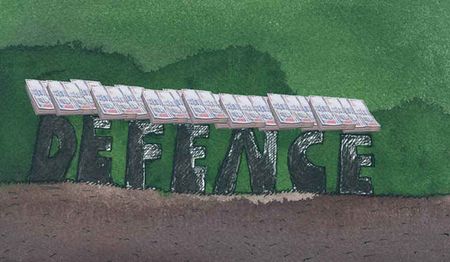 Illustration: Bhaskaran
Given this context, there was both surprise and disappointment that the defence budget was not higher than what it is. Fiscal analysts have complimented Arun Jaitley for sticking to the fiscal deficit target and cutting his coat of arms, so to speak, according to the fiscal cloth. Manohar Parrikar has been complimented for an imaginative use of funds available. Finally, those worried about India’s high defence spending seem satisfied that the increase in spending, if pensions are left out of reckoning, has been minimal.
How does one judge the adequacy of a defence budget without a long-term defence plan? There is no five-year plan for spending, there is no strategic defence review available in the public domain by which to judge whether or not the government of the day is spending enough on defence or not.
A rule-of-thumb number about the adequacy of defence spending that is often used is that it should be around 3 per cent of national income (gross domestic product). Some have wondered where this ‘3 per cent of GDP’ number has come out of. In 2000 the National Security Advisory Board (NSAB), of which I was a member, analysed defence spending in India over the entire post-independence period, compared it with defence spending by major powers and India’s neighbours, and took the view that India’s defence needs would be well served if the finance minister allocated around 3 per cent of GDP to defence. The NSAB’s Strategic Defence Review (SDR) believed the Indian economy and the fisc could bear this burden.
Over the past decade, as India’s GDP doubled, this ratio has actually come down. Today it is estimated to be around 2.25 per cent of GDP (with pensions included). India may be spending enough on defence, but is it spending that wisely? Even the services—Army, Navy and Air Force—differ on that question, each seeking a larger share of the pie. Strategists worry about the ‘bang-for-buck’ and the ‘teeth-to-tail’ ratio.
If we cannot spend more on defence, we would need an economic and a foreign policy that would step in to bridge the gap.