




-
“The Gulf [region] is slowly shutting down and tourism is Kerala’s major hope. But it is in bad shape because of the excise policy, demonetisation and now the Supreme Court order.” - Jose Dominic, MD, CGH Earth Casino Hotel, Kochi
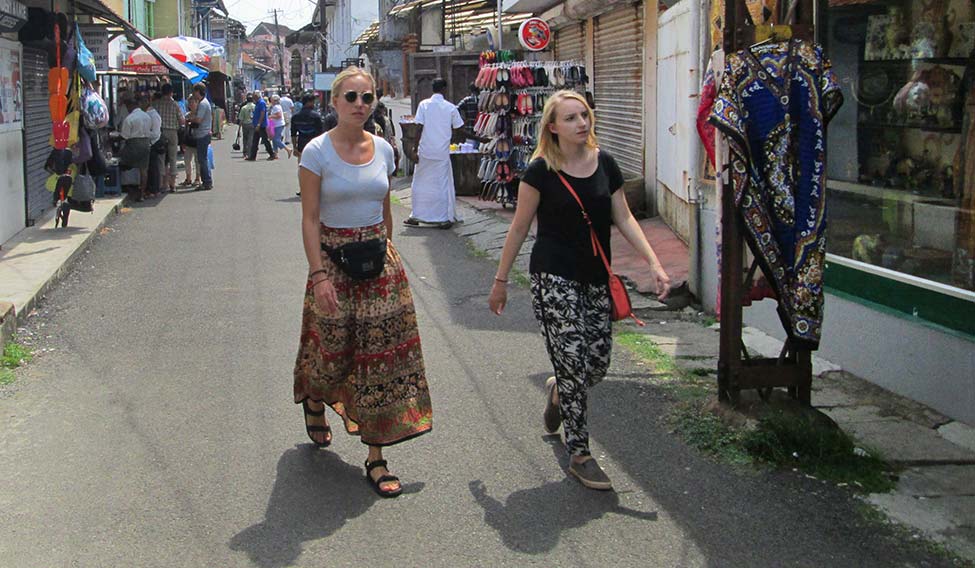
It has been a bad few months for foreign tourists in God’s own country. A few months ago, a 40-year-old foreigner ran away from a restaurant in Munnar without paying the bill as he was cashless after the demonetisation. More recently, foreign tourists were perplexed by the Supreme Court’s order banning sale of liquor near highways. “The word ‘ban’ is not very encouraging,” said Andrew Taylor, a 68-year-old Briton who is a frequent visitor to Kerala. “It tells me that the situation is desperate here and therefore I should probably stay away.”
These are ominous words for Kerala’s tourism sector, already reeling under the double impact of the demonetisation and the state’s own liquor policy, which in 2014 closed down liquor sale by most restaurants and hotels. “This is the death knell as far as Kerala tourism is concerned,” said V. Venu, the state’s tourism principal secretary about the Supreme Court order. “Kerala is densely populated with a crisscrossing of national and state highways. In other states some popular tourism destinations were spared because the highways do not always pass through the cities. But this is not the case in Kerala.”
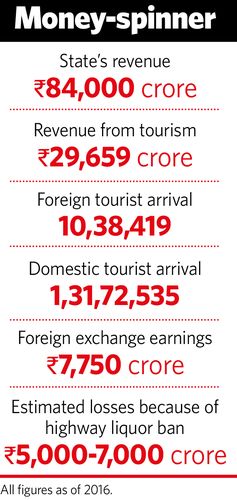
In the two years since the implementation of the 2014 liquor policy, the growth of foreign tourist arrivals in the state had decelerated to 6.2 per cent from 7.6 per cent. It had been 18.3 per cent in 2010. The growth rate of foreign exchange earnings, which was 15 per cent in 2014, reduced to 11.5 per cent in 2016.
In a survey conducted by the tourism department, 32 per cent of hotel and resort owners and 19 per cent of tour operators named the state’s liquor policy as the biggest factor affecting tourist arrivals. Now, after the Supreme Court’s order, the occupancy rates in five-star hotels in the state is expected to drop by 35 to 40 per cent. Venu said that the court’s order could result in revenue losses of about Rs 5,000 crore to Rs 7,000 crore in the state’s tourism industry.
Unlike most other Indian states, Kerala has a lack of manufacturing industry. The service industry dominates Kerala economy, and tourism has been the mainstay. According to the 2016-17 revised budget estimates, the state’s revenue receipts stood at Rs 84,000 crore. Of this, the total revenue (direct and indirect) from tourism was about Rs 29,600 crore.
Tourism accounts for almost 10 per cent of Kerala’s GDP and 25 per cent of the new jobs created. The communist-led government, which was elected last year, increased the outlay for tourism and the sector was expected to create 5 lakh new jobs. “The impact will filter down and affect related employment such as taxis, guides and the local economy surrounding tourist destinations,” said Venu.
Aneesh Sasidharan, a taxi driver who returned from Dubai last year because of lack of opportunities there, said those who made policies and issued orders should try to understand the effect they would have on ordinary people like him. “I returned from Dubai, took a loan and bought my cab. Things were okay last season, but with this new ban it will be difficult to make ends meet. People are talking only about liquor and tourism, but nobody has spared a thought for other related businesses,” he said.
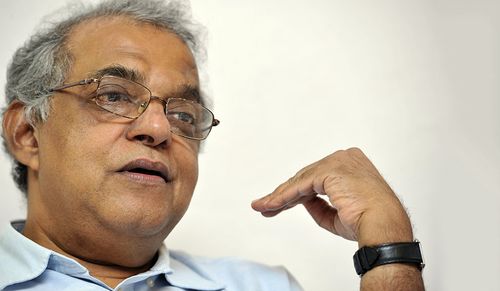 Jose Dominic | Josekutty Panackal
If the restrictions on liquor sales remain, the state’s MICE—meetings, incentives, conferences and exhibitions—is expected to go down by 25 per cent. Around 70 per cent of hotels and resorts have conference facilities and almost 50 per cent of the tour operators handle MICE, which contributed about 30 per cent of the state’s tourism revenue.
Jose Dominic, managing director of CGH Earth hotels, said five-star hotels in Kerala will lose their MICE business to hotels in other Asian countries. “If there is a convention, the customers will demand at least a cocktail dinner. This also affects future development plans. For example, the Lulu Convention Centre, which can accommodate 5,000 people, coming up near Bolgatty will be one of India’s biggest MICE facilities. It would have been a major driver for Kochi and Kerala. But now they may lose out to properties in Sri Lanka,” said Dominic.
The Sri Lanka factor has been much talked about in Kerala since the liquor ban. The flying distance from Kochi to Colombo is about 500km. For a foreign tourist the island country offers great value for money—one Indian rupee is 2.37 Sri Lankan rupees. Not to mention the beaches, landscape and cuisine that make Lanka a mirror image of Kerala. Additionally, ‘God’s other country’ offers visa on arrival, hotels are affordable—7,000 to 12,000 Indian rupees for a four-star hotel room. Liquor and seafood are freely available and fairly cheap.
Earlier, political instability in Sri Lanka had made travellers pick Kerala over the island country. In 2014, when Kerala’s foreign tourist arrival was 9.2 lakh, Sri Lanka only had about 5 lakh. In 2016, when Kerala attracted 10.4 lakh foreign tourists, Sri Lanka got 20 lakh. Many people say this was due to Kerala’s new liquor policy. Kerala tourism has remained competitive because of the state’s natural diversity and niche segments like Ayurvedic tourism. But Dominic said that creation of new barriers would be difficult to overcome. “The Gulf [region] is slowly shutting down and tourism is Kerala’s major hope. But it is in bad shape because of the excise policy, demonetisation and now the Supreme Court order. At the same time, Sri Lanka is thriving because of friendly policies,” he said.
Venu, however, said there was no correlation between what is happening in Sri Lanka and the availability of liquor in Kerala. “Sri Lanka is a country and Kerala is a state,” he said. “Even though there are similar offerings, it is not a fair comparison. And there are also many differences. For example, gambling is legal in Sri Lanka.” He said the 400 per cent increase in the number of foreign tourists in Lanka during 2014-16 was maily due to the improvement in Sri Lanka’s political stability. “The tourist inflow to Sri Lanka was less earlier because it was a war-torn country. Now they are marketing aggressively and hotels are selling cheap. The correlation with Kerala is too simplistic and facile. In any case the international MICE business in Kerala was less than 20 per cent of the total MICE in the state. So, Sri Lanka getting our conferences is a flawed concept,” said Venu
The social impact of such policies and the damage that inflicts on Kerala’s brand recall as a tourist destination are a major issue. A German tourist at Dominic’s Casino Hotel said that the queues (now longer than ever) outside the liquor outlets reminded him of the soup kitchens in Europe after World War II. Said Dominic: “The impression they get is of a nation of drunkards waiting in line for alcohol. These regulations unleash a demon in society. When you drink in a bar there is social supervision. There are strangers there and also the staff. Even if you drink at home, it is okay. But now, the many youngsters in Kerala who don’t have ‘permission’ to drink at home are breaking into other vacant properties and vandalising them.” Another concern is that because of the unavailability of liquor, people will turn to local hooch and narcotics.
Kerala Excise Commissioner Rishiraj Singh said that sudden closure of bars would lead to increased consumption of narcotics. Soon after the Supreme Court order, drugs worth Rs 84 lakh was seized from Kochi. This was one of biggest catches ever from Kerala.
While tourism in the state is definitely not all about liquor, it is evident that salvage measures are needed. Venu said the impact of the order could be mitigated by adopting a forward looking abkari policy. “If we allow some of the three-star and four-star hotels to start their bars again, we will be able to retain some conferences and also provide relief to the sector. I hope the government understands this,” he said. Dominic said the government would do well to let bars it had closed down to reopen if they were away from highways. “Give bar licences to restaurants and house boats, and bring in a policy that will regularise liquor trade all over the state,” said Dominic. Many cities in the west sell liquor in almost every restaurant.
Such solutions are sure to give a boost to the revenues, but promoting liquor consumption could turn out to be a double-edged sword.