



On January 28, Narendra Modi addressed a public meeting in Panjim, said all the right things, promised a new era of development and appealed for a “comfortable majority”.
Around the same time, about 45km away, in Cuncolim—the home turf of the Aam Aadmi Party's chief ministerial candidate Elvis Gomes—only about 200 people participated in the AAP’s rally. Modi’s event was attended by about 20,000 people.
These numbers indicated the magnitude of the task at hand for the AAP, despite a generally positive response towards its candidates.
The AAP, which is making its debut in the coastal state, has urged the voters to bring in change, from the cycle of Congress and BJP governments, by voting in its “honest, young and energetic team”.
Its manifesto has identified key areas of concern and addresses them comprehensively. Finalised after more than 300 meetings with local citizens, the manifesto has something for everybody. It pledges to create jobs, ban casinos, end gambling, drugs and prostitution, “bring back the old glory of Goa” with eco-friendly tourism, and support local taxis and shacks. It has also promised to continue grants to English medium schools.
The party is trying to win over Christians in particular. They form 27 per cent of Goa's population, and are unhappy about the corruption in the Congress and the BJP’s failure to fulfil promises.
 Switching sides: Karen Andrade (right) and Maclean Coutinho,housewives from Benaulim constituency says they were disappointed after voting for BJP last time and this led to them supporting AAP this time | Bhanu Prakash Chandra
The projection of Gomes as CM candidate and the fact that he hails from Cuncolim—a village of Christian warriors who opposed the Portuguese—has helped galvanise Christian voters, primarily in constituencies in South Goa such as Cuncolim, Velim, Benaulim and Cortalim.
“I think they are a good alternative,” said Margaret Jeanette, 63, a resident of Cuncolim. “Even if they are not able to replicate what they did in Delhi, we will at least have a good opposition.”
Karen Andrade, a housewife in Benaulim constituency said: “We had no option last time. A lot of us who traditionally voted for the Congress, voted for the BJP last time, hoping for a change. But, we were thoroughly disappointed. This time the AAP has promised us change, and, after the Bible, I trust the AAP manifesto the most.”
Prithvi Reddy, the AAP’s Karnataka convener and national executive member, said: “There is anger against the BJP and disillusionment with the Congress. But how much of that translates to votes remains to be seen. Goa has very small constituencies. The Congress and BJP MLAs know almost every voter in their constituency, at least by face. So, it is difficult for the voter to switch. Sometimes they are even intimidated.”
He said that though North Goa was generally seen as a challenge for the AAP, it had got good responses in some of their rallies there. “It is confusing, even to us,” he said.
However, not everyone is impressed by the AAP. Shailesh, a resident of Cuncolim, who supports the Congress, said the AAP should first take care of Delhi before capturing Goa. “They are promising everybody everything. They have nothing to lose and everything to gain,” he said.
Congress general secretary Digvijaya Singh told THE WEEK that Goans would not take the AAP seriously. “The AAP is a one-man army [Arvind Kejriwal],” he said. “Many of their MLAs and ministers are facing corruption charges, including their deputy CM. The AAP will be a non-starter in Goa.”
Singh said the traditional support was based on ideology and, while floating votes might go to the AAP or the smaller parties, the major chunk of votes would remain with the Congress.
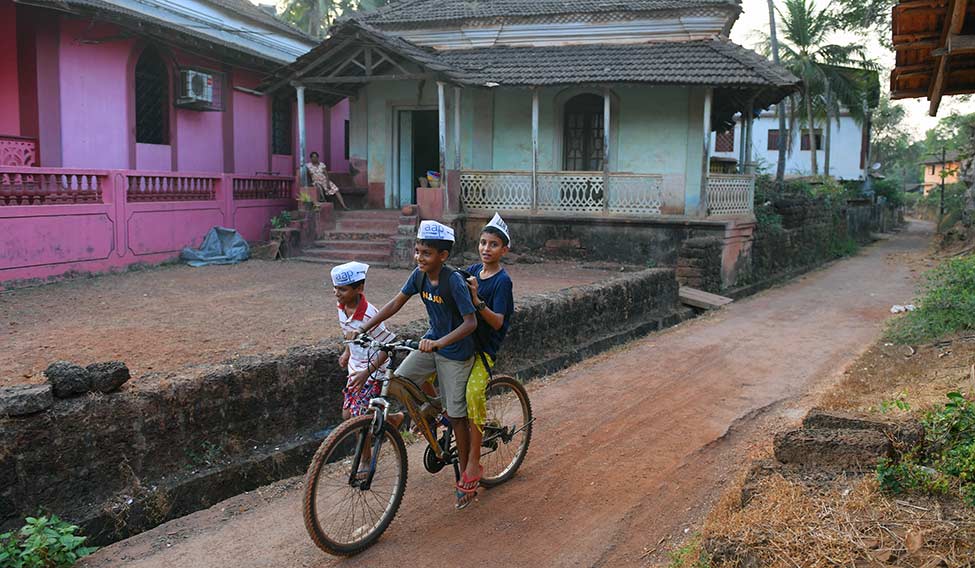
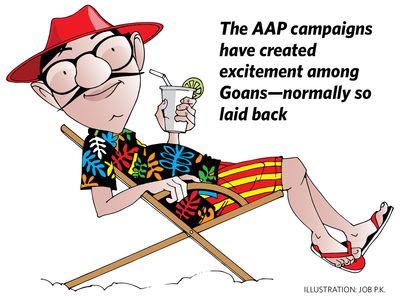
Hundreds of volunteers have descended on Goa from neighbouring states and overseas for the AAP campaign. Their energy and enthusiasm during door-to-door-campaigns and jhadu yatras have created excitement among the Goans—normally so laid back.
Tarak Goradia, a Gujarati born and raised in Mumbai who returned from the US to “do something for his country”, is an ardent supporter of the AAP. He said that the AAP was a platform for everybody who wished to do good.
“During the time spent here, I have realised that even on the issues on which everybody agrees, like banning floating casinos, the governments have done nothing,” said Goradia.“Goa is a state blessed with a great culture and heritage. So the tourism should be more holistic and not just about gambling and drinking, not to mention the water pollution.”
Almost all the citizens, from different communities, THE WEEK spoke to, seemed to be against casinos. Abdul Rehman, a taxi driver in Panjim, said the casinos were destroying Goan values and identity. “I dropped a person outside a casino once and he came back the next day evening totally drunk and having lost all his money. This is harming Goa,” he said.
The BJP had promised to ban floating casinos in 2012. Now both the Congress and the AAP have made the same promise. “But these are big businessmen. I don’t know whether any party will actually do it,” said Keni Fernandes, a hotel owner in Panjim. Casino owners declined comment.
While the AAP’s efforts seem to be bearing fruit in the cities and Christian villages of South Goa, the story is different in the hilly regions and in North Goa.
 Waiting game: Thomas,65,a fisherman from Pernem says he will wait and watch the AAP's performance | Bhanu Prakash Chandra
Constituencies such as Churchorem and Sanguem, upcountry areas in the south, are standing firmly behind the BJP. During a BJP rally in Churchorem, sitting MLA and BJP candidate Nilesh Cabral told THE WEEK, “I am from here. I know everybody. Last time I won by a margin of more than 8,000 votes [in a constituency of 26,000 voters] and I don’t think there is any challenger this time.”
One of the major issues that could have hampered the BJP’s chances in the hills was the mining ban that was implemented during its regime. A good number of the residents here have lost employment and about 6,000 trucks are idle.
But, Sada Doifode, 33, a former truck owner and driver from Chiravand, a village in Sanguem which was badly affected by the mining ban, said it was good for the environment that indiscriminate mining was stopped.
“The government gave packages to rehabilitate truck owners, so where is the problem. The BJP has developed these areas. The Salaulim dam, which gives water to half of Goa, is behind our village, but we had no water till the BJP came to power,” he said. Doifode is now a farmer.
In North Goa, there was good support for the AAP’s rallies in constituencies such as Maem, Pernem and Mandrem—Chief Minister Laxmikant Parsekar’s constituency. But the voters here do not seem ready to experiment yet.
Suresh and Rajesh, fishermen from Mandrem, said only the Congress would be able to do something for them. Thomas, 65, a fisherman from nearby Pernem, said: “The new party [AAP] might win in one or two constituencies. We will see what they do in these places in the next five years. Why should we experiment now.”
Satish Morje, 35, owner of Boom Shack in Morjim Beach (Mandrem), said that Parsekar cared for his voters before he became chief minister. “But, after he became CM he was very busy and has not done much to help tourism here [the coastal areas which come in Parsekar’s constituency].”
Morje said the BJP was going to foreign countries and spending money to advertise Goa, but not doing anything to improve basic facilities for tourists. “When tourists come here, what do we have other than beautiful beaches. There is no parking, no public toilets or showers and no proper garbage disposal system.”
The AAP, he said, might be a force to reckon with next time. “This time they have no chance, even though they are doing good work. They will disturb the Congress and BJP, and, if they win something, that might be a good base to build on,” said Morje.
Evidently, even if the AAP does not achieve its electoral targets, it will not be because of a lack of effort. No matter what the result is, it has established itself as a credible alternative—the third front in Goa.