




-
What was much less evident was sonia’s transformation into a politician of considerable guile and dexterity. The failure to see that misled the BJP into gravely underestimating her subtle outreach to other members of a scattered opposition.
While it is difficult for me, as one who has received so much from Sonia Gandhi, to write “objectively” about her, I also feel duty-bound to celebrate THE WEEK’s review of her contribution to India in the last two decades, that is, the years since December 1997 when she believed it her duty to save the party that her family had nurtured for most of the previous 80 years and that now appeared to be crumbling. She told the journalist Vir Sanghvi that she felt the portraits of her family’s forefathers were frowning at her for not rising to fulfil her duty to them.
The beginning could hardly have been more difficult. For one, there was the wrenching of her life from a privacy she had treasured. For another, the memory of the political assassination of her mother-in-law and then her husband could never be obliterated. Also, her inhibitions about her fitness for, indeed even interest in, a political life could not be easily overcome. So, it was only by gritting her teeth and doggedly doing her duty that she could, over a painful period of initiation, work her way into the manifold compulsions of a life lived in the public eye.
In this, she was hardly the first Gandhi to be hesitant and tentative about taking to the new role. Take Indira Gandhi. Despite having been Jawaharlal Nehru’s official hostess through 17 years of his stewardship of independent India, and having served a somewhat turbulent year as Congress president in 1959 during which she was instrumental in bringing down one of the first democratically elected Communist governments in the world—E.M.S. Namboodripad’s government in Kerala—Indira Gandhi was so tentative in the beginning that Ram Manohar Lohia was able to draw a guffaw that has resonated through the last half century when he described her as a goongi gudiya (a dumb doll). Yet, in a few years, she was being hailed by the entire nation as Durga Ma!
When Rajiv Gandhi suddenly found himself prime minister on the very evening of his mother’s assassination, so awkward was he in front of the cameras that it took a dozen takes for him to stumble through a mere ten sentences of his first address to the nation. Yet, within weeks, he became fluent both on and off-stage, went on to win the largest majority ever, and wowed the country through his first year in office, securing a ‘hurrah’ from even so fierce a critic of his mother (and later him) as Arun Shourie.
Sonia Gandhi’s refusal for the best part of a year to interact with the media, to even say a few words to them either off or on camera, was within the tradition of the always hesitant beginnings of her family. I happened to accompany her on a visit through Andhra Pradesh to Bidar in ‘Hyderabad Karnataka’ a few weeks after she took over as president of the Congress in March 1998. She mumbled a few words to the local pressmen. To encourage her, I tried to congratulate her as she boarded her helicopter to depart. She demurred, shaking her head and muttering that it was a “dreadful” performance.
Yet, by the time the August-September 1999 elections came around, Sonia Gandhi had begun voicing from political platforms her innate self-confidence. She had also, like her mother-in-law, faced down a major challenge from within when Sharad Pawar, Purno Sangma and Tariq Anwar rebelled. Elections over, she took her place in the front row of the opposition, and progressively emerged as an articulate parliamentarian.
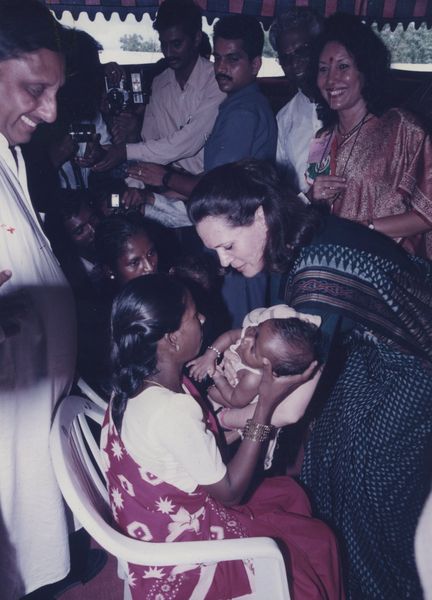 Initiation period: Sonia and Aiyar with families of cotton farmers who had committed suicide in Andhra Pradesh in 1998.
What was much less evident was her transformation into a politician of considerable guile and dexterity. The failure to see that misled the BJP and their ‘India Shining’ programme into gravely underestimating her subtle outreach to other members of a scattered opposition. With consummate political skill, she weaved these disparate forces into a coherent challenge to Atal Bihari Vajpayee’s overconfident government. She brought together opponents who had not only bitterly criticised the Congress in the past, but also mounted the most vicious personal attacks on her, loaded with snide remarks about her place of birth. (I used to counter such attacks by escorting critics to a plaque you can still see in the Central Hall commemorating the day the Constituent Assembly first met in its sacred precincts—December 9, 1946, the very day little Sonia was born. Fate decreed that her life would be tied up with the future of the Indian republic!)
I shall never forget Vajpayeeji’s stunned expression—“shock and awe” just about sums it up—as the UPA government ministers took their oath of office in the Lok Sabha. I was so moved by the utter despair on his face that after taking my oath, shaking the Speaker’s hand and signing the book, I walked up to him and touched his feet in a gesture of seeking his blessings at the crowning moment of my quite unexpected triumph. I received an immediate reprimand from the look in my leaders’ eye when I rounded the corner to resume my seat! (Later that day, Rahul Gandhi came round to my brand new ministerial office to gently inquire whether I had joined the BJP.)
What, of course, added immense lustre to her political persona, and drove her right up to the very top of media polls assessing the most powerful leader in the country, was her astonishing decision to forgo the prized position of prime minister, putting a somewhat bewildered Manmohan Singh in her place. I vigorously protested this decision, followed by several of my newly-minted parliamentary colleagues, but she remained firm as a rock in her decision. Her decision was validated when, five years later, the Congress soared from 140 to 206 seats and the UPA got a further five years in office.
We may have gone into steep decline since then, but the only way forward is the Sonia way—rebuild the rainbow coalition that unravelled in 2014 to keep alive the ‘Idea of India’ that her family and the freedom movement have bequeathed our nation.
Mani Shankar Aiyar is a senior leader of the Indian National Congress.