



We Indians love to debate. Debate for the sake of debate seems to have become the norm though. Thus, certain reiterations in this 'intolerant' climate become essential. Our culture exalts women to the status of God. Durga, Saraswati, Lakshmi—all symbolise essentials of human life. On March 8, I made a statement in Parliament that our culture is not the only iteration of the position of a mother in India. For 'Bharat Mata Ki Jai' or 'Vande Mataram' shaped not only our freedom struggle but also the value system that has been passed over generations to each one of us and the identity of our nation.
When I shout this phrase, with all my heart beaming with pride, I wonder why [Asaduddin] Owaisiji seems to have a tough time resonating with this feeling. The farce of the whole issue is that no one forced anyone to chant 'Bharat Mata Ki Jai'. Owaisi simply created a situation to abuse this slogan out of nowhere. The iteration of the motherland is not one with any religious connotations. If it were so, countries such as Bangladesh and Pakistan would never personify their nation-states.
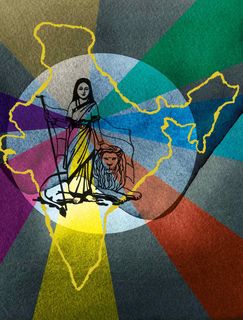 Illustration: Bhaskaran
The origins of ‘Bharat Mata’ can be traced back to a play written by Bengali nationalist Kiran Chandra Bandyopadhyay, which was first performed in 1873. The play, set during the Bengal famine, is about a husband and wife who were forced to flee into the jungle, where they fall in with a group of rebels. A priest then takes them to a temple and shows them Bharat Mata or Mother India. Inspired, they lead a rebellion, which culminates in the defeat of the British. Abanindranath Tagore, nephew of Rabindranath, created what was probably the first pictorial representation of Bharat Mata in 1905, which was widely reproduced and used in the Swadeshi movement.
India is a diverse country, a true union of states. The one thing that binds us all is Bharat Mata. Then why is the utterance of these words seen as forceful? Mahatma Gandhi, in 1936, and Indira Gandhi, in 1983, inaugurated Bharat Mata temples at Varanasi and Haridwar, respectively. Whereas Gandhiji opined that the idea of an undivided India should be promoted and love for the nation should be of utmost importance, today leaders like Sonia Gandhi, Rahul Gandhi and Shashi Tharoor want to bestow upon students like Kanhaiya Kumar the tag of being the modern day Bhagat Singh. The very equation of Kanhaiya with Bhagat Singh is the personification of political doublespeak of the Congress.
Indian communists over the years, under the patronage of foreigners and the Congress, have inflicted harm on the idea of Indian nationhood. They have infiltrated into our educational institutions. Kanhaiya is a symbol of what the communist indoctrination can do to our youth. Since they wrote the official Indian history to suit their perverted objectives, it is time we correct the anomalies within our historic narrative.
Bhagat Singh was a true nationalist; he was never a leftist as claimed by many prime time pseudo-nationalists. In fact, he subscribed to Ram Prasad Bismil's Republican party. Bhagat Singh published The Indian War of Independence –1857, written by Veer Savarkar. Most historians, British as well as Indian, have described the rising of 1857 as ‘Sepoy Mutiny’ or, at best, ‘The Indian Mutiny’. National leaders, however, have regarded it as a planned and organised political and military rising aimed at destroying the British power in India. Savarkar attempted to look at the incidents of 1857 from the Indian point of view.
The immortal words of Bismil and the sentiment echoed by Bhagat Singh on his martyrdom—Rang de Basanti Chola—is an entreaty to Mother India to colour the country with her colours, to free the country from foreign rule and return it to its former glory. This sentiment has been lost to the youth of this nation during the past few decades, but the time has come for these immortal words to be revived and for the youth to commit themselves to the cause of returning Bharat Mata to the glory that it once held in the world.