



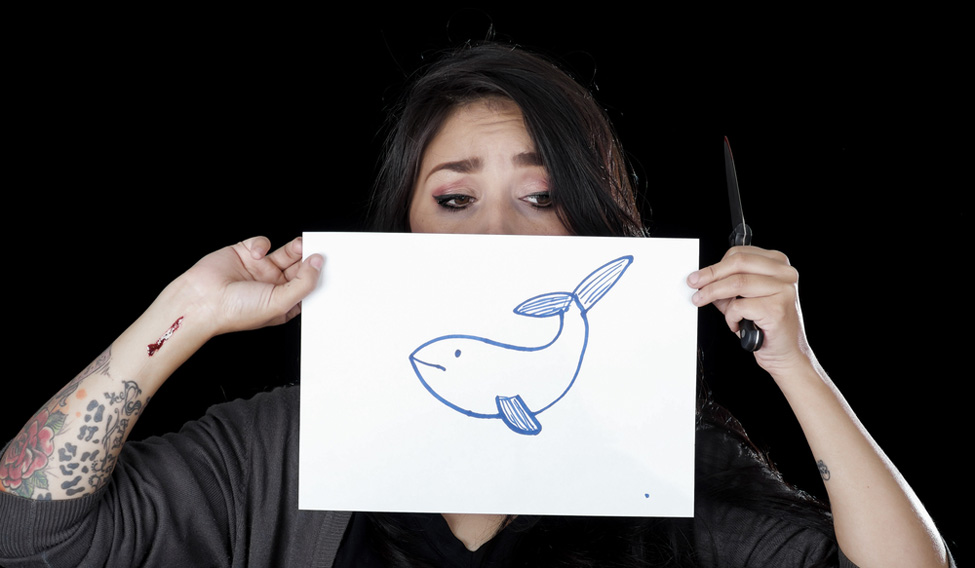
The suicide of a 14-year-old boy from Mumbai has brought the fear of Blue Whale—a sinister online game—closer home. Reports indicate that the online game could be the reason behind the teenager jumping to his death from his building's terrace on Saturday evening. This becomes the first causality from Blue Whale challenge reported from India.
Reports warning parents of the Blue Whale challenge have been doing the rounds on the internet for quite some time now. It is said that the game brainwashes the players, particularly young children, into committing suicide. As of now, reports suspect the game to be responsible for the death of over 130 teenagers in Russia, where the game is said to have originated in 2013. Deaths, however, began to be reported from 2015. Russia's teen suicide rates is second highest in the world, next to New Zealand.
When a player signs up for the game, he or she is assigned with 50 daily tasks that they need to accomplish. Completion of each task takes them to a higher level in the game. In the beginning, tasks may be as simple as watching a horror film. As the levels progress, administrator of the game instructs the players to inflict harm on themselves. As proof, players also have to submit photographs of tasks completed. Committing suicide is the 50th task. According to media, players have also been asked to carve a whale on to body parts.
All the way from Russia
 Rina Palenkova's last selfie
In November 2015, 17-year-old Rina Palenkova posted a haunting selfie with a message that went viral for all the wrong reasons. The teenager posted a picture of herself on the Russian social media site, VKontakte, with a message 'goodbye'. Shortly after this, she killed herself by jumping in front of a train. Police suspected Palenkova to be suffering from depression due to relationship issues with her boyfriend. However, in 2016, Russian newspaper Novaya Gazeta published an investigative feature on 'death groups' on social media. This exposed online communities on Russia's largest social media platform— Vkontakte—that attracted teens, and pushed them to committing suicides. The investigation revealed that Palenkova, too, was involved in such groups which attracted teenagers with a game called 'Blue Whale'. Palenkova is believed to be the first casualty of Blue Whale challenge.
In July, 15-year-old Isaiah Gonzalez from San Antonia in the US, committed suicide, and his parents blamed it on the Blue Whale. “This is a warning to you and your loved ones,” one of his parents posted on Facebook. “If you have not heard of what the ‘Blue [Whale] Challenge’ is, please look it up and teach your kids about it.”
According to a Dailymail report last week, a suspected ring leader of the Blue Whale game in Russia was jailed for three years for inciting young people to kill themselves. Philipp Budeikin, 22, has been reported as the key mastermind of the social media game. Budeikin branded victims of the game as 'biological waste' and told police that they were 'happy to die' and he was 'cleansing society'.
Vulnerable adolescents at risk
Challenges like these point at the dark world of seemingly fun-filled online games. Last year, when the Pokemon Go craze took both the young and the old by storm, there were a fair share of problems—thousands of road accidents due to pedestrians and drivers focussing on catching Pokemon. But there was a dirtier consequence—paedophiles using the game craze to lure young unsuspecting children in to quiet corners.
The fact that an online game could push children to the brink of taking their own lives is unfathomable. These incidents are frightful reminders of what social media and other platforms could do to the minds of vulnerable adolescents. That's probably what Budeikin, the creator of the game, meant when he claimed he was giving the victims the warmth and understanding they didn't get in their lives.
Dr Samir Parikh, director, department of mental health and behavioural sciences at Fortis Healthcare, reminds us of a Netflix series—13 Reasons Why—which sparked a spirited debate in countries like the US. In the popular teen series, the protagonist kills herself, leaving behind 13 audio tapes that explains why she did it. The series drew criticism from school counsellors who said it sends a wrong message by glorifying suicide. Interestingly, internet searches on 'how to commit suicide' were significantly higher after the series aired.
“Teens tend to have a higher trend of suicide in any population. There is also a vulnerability among teens. Such challenges reach out to teenagers who are part lonely, or is being bullied, dealing with self-esteem issues or trying to prove themselves. This is like playing a dare challenge. Once you get into the flow of things, and reach the last few steps, rather than realising the consequence of the step, the process takes over you,” Parikh adds.
Young children and teenagers are experimental, and have poor logical thinking. Sometimes there are certain underlying emotional problems that kids go through that often remain unaddressed, says Dr Zirak Marker, child and adolescent psychiatrist. Non-suicidal self harm has also become a rage among young adults and teenagers with online chat groups and videos teaching kids how to cut, warns Marker. Subtle peer pressure and the sense of wanting to belong to a group, plays a major role in all these, he adds.
Globally, parents are being alerted about the challenge, and advised to keep an eye on their children's activities. “It is not just about what parents have to do,” says Parikh. “It is about social media literacy and how we need to warn children about such dangers that can influence their thinking patterns. When such a thing happens children need to know to whom they can reach out to.”
Incidents like these should be a wake up call. We need more healthy conversations about mental health, says Marker.