



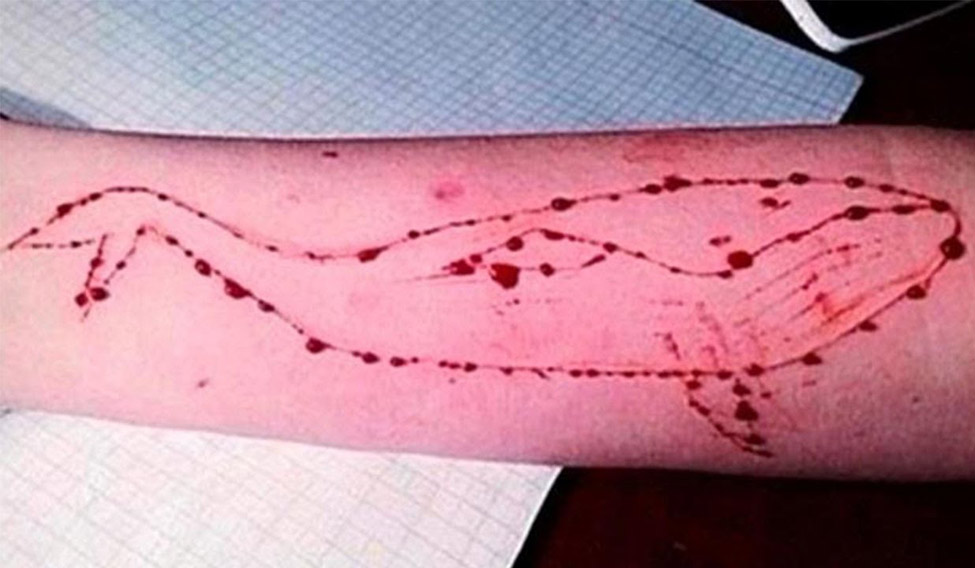
The Blue Whale Challenge seems to have been taking more victims from India recently. Earlier in August, a 14-year old boy jumped from the terrace; a suspected victim of the Blue Whale challenge. A few days later, a 13-year old was stopped from jumping off the terrace of his school building by his friends in Indore. A class 10 student recently committed suicide in West Midnapore and the game has been suspected as the cause. Just two days ago, a 16-year old boy from Kerala hung himself. His mother told the media that she thinks it is the Blue Whale challenge that drove her son to kill himself, especially since he had discussed it with her. In wake of these suicides, Union Minister for Woman and Child Development Maneka Gandhi wrote to Home Minister Rajnath Singh and Information Technology minister R. S. Prasad to ban the game from the country.
The game has claimed 130 lives in Russia itself and close to 100 in US, China and UK. The challenge includes 50 tasks including carving out different initials on yourself and watching horror videos. The proof of each task should be sent back to the challenger in form of an image. The alarming part, however, is that all it takes is a status message with certain hashtags to be accepted into the challenge. The question here is, will a ban really be effective? Shouldn't deeper, psychological problems of teenagers be addressed with keeping in mind other dangerous games that simulate violence that are being played by the youth today? Philip Budeikin, the founder of the game may be serving a sentence, but that hasn't stopped others entrusted to carry on the task of enticing other gullible victims into self-harm.
“The Indian government's direction to internet companies like Google and Facebook to remove all links which direct users to the (Blue Whale) game is easier said than done. Yes, the companies can and in all probability will, disable known sites that lead to the game. But there is no way to totally prevent access to mirror sites which hide behind aliases that are virtually undetectable and reside in the so-called dark web. In any case Blue Whale is part of social media and the persistent or just curious, can always find ways to reach whatever internet sites they want in spite of any firewalls, through online word-of-mouth suggestions. Educationists and psychologists generally agree the more pragmatic response is to encourage the young to treat such dubious games with healthy scepticism and not be led to perform any bizarre acts out of a perceived peer pressure,” says technology expert Anand Parthasarathy.
As for the recent cases of suicide, it hasn't been to establish that the Blue whale challenge is the cause behind it. Parents and teachers still seem to be trying to grasp this concept. One of the main problem seems to be that the game isn't an app that that can be downloaded. It looks more like an elite club that one gets to join only if one promises to unwaveringly follow all the 50 tasks set to them, while knowing that the end result will be taking their own life. This makes it even harder, as the people who get in touch with the youngsters with these tasks could be anyone from any part of the world. “They could also be using any social media platform,” as a professor at IIIT Bengaluru, T.K. Srikant points out.
“Not much can be achieved by banning the game. It will only make the game harder to be found. Which to an extent could help. But, since it can be hosted on any platform, teenagers could access it literally from anywhere. A ban will not make the game go away. So far from among other games that simulate violence, this seems to be evil of them all,” he adds.
So, rather than just banning the game, it would be prude to counsel students to take it with a pinch of scepticism. Counsel them to prevent them from attempting any of the challenges or revealing vital information to the 'curators' who could later use the information to blackmail them.