




-
Overnight, the likes of Harmanpreet Singh, Harjeet Singh, Armaan Qureshi, Vikas Dahiya and Dipsan Tirkey have become recognisable names.
After every match India played at the junior world cup hockey in Lucknow last month, there appeared an Indian player in the dining hall, wearing a woman’s pink dress. The player didn’t look uncomfortable, nor did his teammates. But players from other teams were definitely curious. It later emerged that the player in the pink attire had earned the ‘colours’ for having played either the best or the worst.
Many such stories of camaraderie and bonding have emerged in the wake of the successful campaign of the young Indian team, which lifted the trophy in front of a delirious home crowd. Overnight, the likes of Harmanpreet Singh, Harjeet Singh, Armaan Qureshi, Vikas Dahiya and Dipsan Tirkey became recognisable names.
The coach, Harendra Singh, too, assumed heroic colours in the stories—how he would walk around barefooted through the hostel corridors to check whether the lights were switched off at 10pm. Or how he warned the players against getting their families or coaches to call him to recommend their names for the final squad. “I sent out this message to the players, ‘If I get even one call asking to pick any one of you, it will be either my last day or yours,’” said Harendra.
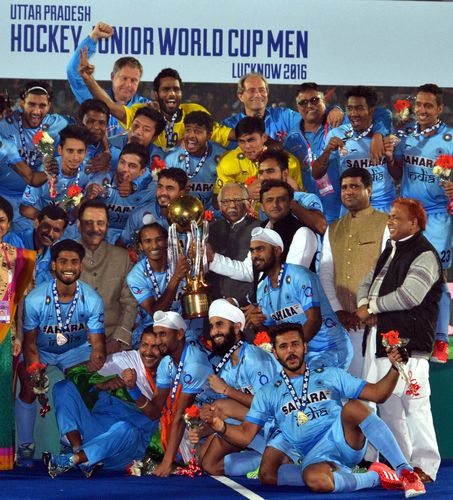 The victorious Indian team | PTI
Even the death of some of their dear ones did not deter members of this young team from their mission. In July 2015, midfielder Santa Singh from Sant Nagar, Punjab, lost his sister. But he did not go to the funeral. Goalkeeper Krishan Pathak, who lost his father just as he was about to leave for his first international tournament in England, too, opted to stay with the team. Harendra lost his cousin, an Army man who was fighting insurgents in Mizoram, just ahead of the Sultan Johor cup in Malaysia, his first competition as junior national coach. He also did not attend the funeral.
And, the young team is now reaping the rewards of its hard work and sacrifice. “Here in Kolkata, we are being invited for felicitations almost every day,” said Gurjant Singh, who was the man of the match in the final game of the world cup. Gurjant and his teammates were in Kolkata to take part in Beighton Cup, the oldest hockey tournament in India. “Even taxi drivers recognise us, and people are hopeful that we will bring more trophies to India,” said goalkeeper Dahiya.
Following the world cup triumph, life has changed completely for skipper Harjeet Singh, who hails from a poor family in Kurali, Punjab. He got Rs 25 lakh from the Punjab government and 05 lakh from Hockey India. “Forget a hockey stick, we could not afford half-a-litre of milk,” said Harjeet. “Hockey has given me a new life. Today, I could build a house in Kurali, my hometown.”
Harendra, who works as director, operations, at Terminal 3 of the Delhi airport, is busy catching up with his family after the world cup victory. At his flat in the sprawling Air India colony, the steady stream of well-wishers, relatives and media continues even now. Winning the cup has been a vindication for him, that he can coach at the highest level. “He has got much more experience under his belt now as coach from the time when I played under him,” said P.R. Sreejesh, captain of the Indian senior hockey team. Sreejesh was part of the bronze-winning 2005 junior world cup team, which was coached by Harendra.
As coach of the senior team in 2009, Harendra was shattered by India’s loss to the Netherlands in the Punjab Gold Cup tournament held in Chandigarh. He then shocked everyone by stating that the Indian team needed a foreign coach. “I realised that India had great hockey players, but no great coaches. I updated myself and used modern technology, hoping to groom these youngsters. I spent money from my own pocket, enrolled in coaching courses of the International Hockey Federation and went to tournaments on my own,” said Harendra.
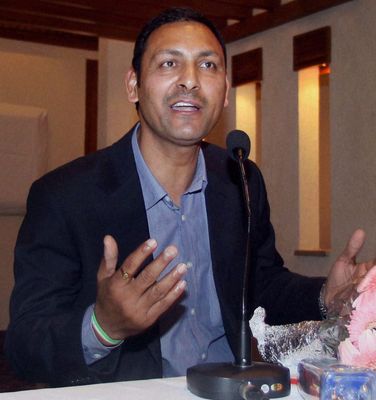 Winning position: Harendra Singh’s message to his team was to focus on the basics | PTI
In the 2014 junior nationals held in Chennai, he was the coach of the Comptroller and Auditor General of India team. Roelant Oltmans, high performance director of Indian hockey [later head coach], was also present in Chennai during the tournament. A few days later, Harendra got a call from Oltmans and N.K. Batra, president of Hockey India, offering him the junior team’s coaching job. Harendra accepted, and selected 60 players to begin with. The number of players was later brought down to 48, then 33 and, finally, to a core group of 25. The toughest task, according to Harendra, was to select the final 18-member squad for the world cup.
Harendra’s first message to his players was to focus on the basics. “Till your basics are not sound, your skill and ability are useless,” he said. “Stopping and passing” was his mantra. He docked points for creating one-touch goals, while more points were given for two-touch efforts and maximum points for scoring through penalty corners. “I showed them how stopping and passing was a big factor in taking their hockey forward,” he said.
A major part of the coaching team’s efforts went into mapping the players’ mental makeup. Harendra had regular one-on-one sessions with his players. “A player from Punjab has a confidence level that cannot be expected from a player who hails from the tribal belt of Odisha. In these sessions, a lot of players broke down, too.”
Another matter of pride for Harendra is the fact that 32 of his 33 wards are now playing in the Hockey India League, which had a major role in their skill development. “It is the base to get international exposure for all domestic players, playing against top players, under top foreign coaches,” said Sreejesh.
The synergy between the senior and junior teams prompted Oltmans to draft players like Harmanpreet, Dahiya and Mandeep Singh into the senior side. He was all praise for the junior team’s performance in the world cup. “Mentally, they were strong,” said Oltmans. “There was no panic when India trailed. You just have to stick to the plan that has been determined before the match. That yields positive results. In the past, individual players thought they could equalise and solve the problem. But that’s not the way it works. That was unIndian-like, which was good in this tournament.”
That was perhaps the best compliment Harendra could get. In his view, individual gamesmanship has been the bane of Indian hockey. “I used to tell the boys to keep the Olympian tag out of my camp. This has ruined Indian hockey,” he said.
Under Harendra’s watch, Indian hockey has made a giant leap as bench strength has been created and a talent pool prepared. Taking these positives forward will be the real test for Indian hockey and the young players. Hockey India has struck gold by creating a system; sustaining it will be the ultimate prize for Indian sports.