



Only three move in the heat of the day—the spiny-tailed lizard, the Baori and the forest guard—each in pursuit of the other.
—saying among tribals in Rajasthan
The last ray of the sun left the grasslands of Chhapar village in Rajasthan’s Churu district. A black buck appeared to signal its herd to return to the Tal Chhapar Sanctuary; the herd had strayed into the village pasture. A laggar falcon slowly descended, and then swooped down on a spiny-tailed lizard. The reptile, however, was not inclined to be the raptor’s dinner. It scurried to a burrow, where it would spend the night.
The burrow would be closed till dawn. When the sun comes back up, the lizard would again venture out, trying to feed on scrub and grass, and looking to survive one more day without getting caught by raptors and hunters belonging to the local Baori tribe.
 The oil extracted from a lizard’s tail is believed to have medicinal qualities; a tribal showing the extract.
The Indian spiny-tailed lizard, named so because of the distinctive scales on its tail, is commonly found in areas near Thar Desert in Rajasthan. According to Surat Singh Poonia, assistant conservator at the sanctuary, spiny-tailed lizards are primarily herbivorous, and they dig underground lairs to shelter themselves from danger.
They are also an important link in the food chain. As many as 46 kinds of raptors, including eagles, harriers and buzzards, survive on these lizards while they transit the desert in their migratory route. The lizards are also the preferred food of the indigenous laggar falcons and tawny eagles.
Records say the territory of the spiny-tailed lizard once stretched to Kannauj in Uttar Pradesh. “If the unplanned growth of towns continues in the present manner, the population of spiny-tailed lizards will see a 90 per cent loss in the next 10 years,” says S.K. Das, assistant professor at University School of Environment Management (USEM) in Delhi’s Guru Gobind Singh Indraprastha University.
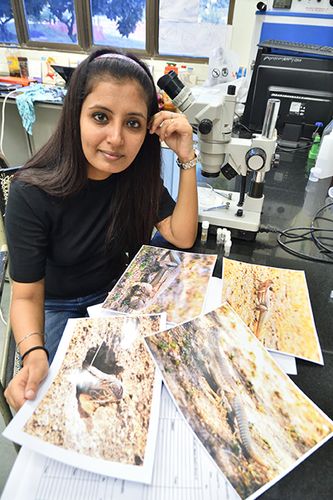 Mandeep Kaur, a researcher who is working on a thesis on the reptile.
It does not help that the lizards are part of tribal lore. The Baoris believe that the oil extracted from the lizard tail can help increase one’s sexual prowess. Earlier, before the government banned the poaching of spiny-tailed lizards, Baoris selling sanda ke tel and displaying lizards that had their spines broken (so as to hinder movement) were a common sight in the region. Even now, some villagers poach lizards for food and oil.
Researchers, too, find the spiny-tailed lizards interesting. Mandeep Kaur, a PhD scholar at USEM, had been wondering whether to do her thesis on spiders or reptiles when, during a field trip, she saw a spiny-tailed lizard. “It was like love at first sight,” said Mandeep, who instantly decided that the creature, about which not much is known, would be the subject of her thesis.
Her field study, however, has been exacting. The lizards hibernate in winter, so she could start search missions only after March, when summer began. During one such mission in Churu in June, Mandeep fainted from dehydration, as the temperature had touched 50 degrees Celsius.
Lizards can survive extreme hot weather. What they cannot survive, apparently, is rapid urbanisation. Pratap Singh Katari, associate professor at the department of zoology in Dungar College in Bikaner, said that, as recently as ten years ago, spiny-tailed lizards could be spotted within the city. But development apparently has pushed them to the outskirts. Perhaps, their presence is one reason that Bikaner and Churu now host flocks of migratory raptors.
Common name: Indian spiny-tailed lizard
Scientific name: Saara hardwickii
Genus: Uromastyx
Length: 40-49cm (male); 34-40cm (female)
Weight:100-400gm
Named after Thomas Hardwicke, a British major general and naturalist who, along with zoologist John Edward Gray, published Illustrations of Indian Zoology in 1835.