



-
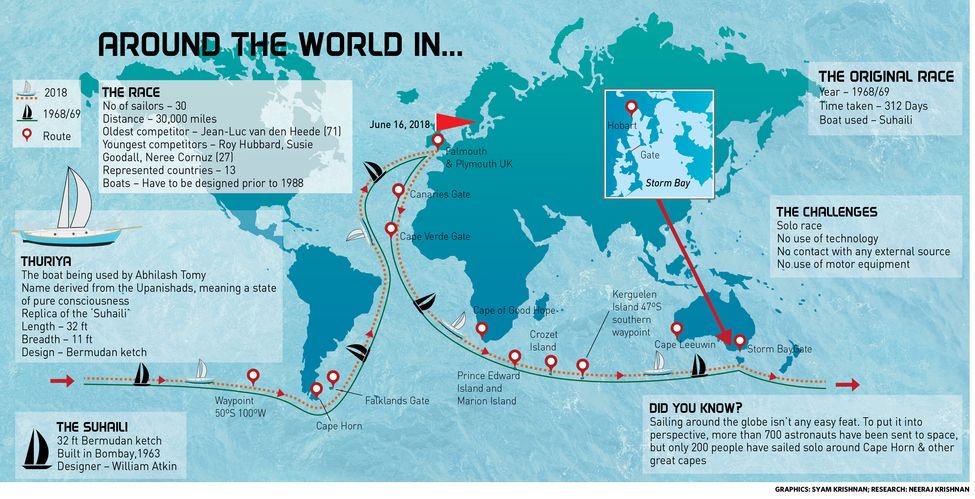
Tomy is one of five special invitees to the Golden Globe Race 2018 (GGR), which will flag off from Plymouth, the UK, on June 30, 2018.
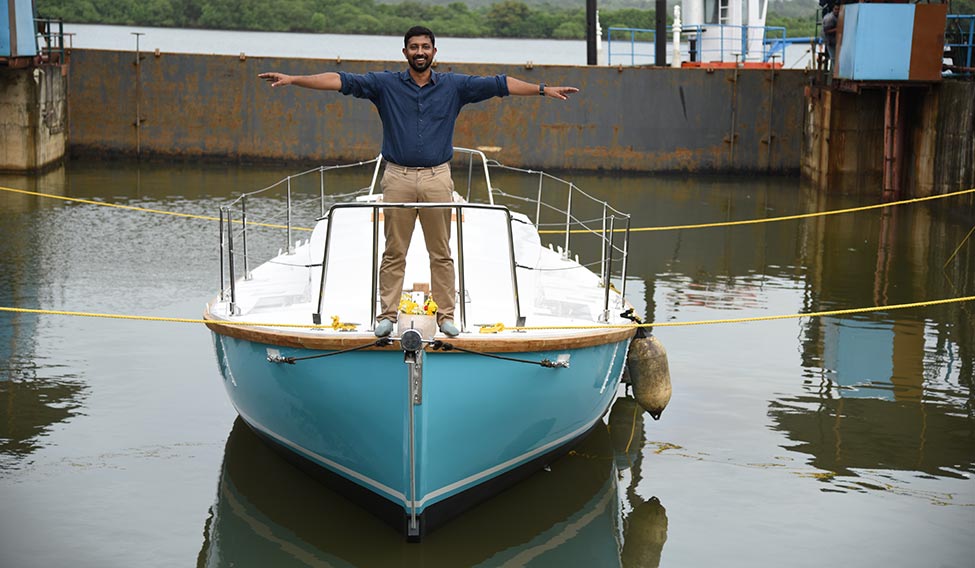
She is all of 32ft, and she takes your breath away. The deck is snow white. The gunwale and the bowsprit are laminated wood. The portholes are steel. It is all teal, just about until the waterline. A white stripe. Then it is indigo all the way down. Designed in 1923, she is a Bermudan ketch. When her two masts are up, she’ll carry four sails. Thuriya is the name.
On August 7, Nariyal Purnima day, the pantheon of Indian sailing was present at Aquarius Shipyard in Divar Island, Goa, to witness her launch. The first Indian solo circumnavigator, Captain (retd) Dilip Donde, sported a red polo T-shirt that said Suhaili. There was Commander Abhilash Tomy—the first Indian solo, nonstop circumnavigator—with a red Surya Kiran pin on the collar of his indigo shirt. And, there was Ratnakar Dandekar, owner of Aquarius and the man who built three landmark vessels—the sloop, INSV Mhadei, which both Donde and Tomy sailed around the world; her sister, the INSV Tarini, which will soon set off on the Indian Navy’s first all-woman circumnavigation attempt; and, this wee ketch.
For native fishing communities, Nariyal Purnima, literally the coconut full moon, is auspicious as it signifies the end of the monsoons and the start of the fishing season. At the dock, the Thuriya hung from canvas cradles from two cranes. Tomy and an officiant stepped on to the Thuriya, performed a pooja, smashed a coconut and opened a new chapter in Indian sailing history. The cranes gently lowered the boat into the water.
On March 31, 2013, after his 150-day circumnavigation, Tomy was officially received by president Pranab Mukherjee at the Gateway of India. After reporting to the supreme commander that the assignment was complete, and after the echoes of the gun salute had died away, Tomy asked Mukherjee, “Sir, can I go for one more round, please?” Looks like the man is about to get his wish.
Tomy is one of five special invitees to the Golden Globe Race 2018 (GGR), which will flag off from Plymouth, the UK, on June 30, 2018. And, the Thuriya will be his vessel. GGR commemorates the golden jubilee of the first solo, nonstop circumnavigation by Sir Robin Knox-Johnston in 1968/69. RKJ, as Sir Robin famously signs off his emails, sailed around the world in the Suhaili, which was built in Mumbai. The Thuriya is a replica of the Suhaili. And, she will be the only Suhaili-replica at the start line in Plymouth.
So, what is one more circumnavigation to Tomy? Nothing could be farther from the truth. This race will be like no other, as participants are permitted to use only technology that existed in 1968. So, no GPS, no internet, no desalinators, no pocket calculators, not even a digital watch. Logs must be handwritten. Only film cameras are allowed. All regular communication will be via ham radio. Tomy will have to rely on a sextant, paper charts, chronometer, barometer and compass to find his way across the water world. And, then there is the money.
While the Navy has expressed its support for his entry in the race, it is not funding it. The expression of support is crucial as he is a serving officer. So, how much money will put him at the start line in Plymouth? “Around Rs 7.5 crore,” he said. “I wanted to build the boat in India, and there is no one here I trust more than Ratnakar. He has not billed me for it, but I do have to pay him. And that alone will be around Rs 2 crore, plus taxes.” The Navy projects did not have to factor taxes, but this venture has to. That’s 38 per cent, of which 28 per cent is GST.
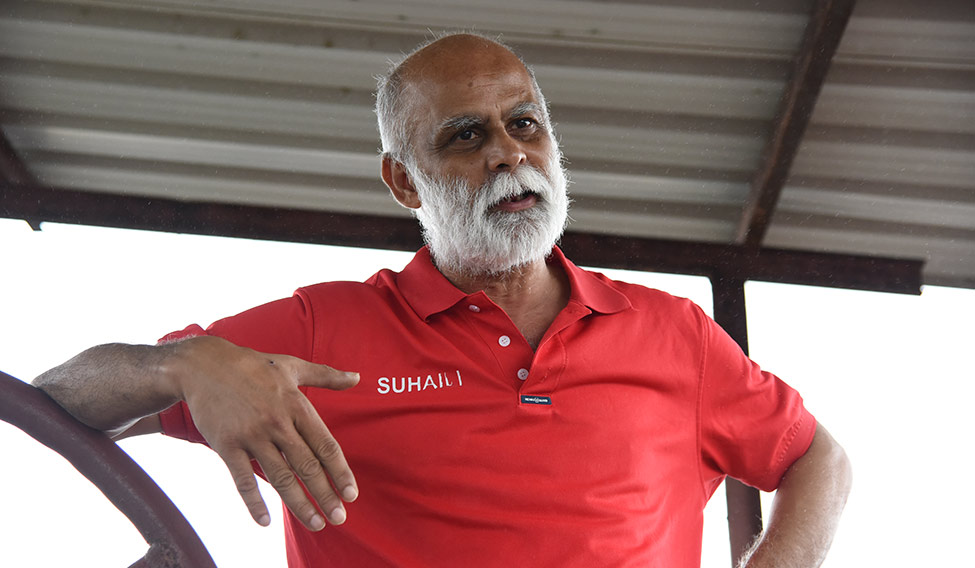 Living legend: Captain (retd) Dilip Donde, first Indian solo circumnavigator. Donde will be Tomy’s manager for the race | Vipin Das P.
Then, there is the equipment. Sails, sextant, charts…. “Paper charts are about 25 pounds a chart, and I need them for all oceans,” he said. “Sextants cost around Rs 2 lakh.” My eyes pop, and he adds, “These are not the ones you get in Chor Bazaar! They won’t take you from here to the bathroom. I am talking of Cassens & Plath. The sextant must be accurate. If it is off by as much as one second, your position can be off by around 2 kilometres. Plastic sextants tend to warp in the heat. So, it has to be a metal sextant. And, only one metal. If there is more than one metal in the device, there will be accuracy issues. Different metals expand at different temperatures.” The Cassens & Plath website said, “Trust is good, control is better.” Absolutely, especially when one is alone in the middle of the ocean.
Then, there is the speed and the size of the boat. The Mhadei was based on a relatively new design—Tonga 56, by Van de Stadt Design—and was commissioned in 2009. GGR rules specify that participating boats must have been designed before 1988. Hence, Tomy had to go with the Suhaili’s design—Eric, by William Atkins—which came off the drawing board in 1923! The Mhadei is 56ft long; the Thuriya is 32. Which means less space for stores and creature comforts. The Mhadei’s main sail alone was around 1,000sqft; the Thuriya’s total sail area is 726sqft. Less sail = less power = longer journey.
So, basically, the commander has fewer supplies and a longer journey. “I finished my circumnavigation in 150 days, and I expect to take twice that time for GGR,” Tomy said. Reality hits only when one realises that the Mhadei had 600lts of drinking water in her tanks, 300 in bottles and a reverse osmosis plant, while the Thuriya has just 240lts in her tanks. “That is less than a litre a day. So, I will be dependent on rainwater,” said Tomy.
Will that be his greatest challenge? “No,” he said, “Navigation will be.” While the earlier voyage had the benefit of electronic navigation equipment which pinpointed his position, this voyage will test his navigational skills.
Commander Riji K. Krishnan, submariner and long-range navigation specialist, said, “What is being demanded of him lies at the core of navigation. No frills, the very basics. And then, he not only has to get from Point A to Point B, he has to do it first. We are all taught celestial navigation when we are trainees, but it is mostly as Plan B. Here, it is the only plan available to him.” Another dark area will be weather data. Tomy will only receive general weather data available to all merchantmen.
So, is there nothing new on the boat? “Clothing can be new,” he quips. “Security systems have to be par with current global standards. And, oh, lighting on the boat can be LED.” Tomy plans to fix the masts—by Seldén Mast AB, the Netherlands—on the Thuriya by September and then put her through sea trials. Then, it is on to Cape Town in late December. “I want to test her and see the breakable areas, and correct it all there,” he said. “Then, if I have money, I’ll ship her to England. If not, I’ll sail her.” The prize? Finishers get a GGR plaque, podium finishers will get trophies. No purse as of now.
Help has been coming from various corners, thankfully. Peter Förthmann, who owns a company called Windpilot, which makes self-steering devices for yachts, has donated one of his products to Tomy. Donde, who now lives in Goa, has agreed to be Tomy’s manager for the race. There is always Dandekar. And, old volunteers like the Mumbai-based Swapnali Dhabugade have come back to support him this time, too. Tomy has also put out a crowdfunding appeal on ketto.org.
While Tomy is sure that Dandekar has built an “honest boat”, the man himself admits that there is pressure. “Well, we have done well the first two times [INSV Mhadei and Tarini], so it is only natural that we want to match it or be better,” Dandekar said. “People still worry if we will be race-ready. We have no doubts. None at all. We started with no money. The designs cost only $200 or so. I began with the wood and other materials that I had. No regrets and no doubts.”
Another man who seems to be quite confident of Tomy and Thuriya is RKJ himself. Speaking to THE WEEK, the sailing legend said, “Some 220 people have sailed solo around the world, only about 80 nonstop. Abhilash is one of this very small, but exclusive group. Compare this with more than 600 that have been into space! So, Abhilash has already proved himself. He comes to the Golden Globe Race 2018 as one of only two (I think, the other is Frenchman Jean Luc van den Heede) who have completed a solo, nonstop, circumnavigation before. He does not need me to explain that he is special, he has proved it.”
Tomy said that he is not competing against anyone. “I just want to finish in one piece,” he said. Lt Commander (retd) V.C. Tomy, Abhilash’s father, said, “His mother and I have never discouraged him. We stand by him. We are confident that he will do well. But, as parents, we cannot be separated from our fears, can we be?”
Tomy has given up another dream to take up this race. The Navy had planned to send him on an aerial circumnavigation as he is basically a reconnaissance pilot. The project, codenamed Vayu Parikrama, was supposed to be done by microlight aircraft. “I had kept aside 2-3 years for it,” said Tomy. “There were a lot of problems, and we were missing the weather windows every year. So, there is no such expedition anymore. I am focusing on GGR.”
The GGR is special to Donde, too. He had trained with RKJ for six weeks after he decided to do the circumnavigation. Once the Mhadei was commissioned, RKJ flew to Goa to take her out for trials and suggested improvements. And, Tomy was manager of Donde’s circumnavigation. So, RKJ is special to both of them. “When I volunteered for him for six weeks, I said the only compensation I wanted was an autographed copy of his book, [A World of My Own]. Before he signed it, he wrote, ‘With this, I am booking the first copy of your book.’ That was his confidence in me, in us. And, when my book [The First Indian] came out, I sent him the first copy.”
The Thuriya was in the water, yet it was not easy to forget the Mhadei. Where is she now? I asked the circumnavigators. Both sidestepped the question smoothly. A guest who overheard my question pushed me in the direction of Col (retd) Milind Prabhu, president of the Goa Yachting Association. “The Mhadei was grounded on Miramar beach,” he said. Ashwin Tombat, a businessman, and Prabhu had gone to Miramar to see the casino, MV Lucky 7, that had grounded there, and they spotted the Mhadei “heeling at wild angles” and “whiplashing”, which is sailing parlance for the mast thrashing from side to side. “Then, they set the jib, swung in the wrong direction, finally swung free and motored off,” said Prabhu. “I suspect she has suffered serious damage.” And, a source who did not want to be named, pulled out a smartphone and showed me an image of a mast that had a crack running all the way across. “It is the Mhadei’s mast,” he insisted. Tombat exclaimed: “A mast that has survived two circumnavigations and three Cape to Rio races! And, some clown manages to break it on a sandbar in Goa. Can you believe it?”