



Is it old wine in old bottle? There has been lukewarm response in political circles to the suggestion made by Jammu and Kashmir governor N.N. Vohra to create a ministry of national security. It will replace the massive home ministry, which not only handles internal security, but also looks after pension of freedom fighters, relations with state governments, appointment of governors, administration of Union territories, disaster management and enforcement of Hindi as the official language.
From the colonial era, the home ministry has been the instrument for handling policing, princely states, oppressing the freedom movement and ensuring that the writ of the centre runs in all territories. Jawaharlal Nehru and Vallabhbhai Patel decided that the ministry will continue handling these issues (instead of persecuting freedom fighters, the ministry started giving pensions to them), as Patel handled the integration of princely states into the Indian Union as the powerful home minister.
A prime minister who took the idea of security ministry seriously was Rajiv Gandhi, who asked his cousin Arun Nehru to handle internal security as an independent charge, leaving the nonsecurity departments to the cabinet minister for home affairs Buta Singh. After Arun’s fall from grace, P. Chidambaram, a newcomer of promise was given charge of internal security. But, thereafter short-term prime ministers V.P. Singh and Chandra Shekhar junked the idea; P.V. Narasimha Rao partially revived it, by giving internal security to Rajesh Pilot in the wake of the Babri Masjid demolition. But, as Pilot flew too high, home minister S.B. Chavan complained and the young minister was grounded. Since Chavan, there have been six home ministers in 22 years, but they have all held onto internal security, controlling the Central paramilitary forces, Intelligence Bureau, National Investigation Agency, as well as troubled regions of Kashmir, the northeast and Naxal-affected districts.
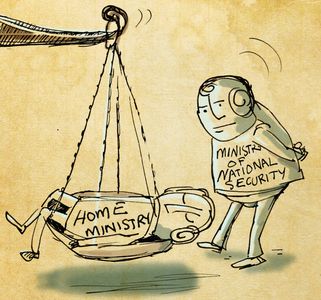 Illustration: Jairaj T.G.
However, the powers of the home ministers have not been absolute as Intelligence Bureau reports directly to the prime minister on all sensitive political matters, and prime minister Atal Bihari Vajpayee in 1998 created the powerful post of national security adviser, giving the job concurrently to his principal secretary Brajesh Mishra. Manmohan Singh and Narendra Modi gave these two jobs to different officers, but the NSA has been used to extend the prime minister’s control on day-to-day affairs of the home ministry. On the other hand, the national security ministry would mean agencies now under different ministries—Enforcement Directorate from finance, Research and Analysis Wing from cabinet secretariat, Central Bureau of Investigation from personnel and training—would come under the national securities minister, who would be a powerful figure with so many spies and policemen under his control. No prime minister would willingly concede such powers to a minister, as it can threaten political stability.
sachi@theweek.in