



The assertion of recently inducted junior minister Anant Kumar Hegde, that the BJP government will change the Constitution, has made eyebrows go up among the senior ministers. Hegde is known more for his pyrotechnic statements on minorities and their “appeasers”, than domain knowledge of skill development, which is his portfolio. He has made a categorical statement on the Constitution, which has so far not been propounded in public by Prime Minister Narendra Modi or his ministers.
Modi has not initiated any major move on the Constitution, as his plate is full of issues from different fronts like economy, national security, foreign affairs and public administration. He can use the comfortable majority in the Lok Sabha to steer the nation in the direction he wants. But, he also knows that the BJP, without its allies, simply does not have the numbers in Parliament to make fundamental changes in the Constitutional scheme of things.
Indira Gandhi was the only prime minister who went for sweeping changes in the Constitution, including introduction of the words “socialist secular” in the preamble, to make India a “sovereign socialist secular democratic republic”, in 1976. The Bharatiya Jana Sangh, and later the BJP, have had serious differences especially with the characterisation of “secular”. The party is comfortable with “socialist” as it is a far more elastic and religion-neutral word. Not only did Indira change the preamble, she extended the powers of the executive and the Parliament, limiting the judiciary and curtailing individual liberties.
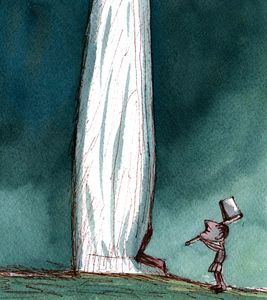 Illustration: Bhaskaran
The Janata Party government, into which the Jana Sangh had merged, undid most of the provisions made by Indira. The party has insisted that post-independence leaders, led by Jawaharlal Nehru, did not appreciate the “civilisational consciousness of India”, and had instead borrowed the “alien” western models of governance. The party has led agitations for scrapping article 370 which gives special status to Jammu and Kashmir, a demand reiterated in Modi’s 2014 manifesto. Another persistent demand is for enforcement of uniform civil code, which is a directive principle in the Constitution.
Now, the Law Commission has been asked to prepare a draft code. In 1999, the BJP promised, and, NDA-1 constituted a commission to review the working of the Constitution and make changes. Though the commission gave its report to prime minister A.B. Vajpayee, there was neither time nor majority to implement the changes. While the party wants comprehensive changes, Hegde represents the stream which wants to remove provisions like articles 29 and 30, which give special status for minorities, and wants to enforce a uniform civil code for the sake of ending “positive discrimination” decreed in these articles.
sachi@theweek.in