



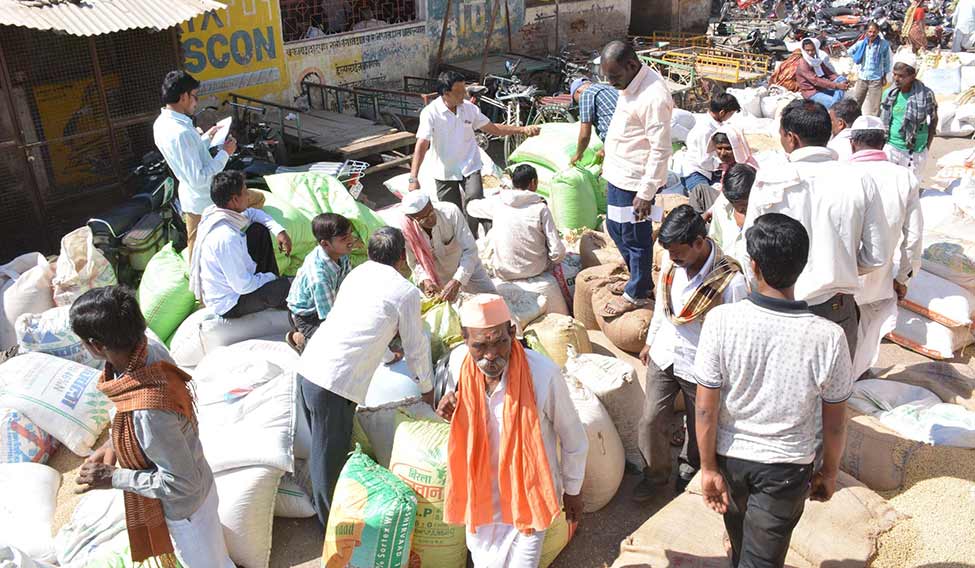
Two months ago, Babasaheb Gunjal, a farmer from Kalam village in Maharashtra’s Osmanabad district, went to the local government procurement centre with his harvest of toor [pigeon peas]. Nothing happened for five days and Gunjal was becoming desperate. Finally, just a day before the procurement process ended, officials accepted his 78 bags of toor, weighing 70kg each, and locked it in the warehouse. He was given a token and was told that he would be paid when the procurement process restarted.
Two weeks later, the government announced the procurement of one lakh tonnes of toor. Gunjal promptly returned to the procurement centre, but he was in for a rude shock. “I found that 14 of my 78 bags were missing,” he said. “Somebody stole it from the locked warehouse. The officials simply turned me away. Many other farmers have also suffered the same fate. And, even if we get Rs 5,050 a quintal, which is the minimum support price announced by the government, it will take 45 days to get the payment. I wish I had sold it to traders even though they pay less than the MSP.”
Maharashtra is in the grip of a severe agrarian crisis. The state had topped the list of farmer suicides last year, with more than 3,600 farmers killing themselves. Farmers have been on strike from June 1, protesting that commodity prices have remained non-remunerative. In many places across the state, protesting farmers threw vegetables and milk on road, demanding better prices and a waiver of farm loans.The prices of vegetables and milk shot up in major cities, including Mumbai.
Vijay Jawandhia, who heads the Kisan Coordination Committee, a coalition of farmer organisations, said the government never acted when the prices of farm produce fell, although it intervened whenever the prices went up. “India imports 40 lakh tonnes of pulses every year. The domestic prices are artificially kept low by importing food grains to satisfy the consumers, but producers suffer.”
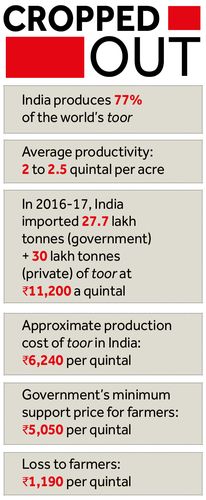
Prime Minister Narendra Modi, for instance, signed a memorandum of understanding with Mozambique in 2016 to supply one lakh tonnes of toor when domestic prices in India had gone up to Rs 200 a kilogram. “The prime minister himself signed the MoU, sending a message to the world that India needed toor. Mali, Kenya, Mozambique and Tanzania subsequently increased their acreage under cultivation and produced huge quantities of toor. This caused a drop in prices,” said Jawandhia. In 2016-17, India imported 27.7 lakh tonnes of toor at Rs 11,200 a quintal. “The government encouraged farmers to grow more toor, the monsoon was good and so was the projected yield. Then why did the government import such a huge quantity?” asked Jawandhia. This killed toor prices.
The Commission for Agricultural Costs and Prices (CACP) had calculated the production cost of toor to be Rs 6,240 a quintal. The minimum support price announced by the Union government, however, was only Rs 5,050. Bapu Zori, a farmer from Osmanabad, said, “The nexus between officials, politicians and traders ensured that procurement stopped for flimsy reasons like shortage of storage space and nonavailability of gunny bags. It forced the farmers to sell in distress.”
Under the Pradhan Mantri Fasal Bima Yojana, the government encouraged farmers to store their crop, insured and safe. But then it refused to procure the crop. And, it kept the import duty at zero per cent till the domestic prices dropped. Jawandhia said the government wanted to keep domestic prices and inflation low, as it wanted to transfer interest waivers to corporates in debt.
The majority of monsoon dependent-crops in Maharashtra are grown in the drought-prone Vidarbha and Marathwada, while the largely irrigated districts in western Maharashtra grow cash rich crops like sugarcane and grapes. Jawandhia said, “Whenever sugar prices fall, the government hikes import duty by 60 per cent. The subsidy for a sugarcane farmer is far more than for a cotton or toor producer. Farmers from dryland are treated like stepsons.”
The government is yet to lift the ban on the exports of pulses although tonnes of it remain unsold with farmers. Modi said his government could not give loan waivers to farmers because agriculture was a state subject. “The Union government decides fiscal policy and export/import policy for agriculture. It decides minimum support prices of crops. It decides the volume, place and even the rotting of stored food grains. Then why not leave all these to states?” asked Jawandhia.
The National Commission on Farmers headed by M.S. Swaminathan had recommended MSPs to be at 150 per cent of the actual production cost. It had also suggested to change agriculture from the state list to the concurrent list of the Constitution. “Modi had promised to implement the recommendations of the Swaminathan Commission during his election campaign and also in the BJP’s election manifesto,” said Jawandhia. But that promise is yet to be fulfilled.
Agro-economist Milind Murugkar said non-procurement at MSP and restriction of procurement quota were baffling after the PM’s assurance. He said it was the government’s duty to act as a price stabiliser to protect producers and consumers. “Toor and other pulses are grown by farmers who rely on the rains. However, agriculture subsidies for seeds, fertilisers, pesticides and electricity are all meant exclusively for irrigated crops and not rain-fed ones. Hence, a rain-fed farmer has a moral right to claim all protection.”
Murugkar cited a report by Arvind Subramanian, chief economic adviser to the Union government, which recommended higher support prices and efficient procurement of toor and other pulses. India consumes 30 per cent of the world’s production of pulses and that increases the international prices to a very high level. “This is not practical all the time and hence the solution is to encourage high production of pulses and procurement at higher MSPs,” said Murugkar. “Subramanian had recommended the inclusion of pulses in the public distribution system. Being in PDS will ensure that the government procures all the crop. There is no other alternative to give justice to toor producers.”