



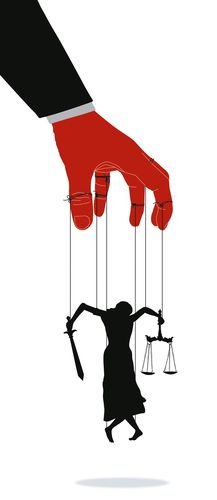
EXECUTIVE ASSERTS
The 1960s and the 1970s were a period of political assertion against the judiciary. It also had an ideological hue, with the political class claiming to represent progressive interests and the judiciary being viewed as conservative. Provoked by the I.C. Golaknath and other judgments that curbed Parliament’s power to make radical laws, Indira Gandhi’s left-leaning aides (Mohan Kumaramangalam and others) openly talked of the need for a committed judiciary.
1973: The executive strikes, by appointing A.N. Ray chief justice, superseding three seniors—J.M. Shelat, K.S. Hegde, A.N. Grover—who resign. The judiciary caves in when, in the ADM Jabalpur case (1975), it curbs the citizen’s right to seek judicial remedy to claim his fundamental rights.
1977: The executive strikes again, by appointing M.H. Beg as CJI, superseding H.R. Khanna who had dissented to the ADM Jabalpur judgment. Khanna resigns.
1982: In the S.P. Gupta case (also called the First Judges Case), P.N. Bhagwati’s court concedes that the executive can, for “cogent reasons”, refuse the “primacy” of the CJI’s recommendation in appointment of judges. This establishes the paramountcy of the executive in appointments.
JUDICIARY COUNTERATTACKS
The late 1980s and the 1990s saw the rise of coalition and minority governments, thus much weakening of the executive, and assertion of the judiciary. In a series of PIL judgments, the court expanded the citizen’s rights, extended its own powers and began holding the executive accountable.
1993: An unprecedented assertion by the legislature is witnessed in the move to impeach Justice V. Ramaswami, but the motion fails when the executive grows cold feet, and the ruling Congress abstains.
1993: In the Supreme Court Advocates-on-Record Association case (also called the Second Judges Case), Justice J.S. Verma’s court appropriates to itself the primacy in appointment and ushers in the collegium system.
1998: Answering a presidential reference (Third Judges Case), Justice S.P. Bharucha’s court refines the collegium system and reasserts judicial paramountcy in matters of appointment.

CEASEFIRES, SPARRINGS, SKIRMISHES
Much loud-thinking was heard in the late 1990s and the early 2000s about judicial activism degenerating into judicial tyranny. The court came to be accused of imposing its philosophy on policy issues of social welfare (eg: reservation, college admission cases), environment (eg: coastal management, curbs on diesel vehicles) and even intruding into the legislature (eg: directive to the legislature on manner of conducting floor test).
A lot of rethink on the court’s part also became evident when it restrained itself in several cases. A case in point is the still-debated Section 377 case wherein the court refused to intervene in law-making, despite overwhelming demands from progressives and liberals. A series of scandals involving judges in various High Courts and even the Supreme Court also weakened the judiciary, leaving the field open to legislative assertion.
2009: The legislature strikes, with the Rajya Sabha carrying a motion to remove Justice Soumitra Sen. The judge resigns before the Lok Sabha takes up the motion.
2014: Parliament passes the National Judicial Appointments Commission Act by which it envisages selection of judges by a committee in which the judiciary, the legislature and the executive are represented.
2015: The court strikes down the NJAC Act as unconstitutional, restores the collegium system and seeks a new procedure for appointment, which is still in the works. The executive follows a policy of benign neglect, even as judicial reforms get stuck and appointments slow down.
2018: Collegium system gets derailed, with four most senior judges declaring open war on CJI Dipak Misra. Likely to pave way for executive and legislative assertion.