



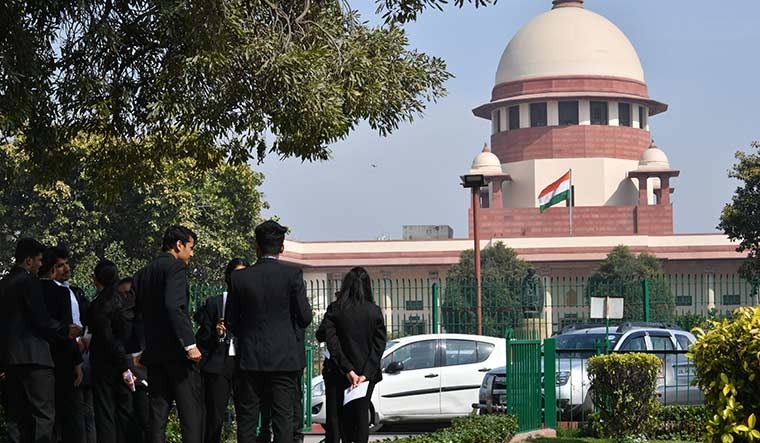
The Supreme Court on Thursday ruled that the anonymous electoral bonds violate Right to Information Act and Article 19 (1)(a).
Hearing the case, Chief Justice D.Y. Chandrachud and a bench comprising Justices Sanjiv Khanna, B.R. Gavai, J.B. Pardiwala and Manoj Misra unanimously ruled that anonymous bonds were in violation of Right to Information Act. Reading the judgment, Chief Justice Chandrachud said, “Political parties are relevant units in the electoral process. Information about the funding of political parties is essential for electoral choices. Financial support to political parties can lead to quid pro quo arrangement,” LiveLaw reported.
The Bench declared amendments made to the Income Tax Act provision and Section 29C of the Representation of Peoples Act are ultra vires and amendment to the Companies Act was unconstitutional, the publication reported.
The bench ordered the issuing bank to stop the issue of electoral bonds and directed State Bank of India to furnish the details of donations through electoral bonds and the details of the political parties which received the contributions.
The electoral bond is a scheme introduced by the government in 2018 via amendments to the Finance Act 2017. This was an alternative to cash donations made to political parties as part of efforts to bring transparency to political funding. As per the scheme, the electoral bonds may be purchased by any citizen of India or entity incorporated or established in the country either singly or jointly with other individuals.
However, only the political parties registered under Section 29A of the Representation of the People Act, 1951 and which secured not less than 1 per cent of the votes polled in the last elections to the Lok Sabha or a state legislative assembly are eligible to receive electoral bonds. The bonds can be encashed by an eligible political party only through an account with an authorised bank.
