



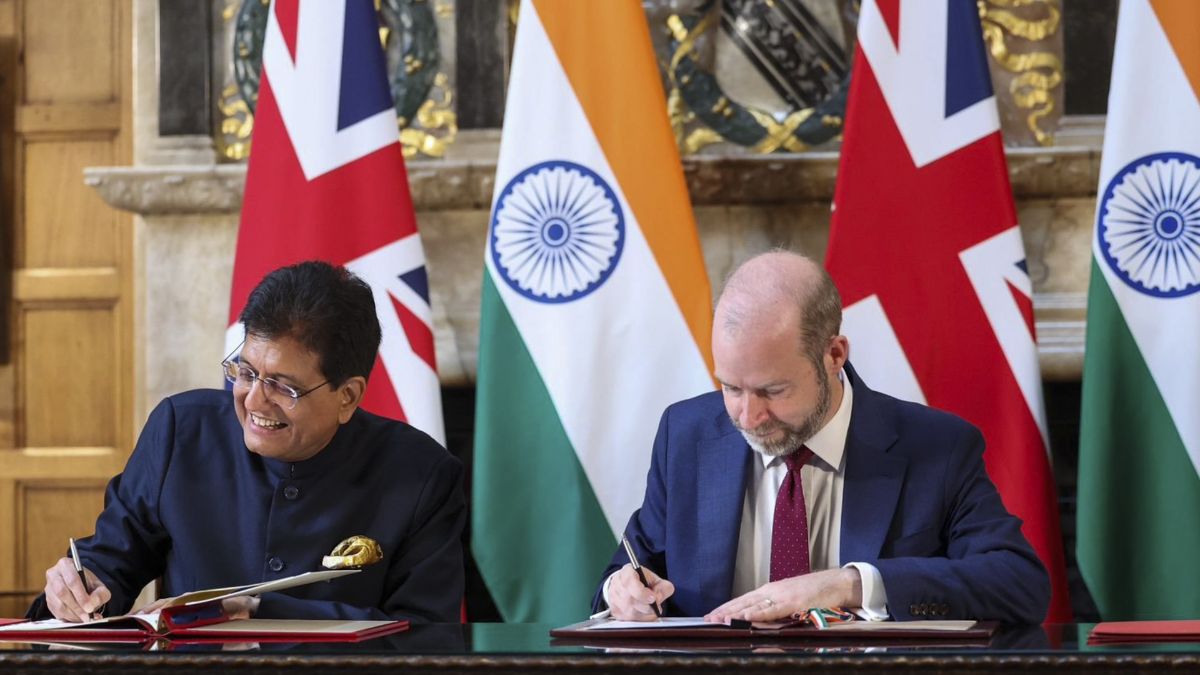
The Comprehensive Economic and Trade Agreement (CETA) and the Social Security Agreement (also known as the Double Contribution Convention, DCC) with the UK are a major step forward for India’s international economic and trade relations with a developed country. It will come into force on July 15, 2026.
This pact aims to boost India’s exports by ensuring duty-free access on 99 per cent of the country’s tariff lines, benefiting many labour-intensive sectors while also protecting sensitive industries.
The accord comprises 30 chapters and seeks to redefine trade agreements by integrating traditional sectors with advanced areas like digital trade and government procurement. It promotes inclusive growth through chapters on innovation, SMEs, sustainability, and transparency, while aiming to secure supply chains and foster technological collaboration.
Prior to moving any further with the discussion on the Indo-UK trade pact, it is vital that some background be known on total trade between these two countries (depicted in Table 1).

As evident from the data, India-UK trade holds immense potential both on the export and import fronts. For India’s exports to the UK (in absolute numbers), the value has risen from $10,461.29 million to $13,444.20 million between 2021-22 and 2025-26. In terms of India’s total export shares, this corresponds to a value of 2.48 to 3.04 per cent for 2021-22 and 2025-26, respectively. For India’s imports from the UK (in absolute numbers), the value has risen from $7,017.78 million to $11,682.43 million between 2021-22 and 2025-26. In terms of India’s total import shares, this corresponds to a value of 1.14 to 1.51 per cent for 2021-22 and 2025-26, respectively. India’s total trade with the UK hovered between 1.69 and 2.06 per cent for the period 2021-22 to 2025-26. The trade balance stood at a negative $191,047.65 million in 2021-22 and a negative $334,267.79 million in 2025-26.
Clearly, the values for exports and imports between the two trade partners are rising in absolute terms as well as in terms of shares. However, as India has a negative trade balance with the UK, there is a vital need for concrete and long-term measures such as the India-UK CETA.
This people-centric agreement is expected to provide benefits to various sectors. Farmers could access premium export markets, while fisherfolk could see enhanced seafood exports. Labour-intensive sectors also stand to gain and see the creation of new job opportunities. Women entrepreneurs, youth, startups, and MSMEs gain improved access to global value chains (GVCs), and professionals could benefit from improved mobility and recognition. Implementing this CETA thus signifies a major step towards India’s goal of a globally integrated and resilient economy, aligning with the bilateral commitment to deepen their strategic partnership for mutual prosperity.
Benefits and prospects
First, Indian exporters would gain from the complete elimination of British tariffs on key sectors, including processed food, marine products, engineering goods, leather, textiles and chemicals. This reduction to zero tariffs under the CETA aims at enhancing Indian export competitiveness, while also creating novel opportunities for farmers, fishermen, MSMEs, and manufacturers.
This helps the country’s integration into the Global Value Chains (GVCs) and empowers its artisans and manufacturers to become more competitive. Adequate protections for sensitive sectors such as dairy, cereals, and certain vegetables remain in place.
Second, this trade agreement enhances market access and regulatory certainty for Indian service providers across IT, financial, healthcare and education domains. It would also infuse predictability in mobility pathways for various service providers such as Business Visitors and Intra-Corporate Transferees. Indian chefs, yoga instructors, and classical musicians stand to gain because of this pact.
Third, the Social Security Agreement (also known as the Double Contribution Convention, DCC), prevents Indian workers and employers from making dual security contributions in the UK for temporary assignments, extending the exemption period from 3 to 5 years. Many companies and professionals are expected to benefit, facilitating mobility and granting social security coverage. This strengthens the India-UK partnership in the services sector.
Fourth, from the UK’s point of view, not only could British businesses access one of the world’s fastest-growing consumer bases post-Brexit, but also save on costs due to the imposition of import tariffs.
Challenges
Despite a number of benefits and advantages associated with the India-UK trade pact, the same has a number of challenges linked with it. First, the steel safeguard measures and the Carbon Border Adjustment Mechanism (CBAM) could complicate the implications of this trade agreement. Britain lowered tariff-free steel import quotas and imposed a 50 per cent charge on amounts that exceed the quota.
India has vigorously challenged these limitations because the UK accounts for over $900 million in Indian iron and steel exports. A breakthrough has been established between the two parties; concessions were reached on some tariff lines, guaranteeing that about 85 per cent of Indian steel exports are exempt from the scope of the safeguard.
Second, when it comes to the visa and mobility regime, India pushed for liberal visa quotas for its professionals, but the domestic politics in the UK heavily constrained the same. This could restrict the unfettered movement of service providers.
Third, while tariffs have been reduced and eliminated on most tariff lines, the high Sanitary and Phytosanitary (SPS) standards and complex non-tariff barriers (NTBs) could make it difficult for India’s Micro, Small and Medium Enterprises (MSMEs) to gain entry to the vital British market, thus causing stringency in compliance for the country’s MSME sector.
Fourth, despite the exclusion of sensitive sectors such as dairy, cereals and some vegetables, the sudden entry of UK-based agricultural goods could undercut rural Indian livelihoods and complicate the country’s food sovereignty.
Fifth, although the UK is a services-oriented economy, this trade pact does not go as far in liberalising cross-border trade in services as some other recent UK trade deals have.
The way forward
Upsides and downsides aside, there are several points on which the two countries could work together. First, there is a need to bring better uniformity between the UK and Indian regulatory frameworks. For instance, the two countries could push for mutual recognition and certification of food, safety and pharmaceutical standards to bypass strict non-tariff barriers.
Second, creating targeted facilitation centres and compliance support hubs will help the MSME sector adapt to British standards and fully utilise FTA benefits.
Third, Information Technology (IT) and Global Capability Centres (GCCs) could expand their investments into Tier-1 and Tier-2 Indian cities to diversify and scale digital exports.
Last, there is a need to establish joint carbon offset deals and frameworks to proactively mitigate the effects of the UK’s carbon taxes.
The India-UK FTA will serve as a catalyst for inclusive growth, opening new avenues for trade and investment, while protecting India’s core economic interests. The pact goes beyond tariff concessions and creates an enabling framework that strengthens economic resilience, fosters innovation, and promotes all-encompassing growth across both economies.
The author is Assistant Professor (Economics and Trade Policy), Indian Institute of Foreign Trade, New Delhi.
The opinions expressed in this article are those of the author and do not purport to reflect the opinions or views of THE WEEK.
