



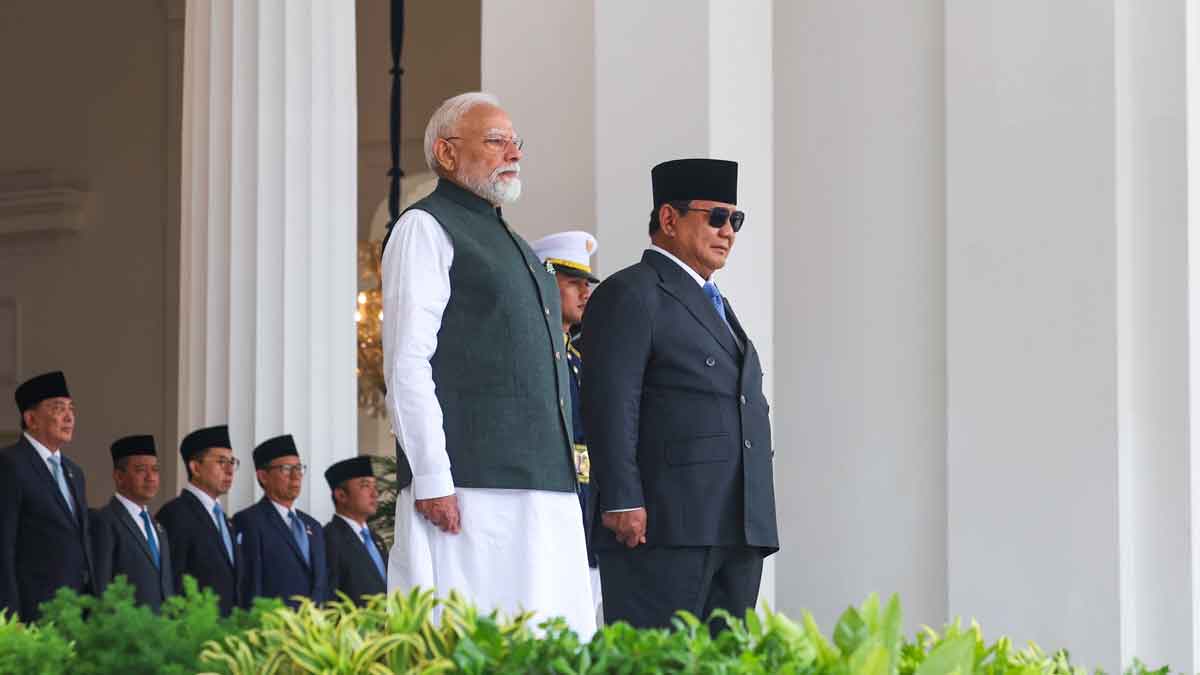
As Prime Minister Narendra Modi's visit to Indonesia continues, with both countries expected to sign a series of agreements deepening their Comprehensive Strategic Partnership, maritime cooperation stands out as a natural and strategically vital pillar of the relationship.
Indonesia is the world's largest archipelagic state, comprising thousands of islands spread across a maritime domain of roughly 6.4 million square kilometres, with the vast majority of its population living in coastal communities.
More than 900,000 Indonesians are directly engaged in international and domestic shipping, supported by 97 international bunkering ports, 141 oil terminals and a network of 260 port administrations overseen by five sea and coast guard bases.
Indonesia's maritime legacy stretches back millennia. Austronesian seafarers began settling the archipelago around 2000 BCE, developing navigational skills that would later carry them as far as Madagascar and Polynesia.
Between the 7th and 13th centuries, the Srivijaya empire controlled trade through the Strait of Malacca, connecting China, India and the Middle East, while the Majapahit empire extended Indonesia's naval reach across the archipelago from the 13th to the 15th century.
Following independence in 1945, Indonesia enshrined its maritime identity through the "Wawasan Nusantara" archipelagic outlook, later formalised internationally under the 1982 UN Convention on the Law of the Sea, and reaffirmed through President Joko Widodo's 2014 Global Maritime Fulcrum policy.
This depth of maritime infrastructure and heritage makes Indonesia a natural partner for India as both nations seek to secure Indo-Pacific sea lanes and strengthen supply chain resilience.
Indonesia's cabotage law, which reserves domestic shipping for Indonesian-flagged vessels, has pushed nearly 99 per cent of its shipping fleet of 11,961 vessels under national registration, reflecting a maritime sector deeply relevant to India's own port-led growth ambitions.
Given Indonesia's location straddling the Strait of Malacca, one of the world's busiest and most strategically sensitive shipping corridors, deeper India-Indonesia maritime cooperation carries significant weight for regional trade security and freedom of navigation.
