



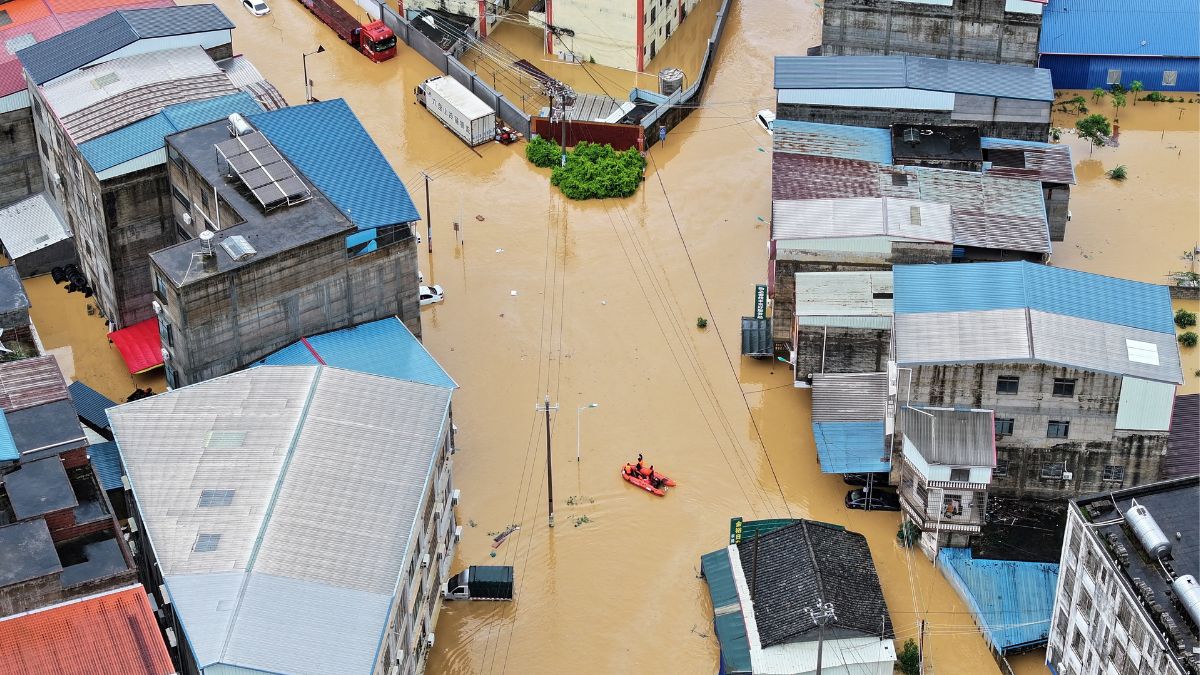
Two tornadoes triggered by Typhoon Maysak swept across central China, wreaking havoc in Hubei province. Torrential rain and strong winds left at least 11 people dead while the National Meteorological Centre warned that northeastern Hubei should brace for further heavy to torrential rain on Tuesday.
State media reported that winds reaching up to 92.58 mph overturned cars, tore roofs off buildings, and left 331 people injured in Hubei province. Five people died in northern China, including two people in Inner Mongolia and three others in Fushun, Liaoning province.
The Ministry of Water Resources stated that the water levels at the Guigang Hydrological Station had risen to 42 meters by July 6. Over the last week, Maysak lashed over Vietnam and China’s southern island province of Hainan.
According to meteorologists, the typhoon will dump the water it absorbed from the South China Sea as it weakens and heads inland.
China has also been placed on alert over Super Typhoon Bavi, which is advancing from the Pacific Ocean toward Taiwan. The US National Weather Service reported that the storm tore across Guam, Tinian, Saipan, and Rota on July 6, packing catastrophic winds of approximately 290 kilometres per hour.
According to experts, tornadoes are extremely rare in Hubei, a major industrial automotive manufacturing and technology hub.
Still reeling from Typhoon Maysak—which killed at least four people in the capital city of Nanning over the past few days—the Guangxi region must now brace for up to 260 mm (10 inches) of torrential rain over the next 24 hours, potentially triggering widespread landslides, the forecast added.
Meanwhile, the state media reported that 16 people remain missing after a landslide in a mountainous county in western China's Gansu province. A total of 33 people were swept away in the landslide that took place in the early hours.
Chinese President Xi Jinping called for "all-out efforts" to rescue those affected by the floods.
Level 1 flood-control emergency has been raised for Nanning and Guigang, while Level 3 geological hazard response has been raised by Guangxi. The maritime authority has also raised a Level 1 response for inland flood control. China’s Ministry of Finance and Ministry of Emergency Management allocated CNY 160 million (USD 23.5 million) to support Guangxi and other provinces and regions, shipping 1,50,000 units of relief supplies.
Who came up with the name Maysak?
The storm’s name, Maysak, was proposed by Cambodia to the Typhoon Committee list. The panel works under the World Meteorological Organisation (WMO) and the United Nations Economic and Social Commission for Asia and the Pacific (ESCAP).
What does the name Maysak mean?
The name Maysak means “teak wood” and comes from the Khmer language, also known as Cambodian, the official language of Cambodia.
History of Maysak
The name Maysak has been used in 2002, 2008, 2015, 2020, and now in 2026 for several significant storms in the western Pacific. These cyclones are known for their widespread damage across East Asia, Micronesia, the Philippines and the Korean Peninsula.
