



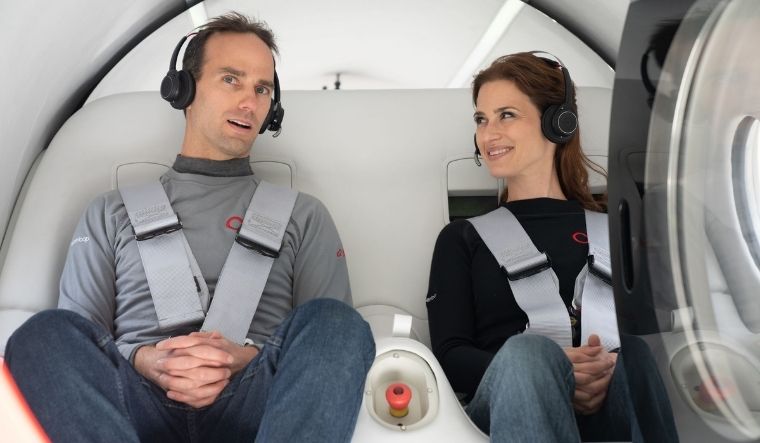
Richard Branson's Virgin Hyperloop has created history as its top officials completed the world's first passenger ride on a super high-speed levitating pod system. Josh Giegel, CTO and co-founder of Virgin Hyperloop, and Sara Luchian, Director of Passenger Experience, rode the first new form of transportation in over a century, the company stated.
The key safety test for a technology that hopes will transform human and cargo transportation reached speeds of up to 107 miles per hour (172 km per hour) at the company's DevLoop test site in Las Vegas, Nevada, where the company has previously run over 400 un-occupied tests. After strapping into their seats in the company’s gleaming white and red hyperloop pod, dubbed Pegasus, they were transferred into an airlock as the air inside the enclosed vacuum tube was removed. The pod then accelerated to a brisk 100 miles per hour (160 km/h) down the length of the track, before slowing down to a stop.
The Pegasus pod used for the first passenger test, also called XP-2, was designed with help from famed Danish architect Bjarke Ingels’ design firm. It weighs 2.5 tons and measures about 15-18 feet long, according to Giegel. Inside, its lush white interior is meant to be familiar to passengers, who may not be immediately comfortable with the idea of slingshotting through a vacuum-sealed tube at the speed of a commercial jet.
“For the past few years, the Virgin Hyperloop team has been working on turning its ground breaking technology into reality,” said Richard Branson, Founder of the Virgin Group. “With today’s successful test, we have shown that this spirit of innovation will in fact change the way people everywhere live, work, and travel in the years to come.”
Giegel and Luchian made their maiden voyage on the newly-unveiled XP-2 vehicle, designed by BIG – Bjarke Ingels Group and Kilo Design, custom-built with occupant safety and comfort in mind. However, the production vehicle will be larger and seat up to 28 passengers.
“When we started in a garage over 6 years ago, the goal was simple – to transform the way people move,” said Giegel. “Today, we took one giant leap toward that ultimate dream, not only for me, but for all of us who are looking towards a moonshot right here on Earth.”
Sultan Ahmed Bin Sulayem, Chairman of Virgin Hyperloop, watched this historic passenger testing first-hand. "Today I am on the ground at the @virginhyperloop test track in Nevada, USA, for what is a momentous day for the future of mobility: the first ever passenger journey via Hyperloop," he tweeted.
