



KOCHI
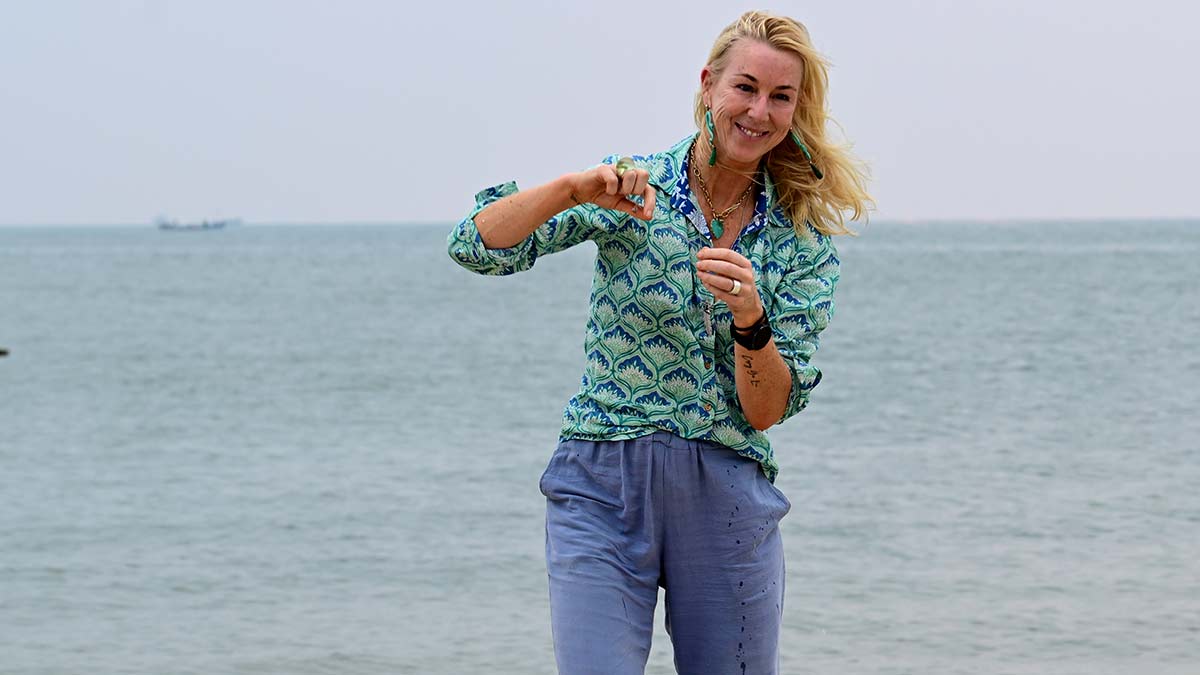
Caroline Casey makes as if to hug me, and then pauses. “Are you a hugger?” she asks a little doubtfully. I am not really, but I don’t want to make a bad first impression. After all, I am going to be spending the next three days with this Irish woman and her friend Andy (Andrea Webb), traversing Kerala from north to south. Caroline envelops me in a warm hug and leads me to the outdoor dining area of a hotel in Fort Kochi, where the two are just finishing breakfast. That hug, I realise later, says a lot about her. Not many Indians would meet a stranger with a hug. I don’t know if it is an Irish thing, but it is definitely a Caroline thing, as I observe her warmth and friendliness towards everyone we encounter—from waiters to receptionists to taxi drivers. As she speaks with them, her tone is light-hearted and jaunty, although the jokes go over most of them who struggle to comprehend her words, let alone her humour. But they all gamely laugh, probably associating the familiarity with her foreignness.
Caroline also cries as easily as she laughs, and the first sign of tears I see is in the car on our way to Kappad beach in Kozhikode, as she remembers the last time she was there on a journey that would change her life. Nearly 25 years ago, she came to India to ride an elephant across three south Indian states (Kerala, Tamil Nadu and Karnataka), covering a distance of 1,000km and raising money for 6,000 cataract operations. This sounds difficult as it is, but there was a factor that made it near-impossible: Caroline is legally blind.
As a child, she did not know it. On her 17th birthday, she accompanied her visually-impaired sister to an eye specialist. After an eye examination, the specialist asked her how she was going to celebrate her birthday. “I’m going to learn how to drive,” she told him. He turned to her mother and said, “You haven’t told her yet.” That is when she learned about her condition—ocular albinism, which restricts her vision to about half a foot. Her parents had made the radical decision of not telling her, instead raising her as though she was sighted.
With dogged determination, she decided to believe that herself and not to tell anyone about her condition. She worked as an archaeologist, a landscape gardener, a waitress and a masseuse before getting a global consulting job at Accenture. More than two years later, in 1999, at the age of 28, she temporarily went almost completely blind. That is when she decided she could not do it any more. “I was so lost,” she says. “I did not know who I was any more.”
It was another eye specialist who changed her life. He told her it was time for a change. “What did you want to be when you were little?” he asked her. Slowly, an idea began to form in her mind. As a kid, she had always wanted to be Mowgli from The Jungle Book. Why not try to make that dream a reality? Some years ago, she had read the book Travels On My Elephant by Mark Shand. As she re-read it, she formulated her plan: she would become an elephant handler, riding an elephant across south India and raising money for the blind. With Mark’s help, she came to India in 2001 and met her elephant Bhadra (who she later renamed as Kanchi) at Kappad Beach, from where they began their journey together.
This trip is a homecoming of sorts as she relives that long-ago journey with Kanchi who, at 38, died during the Covid pandemic in 2020. After Kappad, she plans to visit Kanchi’s grave in Thiruvananthapuram.
KOZHIKODE
On the way to Kappad, Caroline tells me about some of the adventures she had with Kanchi. Once, while travelling through the forests of the Nilgiris, they heard a rumour that the sandalwood smuggler Veerappan had heard about her expedition, which by then had got much media coverage. A white woman on an elephant was unusual, but a white woman travelling through forests thick with dacoits, raising money for an international NGO, was downright dangerous. At night, Caroline and her team took turns keeping watch. One night, she saw flares and heard panicked shouts. “Oh no, Veerappan is coming for me,” she thought.

But it was not Veerappan. Instead, it was a herd of wild elephants who had caught the scent of Kanchi. Wild elephants approaching your camp was perhaps as dangerous as a wild dacoit, so they spent the whole night clanging pots and pans to keep them away.
Another time, they crossed into Coorg from Kannur and were enjoying a family’s hospitality. That night, Kanchi woke up screaming. They rushed outside to see a hissing cobra circling her. It had somehow found a way around the boric powder they had scattered all around to keep snakes away. Fortunately, they managed to scare it away. By then, all the villagers had gathered outside. A young boy approached Caroline and when he heard she was Irish, told her about his love for the work of Irish poet Seamus Heaney. Amazingly, Caroline had a collection of Seamus’s poems in her rucksack, with the boy’s favourite, ‘Blackberry Picking’, being one of them. So she sat with the villagers around a bonfire and read to them Seamus Heaney poems.
The journey was by no means easy. Usually it takes several years to learn to be a mahout and master how to feed, bathe, train and build a connect with the elephant; Caroline had to do it in a few weeks. Matters were further complicated by her blindness. Because she could not understand Malayalam, she could not comprehend mahout Jayan’s lessons. And after mounting Kanchi, she could not even see his gestures to instruct her. She was, literally and figuratively, in the dark. Her feet got badly injured by the jute rope around Kanchi’s neck, and sitting for hours atop Kanchi was a strain on her back and shoulders. Still, she persevered. Her courage and determination earned her the nickname ‘Casey Boy’ among the mahouts and others on the trip.
As we approach Kappad, Caroline’s mood becomes contemplative. Except for the seawalls, where there used to be trees before, things have not changed much, she says. The place has not developed as much as she thought it would have. Kappad beach is a picture of serenity—a few Muslim families clustered on the far end; some young men taking a dip in the sea; children holding ice-creams that melt into their clothes; couples eating peanuts from newspaper cones, with the shells drifting in the wind. The sea is calm, the waves gently lapping the shore. The dimming sun bathes the beach in an amber glow. It is as though the stage has been perfectly set for Caroline’s return. This sunset might mark the end of the day for Andy and me, but for Caroline it is the end of something more. Returning to the place where it all began 25 years ago, this is closure. Life, for her, has come full circle.
THIRUVANANTHAPURAM
The next day, we return to home base—Kochi—and then set out to Thiruvananthapuram the day after. There, we are meeting Vikram, the second mahout whose bond with Kanchi was much more profound than that of Jayan. After she returned to Ireland, Caroline had bought Kanchi and gifted her to Vikram through an intermediary. She does not know how exactly Kanchi died or where her graveyard is; she is counting on Vikram to enlighten us. On the way there, I am amazed by the child-like enthusiasm of Andy and Caroline for the smallest things—the balloons outside a temple, a packet of tapioca chips, a bright orange autorickshaw parked outside a restaurant, the huge knotted trunk of an oak tree.... Despite Caroline being blind, she can see things in my state to which I, ironically, have become blind. These are sights I see every day without really seeing. Familiarity, I think to myself, is perhaps the greatest obstacle to one’s sense of wonder.
As I speak with her, I also realise that despite her humility, humour and ability to not take herself seriously, Caroline might be one of the most powerful women I have met. After returning from her journey with Kanchi, she founded the Elephant Family with Mark Shand, the younger brother of Queen Camilla, Lord Robin Russell, Dugal Muller and Nicholas Claxton. It brought to fore the plight of the endangered Asian elephant. Then she founded The Valuable 500, a global business collective which brought together some of the most powerful entrepreneurs in the world and ended the CEO silence on disability. Currently, she is president of the International Agency for the Prevention of Blindness, which aims to end avoidable blindness in the world. She has received an honorary doctorate and several awards for her work as a disability activist. But behind this veneer of success and fame, there is, I realise, another woman—someone who once wanted to race a motorbike across the desert listening to Led Zeppelin’s ‘A Whole Lotta Love’; who lives with the soul of Mowgli in her; who is blind, yet sees the blinding beauty of life; who has learnt, she says, to own her shadow as much as her light.
A few kilometres from Thiruvananthapuram, we park the car near the turn that leads to the seaside town of Kovalam. There, Vikram, his wife and his brother meet us. The meeting between Caroline and Vikram is almost cinematic. For a moment, there is hushed silence. All around us, there is colour and activity—cars whizzing by, horns honking, roadside hawkers selling wares.... But in this tableau that I am witnessing, the air is still and vibrates with a strange tension. A man and woman gaze at each other, separated not by distance, but by time—a yawning gap of 25 years that might have rusted their friendship, but not their bond. Then Caroline walks over and embraces him, and they hold on to each other for a long time. With Mark Shand (who died in 2014) and Kanchi no more, Vikram is one of her last remaining links to another life, another time, and a journey that helped her find her way back to herself.
As she pulls back, a rude shock awaits her. In the years since she left India, Vikram has become paralysed in one leg after suffering a fall from a coconut tree. Without his source of income, the family has been in a bad state. Worse, the intermediary to whom Caroline had entrusted Kanchi to be given to Vikram appropriated the elephant for himself, employing Vikram as her mahout. He gave Vikram a meagre salary while making money off Kanchi, Vikram’s wife Lali tells us. Some time ago, the intermediary rented out Kanchi to someone in Thiruvananthapuram who replaced Vikram with another mahout. It is at this person’s home that Kanchi died of a uterine cyst. All this is new information to Caroline, who is crushed.
Afterwards, along with Vikram and his family, we travel to the home where Kanchi died; she was cremated in its backyard. The mood is sombre as Caroline and Andy do a little puja for her. The fragrance of incense and the call of crickets fill the air, and as the light begins to fade, the pain, longing and joys of yesterday segue into a bittersweet hope for tomorrow. The girl who once rode an elephant across India is gone, and in her place is a woman who laughs as easily as she cries, whose joy is born of her pain, and who believes in the magic of small things as much as she does in the power of dreaming big.
