


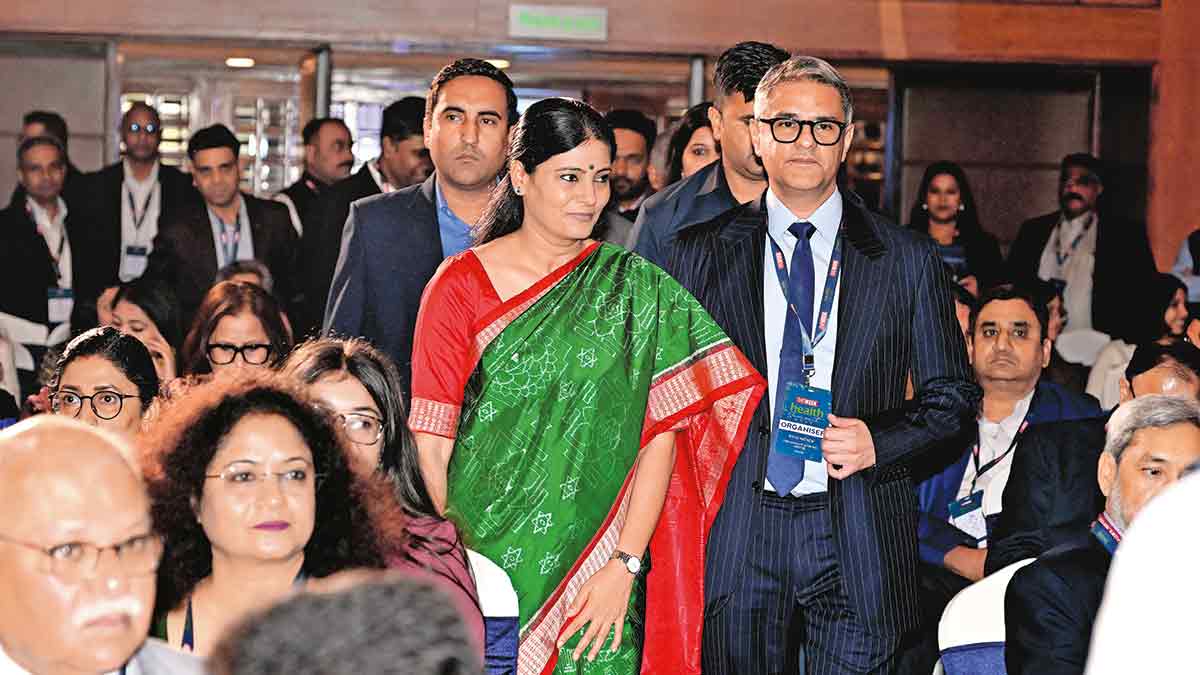
We all understand health care is one of the most critical pillars of the society. Because it is not just contributing to an individual’s well-being, but it also promotes economic prosperity and societal stability. And world over, there are numerous health challenges that communities are grappling with, which range from the emerging and infectious diseases to antimicrobial resistance, to mental health risks, to climate health-related risks.
And of course, the one that has been pointed out by Riyad ji [Mathew, chief associate editor and director, THE WEEK]—the growing burden of non-communicable diseases. And we also understand that diseases today are not contained within the national borders, they tend to trespass.
And which is why what is required today is not just national action plans, but also global action plans. The Covid-19 pandemic has exposed the vulnerabilities of health care systems worldwide, and highlighted the urgent need to build robust frameworks, not just nationally or domestically, but also globally. Pandemics can hit us anytime. Today, the major concern of governments world over is universal health coverage.
Every country is making a steadfast move to achieve that. For a country like ours, universal health coverage is a huge task. We have 17 per cent of the world's population, and 20 per cent of the global disease burden. So, when we say that we want to ensure quality, accessible, affordable health care to every citizen, that is a big challenge. But I am proud to say that the government of India has an unwavering commitment to achieve this.
And why I say this is because [we are working towards] every single factor that is important to achieve universal health coverage. And there are a host of such factors. The first, of course, is a strong political commitment. We have brought health to our national agenda list. Health care is a priority of the government led by Prime Minister Narendra Modi.
The second is that we will continue to enhance our expenditure on health, build more health care infrastructure, expand the medical education infrastructure so we are able to address the shortage of doctors and other paramedics. Our effort has also been towards providing financial protection to the poor and the needy.
Besides these, we are addressing the social determinants of health. This is a government that believes in a whole-of-government approach, which means health care is not just the sole responsibility of ministry of health and family welfare, but every single government department is doing something to make sure that their efforts take us closer to universal health coverage. The other factors that are important are leveraging digital health and technological solution. Innovative technologies are now being adopted.
And we have always kept our focus on preventive health care. We have this vast network of Ayushman Arogya Mandirs, and the first step towards preventive health care is being taken by strengthening these primary health care institutions. We have completely revamped them.
Another important factor is fostering private-public partnerships. And I can give you examples of our programmes like the Pradhan Mantri Ayushman Bharat Yojana—many private hospitals are getting empanelled under this scheme.
Our focus continues to remain on the three key dimensions, which is accessibility, affordability and quality. This is because when we have a larger vision of creating a developed India by 2047. We cannot imagine a developed country without making our citizens healthy.
How do we intend to do this? We started with our efforts towards the national health policy. With the national health policy, which was long waiting to get revised, we brought in a complete transformation in our approach towards health care. So, health care today is no longer just curative. It is comprehensive health care, which means there is preventive, curative, palliative, rehabilitative and promotive health care.
In the past 11 years, government health expenditure has increased from 29 per cent to 48 per cent and out-of-pocket expenses on medicines or implants or medical devices have come down from 63 per cent to 39 per cent. That has not happened by some magic trick. There are very precise steps that have been taken to bring down the out-of-pocket expenses.
Over these 11 years, there has been a record expansion of medical education infrastructure and tertiary healthcare facilities. The number of All India Institute of Medical Sciences has gone up from seven to 23. Medical colleges now have gone up from 387 to 802.
Today, India is being certified as maternal- and neonatal tetanus-free. India is being certified by the WHO as being trachoma-free. India's efforts towards bringing down MMR (measles, mumps, rubella) and bringing down IMR (infant mortality rate) have been recognised globally. We have been acknowledged as being an exemplar performer because the decline in MMR and IMR of India has surpassed the global decline. That has happened because of concerted efforts.
And, we have resolved to make India TB free and it is not just a resolve for political slogans. That is why this 360-degree approach is being adopted and we can see the results. The incidence of TB has come down by 17.7 per cent, and there is 21.4 per cent decline in mortality. TB treatment coverage has expanded by 32 per cent.
We have a big action plan. We are preparing our country for any future health emergencies. We have learned our lessons from Covid. We realise today the importance of self-reliance, not just when it comes to medical education infrastructure, health care infrastructure, but also when it comes to the availability of drugs and medical devices. So the government of India has started these PLI (production-linked incentive) schemes for boosting domestic manufacturing of medical devices.
Health is a shared agenda. And what we need is collective effort. So, I would appeal to this esteemed gathering that we all adopt health care as a priority and contribute in whichever way we can to build a healthier nation because only a healthy India can be a developed India.
