



She could move her arm. She simply... wouldn’t on command. That was the puzzle. The surgery had gone beautifully. A low-grade tumour lying just in front of the supplementary motor area of the brain had been removed completely. She woke up exactly as planned. She understood every question I asked. She could see. She could feel. There was no paralysis. And, yet, when I asked her to lift her right arm, she looked at it almost apologetically. “I know what you want me to do,” she said. “I just can’t seem to start.” It was one of the strangest conversations a neurosurgeon can have. Every wire was intact. Every muscle was capable. And on occasion, without instruction, it would move impulsively. But somewhere between intention and action, something had gone temporarily silent.
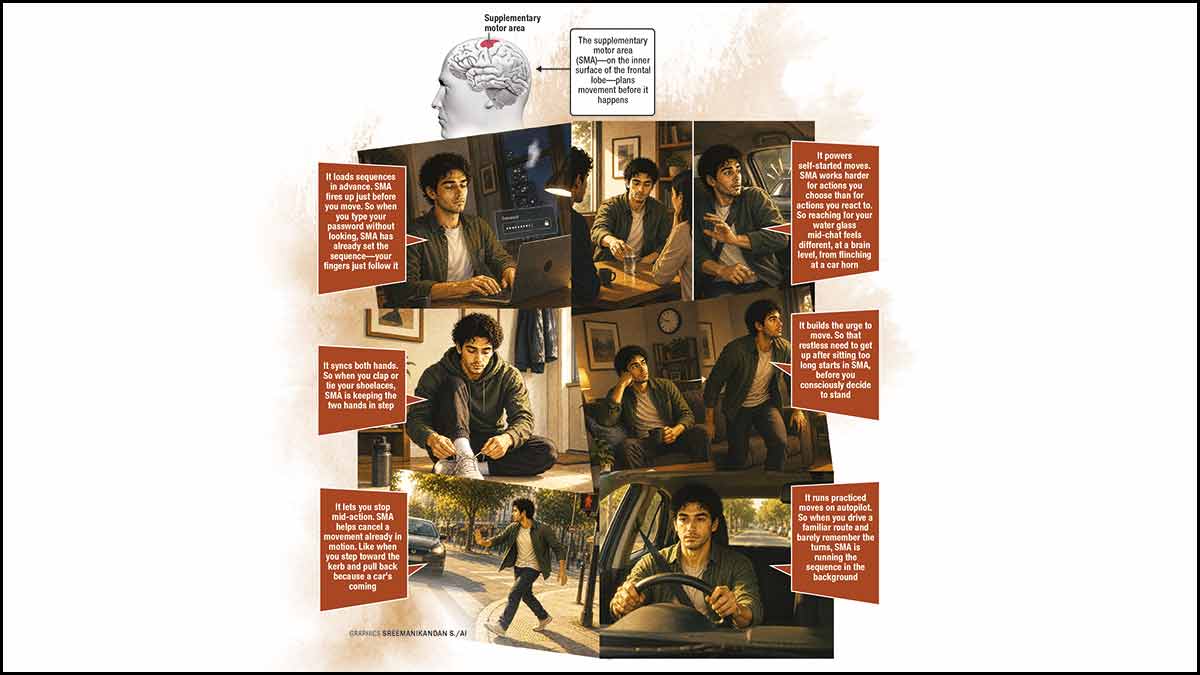
The supplementary motor area, or SMA, is one of the least celebrated regions of the brain, tucked away on the inner surface of the frontal lobe. Most people have never heard of it, yet it performs one of the most remarkable tasks in human biology. It is where intention becomes action. It is the quiet conductor standing before the orchestra just before the first note is played. As Johann Wolfgang von Goethe wrote, “Knowing is not enough; we must apply. Willing is not enough; we must do.” The SMA is where the brain turns ‘willing’ into ‘doing’.
Her husband stood anxiously at the bedside. “Has she had a stroke?” he asked. It was an understandable fear. After all, she wasn’t moving. But this was something altogether different. The supplementary motor area does not generate strength—that is the job of the primary motor cortex. Instead, it plans, sequences and initiates voluntary movement. It decides when to begin. It coordinates both sides of the body for complex tasks like walking, clapping, typing or playing the piano. When temporarily stunned after surgery, patients can develop what we call SMA syndrome. They are fully awake. They understand everything. They desperately want to move. Yet, they simply cannot initiate movement. It is as though the brain has misplaced the word ‘go’.
The first time I encountered SMA syndrome as a trainee, it felt almost magical. The patient appeared trapped between thought and action, like a car with a perfectly functioning engine waiting for someone to release the handbrake. It is a humbling reminder that movement is not simply muscle contracting. It is an idea, patiently assembled before it ever reaches the limbs.
The reassuring part—and one of the reasons this syndrome fascinates neurosurgeons—is that it almost always gets better. Unlike a stroke, where tissue is permanently damaged, the SMA has an extraordinary capacity to recover as neighbouring networks reorganise themselves. Day by day, movement returns. First a finger twitches. Then the wrist. Then an arm lifts almost by surprise. The brain begins quietly rewriting its own instruction manual. As Samuel Beckett wrote, “Ever tried. Ever failed. No matter. Try again. Fail again. Fail better.” Recovery from SMA syndrome feels remarkably like that. Every day the brain attempts something it could not do the day before. Every day the invisible circuitry becomes a little more fluent. Neurosurgery often reminds us that the brain is not a machine built from rigid components; it is a living conversation, constantly adapting, rerouting and teaching itself new ways to solve old problems.
Six weeks later she returned to my clinic carrying a shopping bag in her right hand. Before I could ask how she was doing, she reached out and shook my hand firmly. “I don’t even think about it anymore,” she said. That sentence, more than any MRI scan, told me everything I needed to know.
We spend much of our lives celebrating movement—the marathon runner crossing the finish line, the concert pianist performing a concerto, the child taking their first steps. We rarely pause to marvel at something infinitely smaller: the moment just before movement begins. The silent decision. The invisible spark. The quiet whisper inside the brain that says, ‘now’. As Lao Tzu observed, “The journey of a thousand miles begins with a single step.” Neuroscience would add one small amendment: before the first step comes a single impulse, born in a tiny patch of cortex.
As she walked towards the door, she turned back with a grin. “Doctor,” she said, “I’ve discovered the hardest movement of all.” “Oh?” “Getting off the sofa when my favourite television series is on.” I laughed. Some forms of inertia, it seems, are wonderfully resistant to even the finest neurosurgery.
The author is consultant neurosurgeon at Wockhardt Hospital, Mumbai.
mazdaturel@gmail.com @mazdaturel
