


 Add as a preferred source on Google

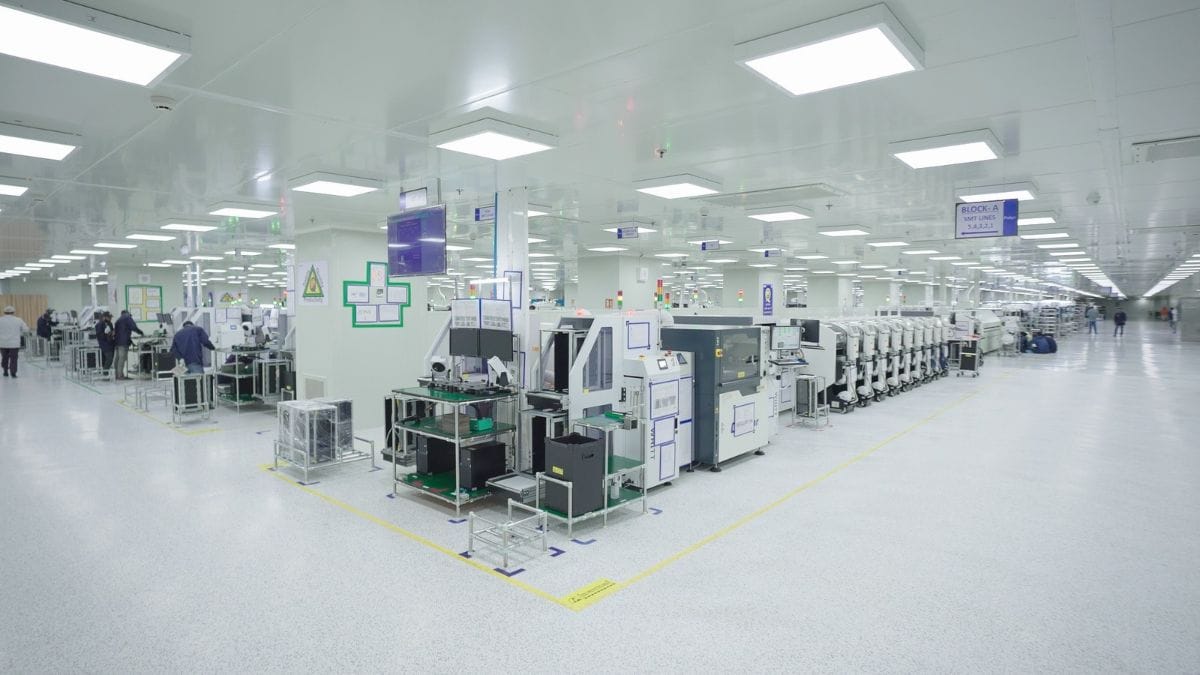
Dixon Technologies (India) Limited has lined up close to ₹1000 crore in investment over the next five years in consumer durables manufacturing in Andhra Pradesh.
The electronics and home appliance manufacturer’s association with Andhra Pradesh began in 2017, when it sought to move beyond its northern India base and establish operations closer to ports. The introduction of the Goods and Services Tax (GST) prompted the company to reassess its manufacturing footprint.
Andhra Pradesh emerged as an option, and the speed of government decisions, supportive officials, workforce availability and access to engineering colleges and industrial training institutes helped make the choice work.
Its first factory in the state moved from groundwork to commercial production in six months, way back in 2017. It has since built a presence in the Tirupati cluster, employing more than 8,000 people, 95 per cent of them local residents. Women account for 40 per cent of its workforce.
Dixon is preparing to widen its footprint beyond existing washing machine and refrigerator operations.
Under a Memorandum of Understanding (MoU) with the state government, it plans an integrated home appliances facility to manufacture microwave ovens, dishwashers and vacuum cleaners.
The proposed investment is estimated at ₹800 crore to ₹1,000 crore over five years, with the project expected to create 2,500 jobs. The expansion comes as Dixon looks to deepen its capabilities in components and original design manufacturing, while exploring opportunities in sectors such as automobiles.
Speaking to THE WEEK after signing an MoU with the Andhra Pradesh government, Pankaj Sharma, President, Dixon Technologies (India) Limited, discussed on Andhra Pradesh’s role in its growth, the new investment and the changing electronics manufacturing landscape.
Excerpts:
Q/ Dixon Technologies entered Andhra Pradesh in 2017. How has the association evolved over the years, and what prompted the company to choose the state?
A/ We came to Andhra Pradesh in 2017. Before that, Dixon was predominantly a North India-based company, with most of our operations in Noida and Delhi. When GST was introduced in 2017, we had to rethink our manufacturing strategy.
Earlier, we were able to pass on the benefits of excise duty exemptions to customers. With the new tax regime, we wanted to optimise costs and establish manufacturing facilities closer to ports. We had two options: Tamil Nadu and Andhra Pradesh.
Fortunately, we chose Andhra Pradesh. At that time, the government was extremely supportive. Decisions were taken quickly, there was no administrative slackness, and officials were accessible and friendly. We could operate without unnecessary red tape and scale up rapidly. Our first factory went from the initial groundwork to commercial production in just six months.
The availability of a large workforce has also been a major advantage. Andhra Pradesh has several engineering colleges and ITIs that supply the kind of manpower we require. The attractive incentive package offered by the government was another factor. All these elements gave us the confidence to expand our operations here.
Q/ What does the latest MoU with the Andhra Pradesh government entail? What are the proposed investments and products?
A/ We are planning to expand our home appliances business. Currently, we manufacture three categories of washing machines—semi-automatic, top-load and front-load—apart from refrigerators.
We now want to enter additional product categories, including microwave ovens, dishwashers and vacuum cleaners. We have taken a land parcel for this purpose and will establish an integrated manufacturing facility where all these home appliances will be produced.
Q/ What is the proposed investment and employment potential of this facility?
A/ We are very careful about the size of our investments and evaluate them prudently. We do not believe in making investments indiscriminately. However, this project is expected to generate employment for nearly 2,500 people. While the commitment made to the government may be different, our investment is likely to be in the range of ₹800 crore to ₹1,000 crore.
Q/ What is the timeline for implementing the project?
We have taken a five-year timeline for the investment. However, we expect to complete it before that.
Q/ Moving beyond home appliances, how significant is Dixon's presence in camera manufacturing in India? What is your growth strategy in this segment?
A/ We earlier had a camera manufacturing unit in Noida. However, we have since sold our stake in that business to our partner and now hold a stake in the parent company.
In the CCTV segment, the regulatory requirements introduced by the government—particularly the STQC certification—have significantly altered the competitive landscape. These requirements cover several aspects, including servers, security architecture, chips and software.
Before STQC requirements came into effect, Hikvision was the largest player, followed by CP Plus—our partner—and then us. There was a long tail of other players, but they accounted for only around 8 to 10 per cent of the market.
With Hikvision and Dahua facing restrictions, CP Plus has a clear opportunity. If you look at its results and sales, the company is performing exceptionally well. Several new players are entering the market, including some big names. But CCTV is not a product that you simply sell off the shelf.
You need an extensive network of system integrators who can install and service the products. Building such a network takes time. A conventional dealer network will not necessarily work in this business. I believe CP Plus has a very bright future.
Q/ Do you think further policy interventions are necessary to encourage camera manufacturing in India?
A/ The government has already introduced restrictions through the STQC approval requirement, and I believe this is the right approach because CCTV cameras are directly connected to national security. We cannot afford a situation in which surveillance data from our roads and public spaces is transmitted to servers in China.
There are concerns that Chinese chips embedded in cameras could potentially be used to transmit data. We do not know how much of this is actually happening, but technologically, it is possible. Whether such vulnerabilities are being exploited is a different question.
I do not see anything wrong with these restrictions. In fact, they were long overdue. The government should perhaps have introduced them earlier.
Q/ Electronics manufacturers are reporting revenue growth, but margins are under pressure because of rising memory-chip prices and other input costs. How do you view this situation?
A/ I would advise people not to look merely at sales numbers. Sales are a reflection of the past. What matters to us is the value we add through manufacturing and our ability to control costs.
Our costs are constantly increasing. Salaries go up by 10-15 per cent every year, depending on the company's performance. Even blue-collar workers receive wage revisions twice a year, in April and October. This year, for instance, we saw a wage increase of nearly 25 per cent in Uttar Pradesh in April.
Therefore, manufacturing costs are continuously rising. If we do not innovate, we will find it difficult to sustain our margins. The important question is whether we are reducing our manufacturing costs or allowing them to increase. As long as we are able to control and optimise our manufacturing costs, we are comfortable.
Q/ What are the next frontiers for Dixon beyond smartphones and consumer durables? Are you looking at higher-value manufacturing?
A/ At present, two of our verticals—telecom and IT—are still in their early stages. We have established good partnerships in both. In telecom, we work with Airtel. In IT, we manufacture for HP, Asus, Acer and Lenovo.
These are important partnerships, and our immediate priority is to expand our capabilities, strengthen our services and increase volumes. We first need to take these businesses to a certain scale. Once we achieve that, we can look at entering newer product categories.
At present, our focus is shifting towards components rather than just finished products. Component manufacturing offers better margins.
We are also moving towards original design manufacturing (ODM), rather than limiting ourselves to electronics manufacturing services (EMS). In ODM, we develop and manufacture products or components within our own design and technology ecosystem, which gives us greater control and better margins.
That is why you are seeing us invest in areas such as camera modules and LCD screens. LCD technology has applications across mobile phones, notebooks and automobiles. We believe our LCD manufacturing facility could provide us with an entry into the automobile sector, where we do not currently have a presence. This will open up opportunities in a new industry and give us additional manufacturing capabilities.
Q/ Is the proposed ₹800 crore to ₹1,000 crore investment entirely for Andhra Pradesh, particularly the Tirupati cluster?
A/ Yes, this investment is for Andhra Pradesh. Our manufacturing presence is primarily concentrated in the Tirupati cluster.
Q/ With memory chip prices rising, how do you see the smartphone market evolving? Will this affect demand?
A/ We are not seeing a shortage of memory chips. Prices may remain at elevated levels, but the brands have, fortunately, been able to pass on much of the increase to consumers.
If you look at the recent festive-season sales, major brands such as Samsung, Xiaomi, Vivo and Oppo have been able to increase their prices. Most of the leading brands have adjusted to the situation. There could be a contraction in the market of around 10 per cent, but the industry is adapting to the changing cost structure.
Q/ You have been in the Tirupati cluster since 2017. What has been the impact in terms of local employment and sourcing?
A/ In Andhra Pradesh, we already employ more than 8,000 people, and nearly 95 per cent of them are local residents. And women account for nearly 40 per cent of our workforce. When we came to Andhra Pradesh from the north, we found that women here were more willing to take up factory jobs.
We were able to build a strong workforce by recruiting and training local women. There were social challenges initially, including apprehensions around women working in manufacturing facilities. We took several precautions and gradually addressed these concerns.
Q/ How do you assess the skill sets and productivity of women workers?
A/ In my experience, women are much more stable workers. They are disciplined and dedicated, and their retention rates are better. Once a woman joins our factory, she generally continues working with us until circumstances such as marriage and relocation require her to leave. Male workers tend to be more mobile.
If I had the opportunity to employ 100 per cent women, I would certainly consider it. We initially attempted this model in Tirupati. When the workforce was around 1,000, it worked well. However, as we scaled up beyond 3,000 employees, we encountered some challenges and had to modify the approach.
Nevertheless, I believe women make an extremely valuable contribution to manufacturing, both in the North and the South. They are disciplined, committed and dependable workers.
