




-
Artificial Intelligence has crept upon us, unannounced. A global study finds most of us are unaware that we are users of the technology
Artificial Intelligence must be the most overused word these days! You will be hard put to find any edition of a newspaper on any day, which does not have at least one reference to AI.
Yet interestingly, this is the Second Coming of the technology that is vaguely defined as human-like intelligence displayed by machines and was first mooted in the US at a conference in 1956. Computers were soon winning at checkers, solving word problems in algebra, proving logical theorems and speaking English. But what of more serious applications? The originators of the AI idea including its Bhishma Pitamaha, Marvin Minsky, claimed that Machines would be capable, within twenty years, of doing any work a Man can do. This proved more difficult, in fact un-attainable—and after those 20 years, around 1975, AI sank into oblivion, termed a scientific failure.
In the early 1980s, AI research was revived by the commercial success of Expert Systems, a form of AI program that simulated the knowledge and analytical skills of human experts. With the increased computational power of machines in the 1990s, AI began to be used for logistics, data mining, medical diagnosis and other areas. Deep Blue became the first computer chess-playing system to beat a reigning world chess champion, Gary Kasparov on 11 May 1997. ((Wikipedia).
Within the last decade, AI has made a commercially viable comeback. Advanced statistical techniques (loosely known as deep learning), access to large quantities of data and data mining plus faster processors and what we now call Machine Learning— giving computers the ability to learn without being explicitly programmed— all came together around 2010 to trigger AI Mark II. And after 2015, this is trickling rapidly into the mass consumer space by way of AI-driven apps and tools for the aam aadmi.
Global study
A new global study just released by enterprise software company Pegasystems Inc. , reveals that consumers are confused about what artificial intelligence (AI) really does,—fears that inhibit them from embracing AI-based technology. However, these fears are often eased once they gain firsthand AI experience – which ironically many enjoy today without even realizing it.
In a survey of 6,000 customers in six countries, only one in three (36 percent) are comfortable with businesses using AI to engage with them. Almost three quarters (72 percent) express some sort of fear about AI, with one quarter (24 percent) of respondents even worried about robots taking over the world, 'Transformers'-style.
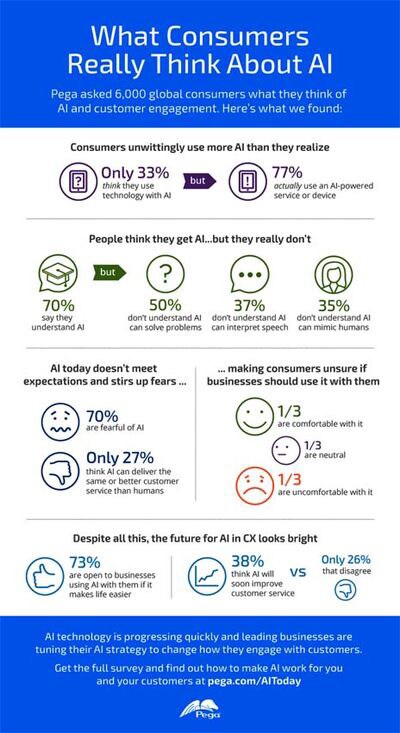
Many consumers may be surprised to learn they are already users of AI. Only 34 percent of respondents thought they had directly experienced AI. But the survey found 84 percent actually use at least one AI-powered service or device – such as virtual home assistants, intelligent chatbots, or predictive product suggestions. When asked separately to identify AI-powered devices, only 41 percent knew that Microsoft's virtual assistant Cortana or Amazon’s Alexa, iPhone's Siri etc run on AI.
Few of us can correctly define what AI is or what it can do. For example, relatively few knew AI has the basic ability to interpret or understand speech (37 percent) or mimic humans (35 percent), while only half could identify some of the most common AI capabilities, like solving problems (50 percent) and learning (57 percent).
In seeming contradiction to all of this, consumers also express optimism in the power of AI. Nearly 70 percent say they want to experience more AI if it will help make their lives easier. Taken together, the survey results that companies should find non-threatening ways to expose customers to its benefits to change their misperceptions and establish trust and comfort over time.
The survey also highlighted some differences by gender and generation. For example: More men think they understand what AI is (80 percent) than women (66 percent). However, more women correctly identified that Siri (60 percent) and Alexa (43 percent) are powered by AI than men (54 percent and 38 percent, respectively). While those 55 and older are generally less comfortable with AI than millennials (ages 18-24), they are also surprisingly less fearful of AI consequences – 30 percent of baby boomers expressed no fears compared to 22 percent of millennials.
Says Pega systems Chief Technology Officer Don Schuerman: “But our study suggests the recent hype is causing some confusion and fear among consumers, who may not really understand how it’s already being used and helping them every day. Businesses need to focus on using AI to develop applications that provide real value for customers to improve their experiences rather than overhyping the technology itself.”
Find the complete report, “What Consumers Really Think About AI: A Global Study,” here.
AI is everywhere!
Throughout last week, The Week has highlighted Indian innovation in Artificial Intelligence. Together these stories testify to the wide range of AI outreaches from enterprises of all sizes—from large India-headquartered multinationals to early stage startups. The message is loud and clear: AI is everywhere—and Indian engineers are in the thick of IT.
AI solutions: Made in India—for the world
Innovation at 2-Indian talent driven companies—Infosys and Xavient
Clipwiser changes online shopping experience
Indian startup uses AI techniques to morph e-shopping and socializing
Need a quick loan? Use your mobile!
CASHe comes as a blessing to those whose CIBIL scores rule out conventional loan channels
Indian startup Boxx.ai, has created an AI-driven analytics tool for companies trying to better reach their customers