



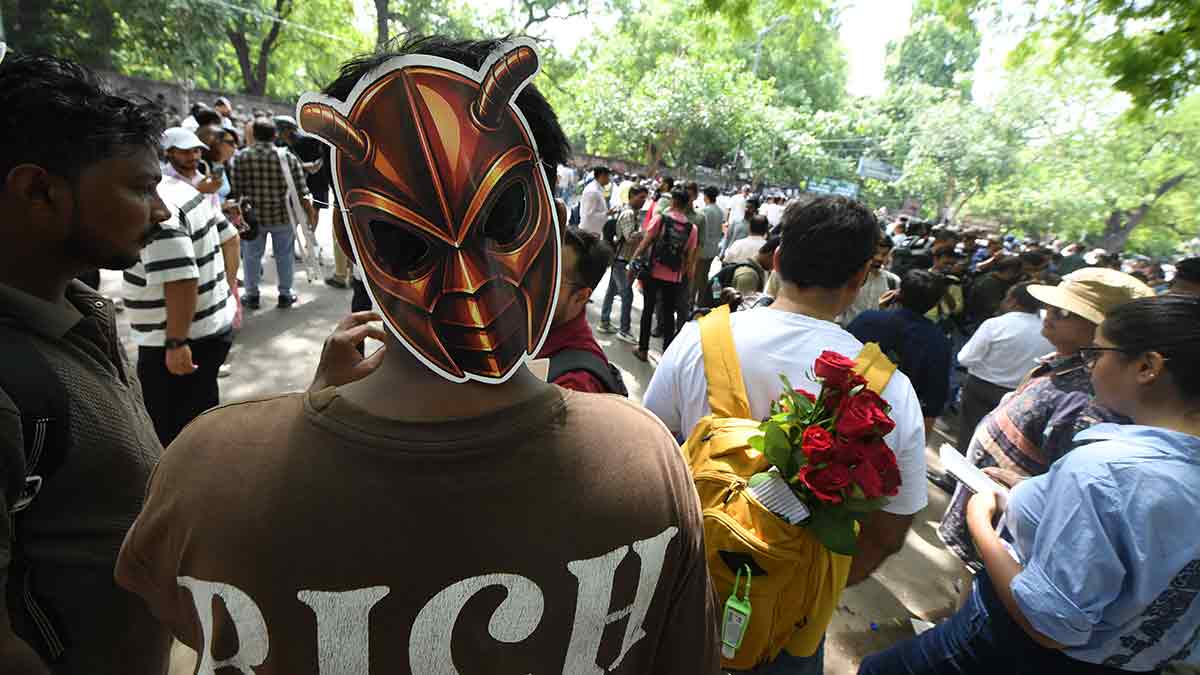
On June 6, Mithu Bhaskar, in his early 20s, travelled all the way from his home in Purnea, a town to the south of Bihar, to the national capital. His aim? To participate in the protest demo of the phenomenon of the year, the Cockroach Janta Party (CJP), at Delhi’s Jantar Mantar.
On the surface, there was no reason for Bhaskar to be there—he works from home as a hedge fund analyst with a global firm in Gurugram’s Cyber City. Yet, he felt it was high time that he raised his voice, that ‘something’s gotta give’.
“I am working and at the same time applying for tests for a government job,” said Bhaskar. “And when you hear of these scams like the NEET paper leak or the CBSE paper marking imbroglio, it gets personally very demotivating. We talk about Digital India, and yet the shoddy execution and loopholes that let scamsters get away come through. It is deplorable and depressing.”
The CJP’s viral moment online soon became a street protest and an ongoing campaign that highlighted the irregularities of India’s education system and demanded Union Minister Dharmendra Pradhan’s resignation. The resonance of what was initially meant to be just a meme has gone much beyond exam scams or a mutiny against the government. It is a reflection of a full-fledged aspiration gap that India has systemically failed to address for the longest time.
STORY
In a nation that often proudly trumpets itself as one of the world’s oldest civilisations but youngest democracies, with about half its population under the age of 25, representation itself has not kept pace. Just about 11 per cent of India’s elected parliamentarians are below the age of 40, while the number of ministers is just 2 of 72.
The scenario repeats itself across institutions, from judiciary to bureaucracy to media and even popular culture, where the top seven or eight most bankable stars are all above or around the age of 50.
So much so, The Economist famously billed India ‘a republic of uncles’.
“Youngsters feel abandoned, they feel they are not being listened to and that they don’t have much of a say in public life,” said Kunal Yadav, a politician, and at 26, one of the youngest elected councillors in Gurugram. “And they are feeling lost due to rising competition, with fears of AI and lack of jobs.”
Perhaps unknown to the establishment, an entire young generation is going through an era of unprecedented chaos and churn—the internet brings them up to date with anything from fashion to trending ideologies and the cultural zeitgeist in real time, even as they realise that their physical reality outside of their screens remains staid and uninspiring. Adding to the cauldron of fury is all the aspirational display of wealth, lifestyle and celeb excesses they see all the time on their devices, creating not just feelings of FOMO, but trepidation about a future that is getting transformed beyond recognition through algorithms and AI.
An entrance test paper leak, then, could well be that pressure cooker valve malfunctioning.
TIMELINE
The warning bells have been ringing for some time now. Fast-tracking dramatic educational and other reforms, like on-screen marking of CBSE exam papers or the temporary Army jobs scheme called Agnipath, for example, contributed to it. Also, the economy had become K-shaped because of Covid and a series of budgets that hoped to pamper businesses to invest in the economy but more or less failed. The sluggish growth has led to a situation where a small percentage of people, primarily entrepreneurs and urban corporates, are doing well, while the rest wallow in uncertainty.

The premise of the 1991 liberalisation, which promised a robust private sector offering multifarious job opportunities, faded in the past few years, with a sore lack of capital investment and job creation by India Inc. The result? A desperate scramble to pass board exams and entrances and vie for stable government jobs in an unstable environment.
And that is where the present issues over NEET or CBSE turn into anything from a CJP meme to YouTube rants. And while no one expects a repeat of neighbouring Nepal, where the Gen Z rose up to boot out a similarly gerontocratic establishment, the warnings are loud and clear.
“The warning is that an increasing number of young people across south Asia recognise that elite impunity, economic inequality and institutional disdain are interconnected realities,” said Prerna Subramanian, writer and academic who calls herself a pop sociologist. “The triggers could vary depending on location: social media bans in one country, economic crises in another, exam scandals elsewhere.... The underlying pattern remains the same: young people feel regulated by systems that expect them to surrender to institutions but simultaneously offer protections (only) for those already positioned within them.”
Explained Snigdha Poonam, award-winning writer and author of Dreamers: How Young Indians Are Changing the World, “Those who have no traditional privilege—family wealth, caste network, land and property—can only depend on education, exams and government jobs to secure their future.”
Understandable then how the floodgates burst open at the crack in the system. But is it just a flash-in-the-pan reaction or are the youth of today really socially conscious and do they have it in them to see through the change they want?
REELS
Gen Z’s social media-first form of dissent is quite a contradiction to two established beliefs—one, that dissent should be expressed through protest, campus agitation, street marches, posters and the like, which seems to have been replaced by memes, virality and online petitions.
The other is a supposed presumption that the young will be dissuaded from reacting through cheap data and the lure of ‘Reels’. Former RBI governor Raghuram Rajan had earlier told this correspondent as much, arguing how social media with its constant narrative of everyone claiming to be doing well confuses the beleaguered youth further into thinking the problem is not systemic, but personal. Instead, they lose themselves in endless entertainment proffered by cheap data through the likes of Instagram Reels and YouTube Shorts.
Are they really in a wonderland? “Their expectations have gone from real to reel,” quipped Yadav. “When they see (on Instagram) someone driving a luxury car, they feel, ‘Why can’t I also do it?’, but they do not realise the hard work that got them (to the point of getting a luxury car).”
Rajya Sabha member V. Sivadasan of the CPI(M) has another point of view. “There are many youngsters who are not socially conscious, but there is also a big group who actively pursue truth and justice, even when it is so difficult to sift through social media posts, with doctored truths and manipulated algorithms making it that much more difficult.”
The surprising, and refreshing, bit is that the youth seem to be trying. “Today, dissidence has become possible prior to organising,” explained Subramanian. “Dissidence has taken on a life of its own; dissidence has become memes, jokes, insults returned to sender, screenshots, Reels, hashtags and shared feelings of embarrassment. This is precisely why the CJP is fascinating. It was not formed as a formal political organisation with a platform. Instead, it was formed out of a word that most young people believe captures how the powerful view them. When a generation finds an insult and transforms it into a collective term, that is not ironic. That is a diagnostic statement.”
WHAT’S ON YOUR MIND?
The seething discontent among the Indian Gen Z is not purely a political dissent, or an anti-government agitation as some make it out to be. It stems from what they see as inefficiency at how things work (or rather, don’t work) and an intense feeling of not being understood. And no, they don’t particularly want to scream “off with their heads” at the ‘uncles’.
“Most young people in India speak respectfully of elders (at home, in their communities and those in leadership positions),” pointed out Poonam. “More frustrating for them is the disconnect between their needs and aspirations and what the political establishment offers them by way of infrastructure for upward mobility.”
It is hard to separate the political, though. “Ahead of 2014, young Indians asked for a government that could respond to their needs, grow the economy and increase India’s standing in the world,” said Poonam. “Now, 12 years later, they find not much has changed. Even though a large majority still has faith in Narendra Modi, many of them complain their aspirations are stifled by the same kind of inefficiency and indifference that they associated with the old establishment.”
That is damning for the present establishment that has taken pains to control the narrative and the whole machinery of digital discourse. But widen the arc, you realise that is not all.
From talks of social media bans for minors to banning anything from e-cigarettes to cryptocurrency to adult entertainment websites, the government has played the morally uptight uncle unmindful of how the world outside, and inside, has changed. And how global the aspirations of young Indians have become.
Take the age of consent, for example. While most leading countries in the world have 14 or 16, India raised it from 16 to 18 last decade. This means, in an age when puberty hits as young as 9 or 10, a youngster cannot indulge in consensual sex until they turn 18, without it being branded as rape. Nepal recently set off legal steps to lower its age of consent after the Biren Shah ‘Gen Z’ government came to power, prompting calls in civil society and media in India as well, but there has been no reaction from the Centre.
Worse, incidents like a Kolkata judge advising women to “control their sexual urges” or a Gujarat plan that requires parental permission for a couple to legally marry highlight this stark disconnect between generations even more so.
Recently, Telangana Chief Minister Revanth Reddy called for lowering the age limit for contesting assembly and Parliament elections from 25 to 21. The response? Deafening silence.
POST
“The old and new generations are distinct groups, but a country’s progress is what brings them into alignment,” said Madan Mohan Jha, political analyst at Ears to The Ground (ETG) Research. “When the alignment is missing, it is often a sign that progress has stalled.”
It’s a twain that can easily be met when both sides have more receptive ears. The young need to realise how the physical world is different from the sort of ‘quick justice’ they expect from their screen life. Megan Garber, in her just-released book Screen People, which dissects how the internet has changed politics and behaviour, quoted psychologist J.M. Berger: “When people are struggling to find order in chaos—they tend to look to identity groups. Membership in community can make a fractured world seem whole again, and a wayward self feel meaningful again. The groups they turn to might be small—church, communities, interest-based clubs or civic organisations—or they might be massive, a political party, for example.”
And, if a million ‘mutinous’ youngsters like Bhaskar gravitate towards the CJP, it should be treated as a symptom that requires a systemic cure, instead of waiting for a full-blown outbreak and then start looking for a ‘vaccine’.
“The establishment would misunderstand young people profoundly if it interpreted every meme as meaningless or every demonstration as conspiratorial,” warned Subramanian. “Memes are often the only language available to express grievance when more traditional languages have failed.”
Sivadasan, however, is optimistic: “We do know from history that no agitation, no protest, no dissent is really a failure. Even a failure is a step towards success, towards change in one form or the other.”
—With Badar Bashir
