



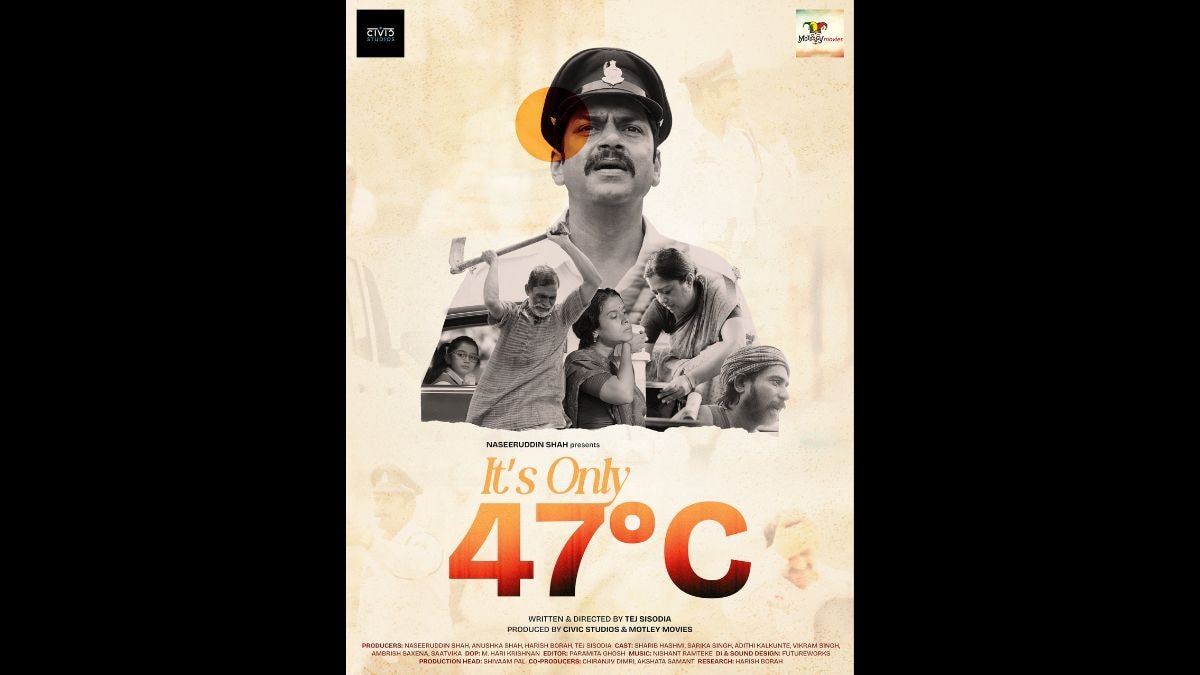
Heat isn’t something unfamiliar to Indians. What is new, however, is the vocabulary that now dominates everyday conversation: heatwaves, extreme heat, urban heat islands. That’s no coincidence. It reflects a reality in which such events are becoming increasingly frequent, with temperatures soaring to 47°C no longer seeming as exceptional as they once did.
Who bears the brunt of it? The poor, those at the lowest rung of India’s socioeconomic ladder, whose livelihoods depend on working under the blazing sun. These workers, many of them in the informal sector, are at the centre of It’s Only 47°C, a new short film backed by Naseeruddin Shah’s Motley Movies and Civic Studios, now streaming on YouTube.
The film opens with Laxman Choubey (Sharib Hashmi) getting ready for another day as a traffic constable. In the background, an official advisory plays: “Avoid going out in the sun, stay indoors, drink plenty of water.” But what about those whose survival depends on toiling under the sun? That is the question the film poses.
As Choubey struggles through the day, at times barely able to stand, at others overcome by dizziness, the film introduces others who share his ordeal: an elderly vegetable vendor, a cook running a roadside dhaba, a rickshaw puller, and a farmer who has lost his entire crop to the scorching heat.
A conversation unfolds about how God has been relentless. “It’s man’s own making,” another counters. Trees felled for human greed and the search for water on the Moon enter the discussion before it turns to who bears the brunt. It’s the poor.
Heat, after all, comes with a rate card, and the poor pay the highest price. That price extends far beyond enduring the scorching sun. It is measured in failed crops, dwindling customers, lost livelihoods, and, at times, health and even life. It is a climate catastrophe unfolding in real time, yet it rarely draws the attention that floods or cyclones do. Unlike them, extreme heat leaves behind no fallen buildings or submerged streets, only lives, livelihoods and health quietly eroded.
The film ends on a striking contrast. Unable to bear the heat any longer, Choubey sinks to the ground as a car pulls up beside him. Inside, a little girl sits comfortably, the air conditioner running at full blast. A poem by Swanand Kirkire, narrated by Naseeruddin Shah, underscores the contrast beautifully.
Tej Sisodia’s film unfolds over the course of a single day. And while it makes an important point, some things don’t quite land. The conversations would have been stronger had the film trusted its images more than its words. The colour palette, too, feels overly sanitised. You hear about the oppressive heat through the characters, but you rarely feel it yourself.
Is this one of the best short films in recent memory? No. Is it an important one? Absolutely, for it reminds us how climate change is also a story of inequality.
